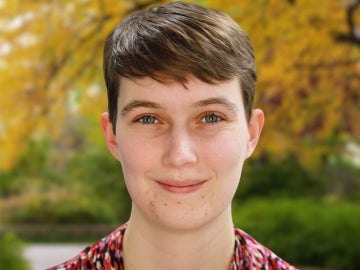
Where Land Meets Art: Maya Miller ’26 Awarded a 2026 Thomas J. Watson Fellowship
Miller will travel to five countries to explore how ceramics and agriculture can repair our connection to the land.
April 6, 2026
Office of Communications
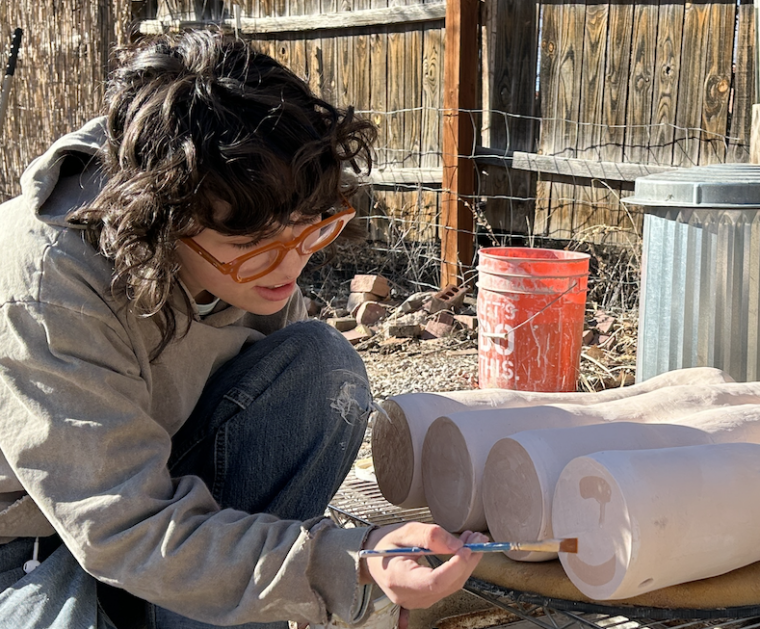
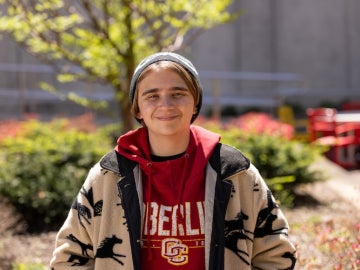
Photo credit: courtesy of Maya Miller
Maya Miller ’26 has been awarded a 2026 Thomas J. Watson Fellowship, a one-year grant that supports purposeful, independent exploration outside the United States.
A double major in gender, sexuality, and feminist studies and creative writing, with minors in studio art and comparative American studies, Miller will travel to New Zealand, Australia, Costa Rica, Iceland, Japan, China, and the United Kingdom.
Along the way, Miller will work with farmers, ceramicists, and artists whose practices engage both land and material, as part of a project that explores “the intersection of agriculture and art, and how clay, soil, and ceramics preserve cultural traditions.”
Miller answered these questions about the Watson project:
Can you describe what your Watson work will entail?
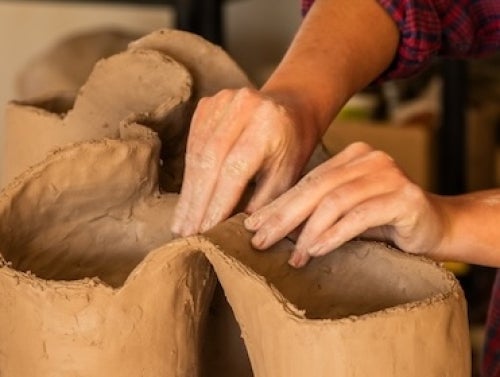
My Watson starts with an admittedly broad question: How can art-making reflect, repair, and reimagine our relationship with the natural world? Clay, soil, and earth are inextricably linked. For millennia, humans have harvested, cured, and shaped earth into vessels essential to daily life. While ceramic and agricultural technologies share origins, they have grown into more disparate practices in the United States.
During my Watson year, I want to explore how the intersections of ceramic and land-based work might offer frameworks, rituals, and methodologies for regenerating our ecological and social soils. I’ll spend time with farmers, ceramicists, and artists working at these intersections, learning from their practices, ecologies, and communities.
In what ways does what you’ll be doing build on your existing work—and in what ways does it open new pathways for you?
I’ve been working on farms on and off since graduating from high school. It’s actually what first brought me to the Midwest—to a farm in rural Illinois. Farming opened up a new sensorial language for me, one rooted in relationships with the nonhuman and the material, and one that challenged my preexisting ideas of personhood and agency.
I love the care work of tending to plants and animals. It can be meditative and is similar to clay work—both invite collaboration with materials that are agentive and demanding of care.
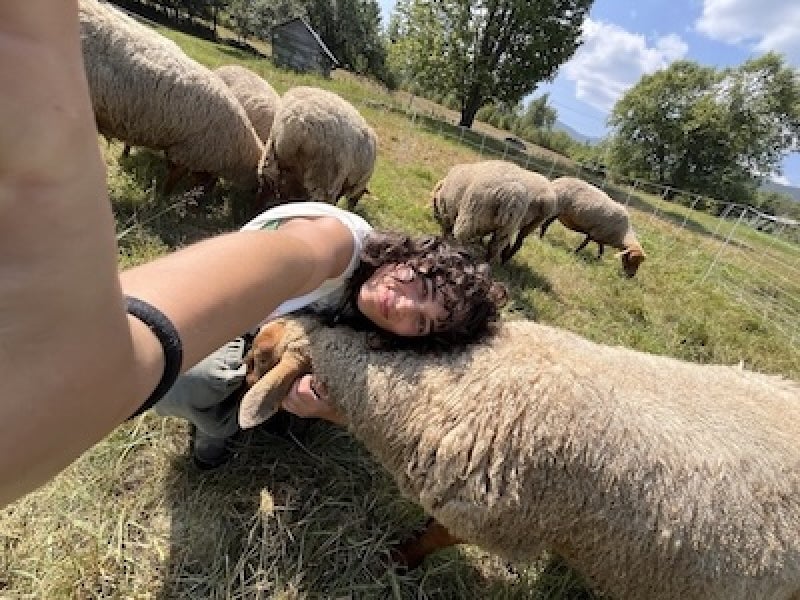
This past summer, I worked as a farmer at an artist residency in the Adirondacks. I spent much of my day digging in the soil, running after sheep, carrying water to the chickens, or repairing pig fencing. In the evenings, I was in the clay studio, writing, or just talking, laughing, and cooking with the artists in residence.
I started to ruminate on the parallels that typically get drawn: Pottery makes dishes, farming makes food; potters and farmers alike work with their hands. And true, there is also something deeper.
My honors thesis in GSFS explores clay as a material with epistemological agency. In its way of being, clay can act as a kind of ontological mirror and a creative methodological tool for queer and disability theory. It shows how slowness, decomposition, and bodily negotiation can be generative conditions, foregrounding interdependence and undoing myths of autonomy and control.
This work is rooted in my own experience and thus somewhat autoethnographic. The Watson year will allow me to expand my thinking outward—to learn from other people, practices, and cultural relationships to land and material.
There is a pathway at the intersection of land and ceramics that I’ve only just begun to glimpse. We are all of this earth, whether our connections feel deep or tenuous. I’m interested in living into that idea and seeing where it leads.
How did Oberlin shape or influence you to pursue this fellowship?
The Watson was suggested to me while I was trying to narrow the focus of my honors research. Rather than dismissing my too-big set of questions, I was encouraged to consider the fellowship as a way to explore them.
More broadly, I’ve been lucky to study with professors who encouraged me to think creatively and across disciplines. In a GSFS class with Thao Nguyen, I was encouraged to pursue a project on disability studies and ceramics practice, even when I couldn’t find existing scholarship at that intersection. That work became the seed of my honors thesis.
My thesis advisor, KJ Cerankowski, has encouraged me to push against [conventional] academic writing and explore connections that might not seem obvious at first. I love the GSFS department and how it encourages and teaches us to think in expansive and experimental ways.
I’ve also taken studio art and creative writing classes with amazing professors such as Amanda Hodes, Sam Cohen, Katherine Berta, and Abby Sherrill. They have encouraged me to see art as a space of inquiry—of searching, becoming, and imagining.
I also spent three winter terms working with Oberlin alumnus Theo Helmstadter in his pottery studio in Santa Fe. A lifelong potter who harvests his own clays, Theo has been an incredible mentor. I’m grateful for the broader Oberlin community and these kinds of connections.
How does pursuing the Watson align with your career goals and trajectory?
I am interested in many things—perhaps too many. I want to work in the arts, work with my hands, write, and create. A year spent exploring both art and land with artists and makers is a great gift. I also imagine some version of my future self tending to a flock of sheep, so I do intend to spend time in the hills with sheep along the way.
More abstractly, this fellowship comes at a liminal moment between student life and whatever comes next. The Watson gives me the chance to stay in that in-between a little longer—to live inside the question of trajectory, rather than trying to resolve it too quickly.
It’s a privilege, and I hope it helps me find ways of living with the kind of curiosity, care, and attention that the world, like clay, continually asks of us.
Connect with Fellowships & Awards to learn more about opportunities for Oberlin students.
You may also like…
Reyna Berry ’27 earns a 2026-27 Newman Civic Fellowship
The theater major will continue her work supporting prison and detention center programming

Andy Roshal '26 earns DAAD scholarship
The Hartsdale, New York, native will travel to Germany to expand on the Yiddish studies they began here at Oberlin.
Nissa Berle ’24 earns Fulbright Study/Research Award
The psychology major will earn a master’s degree in disaster and emergency management at York University