Luke De Carlo-McCann ’26 Wins Oberlin's 2026 Nexial Prize
After graduation, the geosciences major and anthropology minor is working for the U.S. Fish and Wildlife Service and continuing his collaborative community work
May 13, 2026
Office of Communications
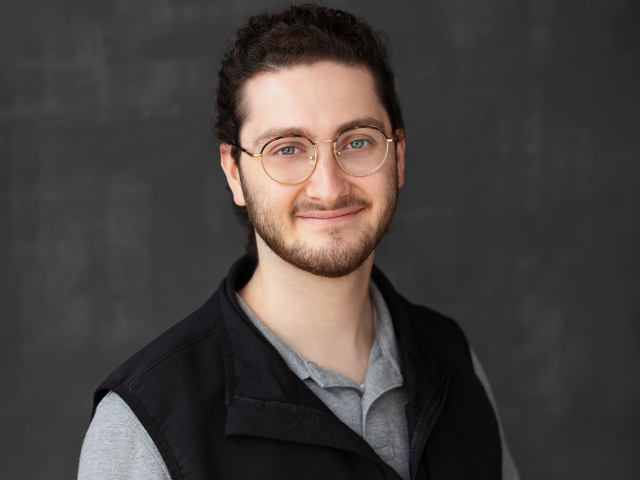
Luke De Carlo-McCann ’26 is the 2026 recipient of Oberlin’s Nexial Prize, which is awarded to a graduating STEM major who has demonstrated excellence across disciplines and a serious pursuit of the study of culture.
Throughout his college career, De Carlo-McCann’s geosciences and anthropology studies have taken him to Alaska, where his collaborative research focuses in and around the Sitka area, particularly on intertidal fieldwork and ecology.
His research is a long-term project involving California mussels; it “investigates how changing environmental and climatic conditions are recorded in [their] shells … and what this means for the stability of the species and those who rely on it as a traditional source of food into the future,” he says.
By tracking the growth of mineral crystals in these shells, De Carlo-McCann can record ocean changes and climate variations over time. “For thousands of years, this edible species has remained integral to the culture, economy, and diet of Indigenous coastal communities,” he says. “My work emphasizes the impacts these changes have on the growth of this species and the human communities that depend on it as a source of food.”
Across this research work, De Carlo-McCann emphasizes the value of communication and community. In collaboration with the Sitka Sound Science Center and Native Sitkans, he conducted fieldwork in Sitka and helped bring research into public spaces through local radio conversations geared toward non-STEM listeners. These discussions framed ocean acidification through the cultural and ecological significance of shellfish.
“I spent time in conversation with community members about what shells mean in their lives – as tools, foodways, and relationships to place – incorporating those perspectives into how I frame and share my findings," De Carlo-McCann says. “These experiences have led me to approach research as a collaborative process that connects scientific knowledge with community contexts and concerns.”
Associate Professor of Anthropology Amy Margaris ’96, who’s known De Carlo-McCann since his first year, praises him as a “humanistic scientist” who translates scientific insights for general audiences while engaging with Native Alaskan knowledge and perspectives on shellfish ecology alongside his laboratory research.
“Increasingly Native people are calling on scientists to listen to their stories, the knowledge that they’ve gleaned in making a living in a particular place for thousands of years,” she says. “Luke is part of the newer generation who’s listening to these calls for inter-cultural collaboration in efforts to heal the earth and has the holistic training and outlook to be effective at it.”
De Carlo-McCann’s research has been supported by multiple funding sources, including Oberlin’s Internship+ program via the Oberlin Summer Research Institute (OSRI); a Western Society of Malacologists James H. McLean Student Grant in Collections-Based Research; and awards from the Richard ’63 and Karen Cowan ’63 Ford Endowed Anthropology Fund and the Abbie Helene Roth ’90 Science Research Fund. He has also earned a prestigious Goldwater Scholarship and is a CELA Award nominee.
In addition to his research work, De Carlo-McCann has served as a committee member on the Arctic Research Consortium of the United States (ARCUS). Upon graduation, he’s heading back to Alaska, this time as a biological science technician with the U.S. Fish and Wildlife Service. His plans for the Nexial Prize award complement this work; De Carlo-McCann is looking to develop a community-engaged model of environmental research across Alaska, working in Sitka, Kodiak, and communities across the Aleutian Islands with local schools and tribal organizations.
“A central focus would be hosting open community dialogue events, creating space for locals to share observations about intertidal ecosystems and shifting coastal conditions, and incorporating these perspectives into how research is understood and applied,” he says. “Similarly, I would use radio interviews as a way to invite people into conversations around intertidal ecology, creating opportunities for collaboration grounded in local experience and knowledge.”
Building on intertidal field programs he previously developed for K–12 students, De Carlo-McCann also plans to continue creating opportunities to educate the next generation of scientists. “Students would engage in hands-on observations of intertidal communities, using species surveys of macroalgae, shellfish, and crustaceans to better understand ecological change in their local communities,” he says. “The funding I’ve received supports travel to remote communities and provides field gear so that all students can participate.”
In the end, De Carlo-McCann traces a significant amount of this success back to the liberal arts education he received at Oberlin. “[This education] has taught me that the Earth is more than physical processes unfolding across deep time – it is a lived and experienced world,” he says. “Coastlines sustain food systems, glaciers shape water security, and ecosystems hold cultural memory. At Oberlin, I learned to frame environmental questions in ways that connect these dimensions, so my research into these complex Earth systems is legible beyond scientific audiences.”
Connect with Fellowships and Awards to learn more about opportunities available to Oberlin students.
You may also like…
Reyna Berry ’27 earns a 2026-27 Newman Civic Fellowship
The theater major will continue her work supporting prison and detention center programming

Andy Roshal '26 earns DAAD scholarship
The Hartsdale, New York, native will travel to Germany to expand on the Yiddish studies they began here at Oberlin.
Nissa Berle ’24 earns Fulbright Study/Research Award
The psychology major will earn a master’s degree in disaster and emergency management at York University