Chhavi Singh ’27 Wins Projects for Peace Award for Work in India
The politics and environmental studies major will help establish a women's health initiative in Udaipur.
April 24, 2026
Office of Communications
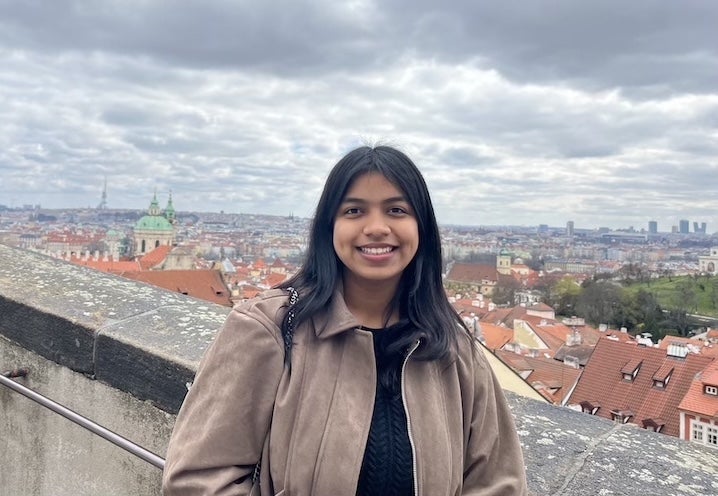
Photo credit: Courtesy of Chhavi Singh
Chhavi Singh ’27, a politics and environmental studies major from Meerut, India, has received a Projects for Peace grant, a global program that supports student-led peacebuilding initiatives. This summer, Singh will return to Udaipur, India, to establish a community-based sanitary pad production facility in partnership with Seva Mandir, a local NGO.
The project builds on Singh’s Winter Term internship in Udaipur, funded by a Shansi In-Asia grant, where she saw firsthand the barriers women face in accessing menstrual health resources. Her initiative focuses on improving access while creating economic opportunities through a women-run production model.
At Oberlin, Singh is involved in the International Students Organization, Badminton Club, Barefoot Dialogue, Global Conversations, and serves as a resident assistant. Outside the college, she has participated in Dexterity Global, the United Planet Impact Investment Fellowship, and the beVisioneers fellowship.
Singh answered these questions about her project:
Tell us about your project and how you will implement it this summer.
I will work with Seva Mandir, the local NGO, to establish a small-scale sanitary pad production setup and train local women in manufacturing, quality control, distribution, and financial management. My role will involve coordinating with the NGO, supporting planning and training materials, and helping ensure the initial setup is structured for long-term sustainability.
How did you learn about the Davis Projects for Peace initiative?
I learned about it through Oberlin’s Office of Fellowships and Awards. I was immediately drawn to its emphasis on grassroots, community-centered projects. The opportunity to design and implement a project with real impact, particularly in empowering women, really resonated with me.
What are your future hopes for this project?
During my time in the Aravalli Hills [India] a few months ago, I became more aware of the hardships people face in accessing basic necessities such as food, education, and healthcare. Women, whose mobility is often constrained due to social barriers, are among the most affected. Through this project, I hope that women are able not only to gain access to safe menstrual health products, but also to build something of their own and benefit economically from it. I also hope that the project contributes to reducing the stigma surrounding menstruation in the region.
The project was designed with sustainability in mind, with the aim of becoming self-sufficient after the initial funding phase. In the long term, I hope it can continue to run independently and gradually expand to other villages and communities.
Do you have a faculty or staff mentor for this project?
My approach has been shaped by my academic experience at Oberlin and the guidance I have received from my professors across different courses. In particular, I have drawn on ideas from courses such as Political Economy of Development in Asia with Professor Marc Blecher, along with a broader emphasis on empathy, critical thinking, and developing solutions grounded in local realities.
What’s the best advice you’ve received from your Oberlin faculty mentors?
The importance of paying attention to the gap between theory and practice, especially when working on social issues. I have been encouraged to think about how ideas actually play out in real community settings and to stay flexible rather than assuming one approach will fit everywhere. I have also been reminded of the importance of staying hopeful and grounded in the belief that meaningful change is possible, even in challenging contexts.
Visit the Office of Fellowships and Awards to learn more about the exciting opportunities available to Oberlin students.
You may also like…
Reyna Berry ’27 earns a 2026-27 Newman Civic Fellowship
The theater major will continue her work supporting prison and detention center programming

Andy Roshal '26 earns DAAD scholarship
The Hartsdale, New York, native will travel to Germany to expand on the Yiddish studies they began here at Oberlin.
Nissa Berle ’24 earns Fulbright Study/Research Award
The psychology major will earn a master’s degree in disaster and emergency management at York University