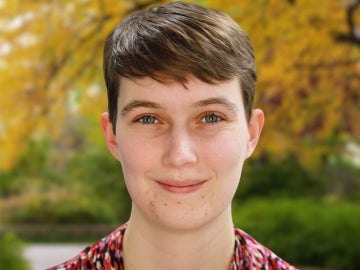
Momo Song Suzuki ’20 Earns Fulbright English Teaching Assistantship
The comparative literature and musical studies major will be living and co-teaching English in Hualien, Taiwan.
May 28, 2026
Communications Staff
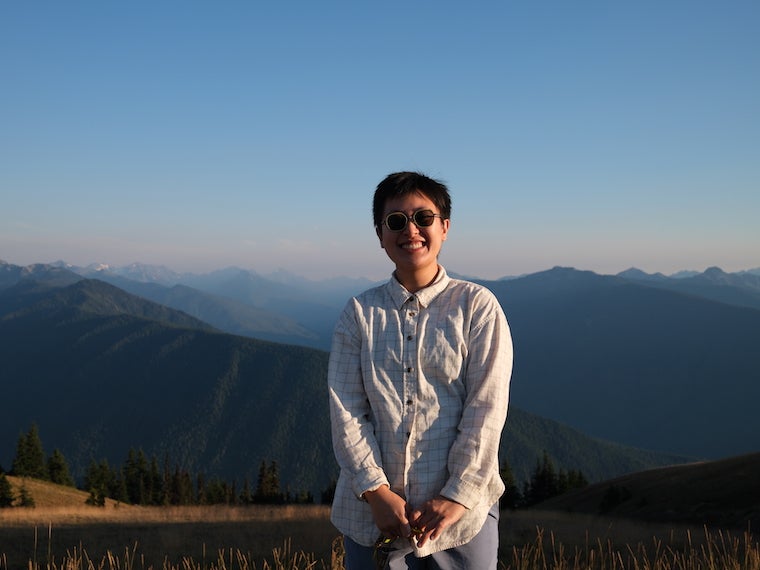
Photo credit: Emerson Ford
Momo Song Suzuki ’20 has earned a Fulbright English Teaching Assistantship (ETA) to Taiwan for the 2026-2027 academic year. The comparative literature and musical studies major will be living and co-teaching English in Hualien, “a city nestled on the east side between the mountain range and the ocean,” they say. “Hualien is known for its natural beauty, so I’m excited to spend a lot of time outside, to go hiking and climbing, and to learn about the local ecology, especially from my students.”
While at Oberlin, Song Suzuki was a radio host on WOBC, a docent at the Allen Memorial Art Museum and member of OSCA in the Pyle Co-op. They were also a writing associate and program note writer at the Cleveland Chamber Choir and participated in orchestra and chamber music ensembles through the conservatory. Song Suzuki also taught in music classes at Prospect Elementary, and facilitated gamelan ensemble for kids from the Lorain City Salvation Army.
What are you looking forward to the most next year?
I’m looking forward most to getting to know my students and to being a part of the community in many ways. I want to volunteer on farms and learn ancestral agricultural practices, talk to elders at farmers markets, and learn more about regional cooking.
How did Oberlin shape or influence you to pursue the Fulbright?
At Oberlin, getting a Fulbright is made out to be a commonplace thing; it feels like everyone does it. That certainly made it more approachable. But more broadly, the general culture and the professors really support exploration, whether that’s tumbling down a rabbit hole about a certain niche in literature, or learning a new language. I felt supported in my intellectual curiosities and pursuits, and Oberlin also gave me the opportunities to ground this in community work.
Whether working at the Allen, running a music afterschool program at the Salvation Army or teaching at Prospect Elementary, I had so many opportunities to share what I was passionate about, and use my studies to brighten other peoples’ lives as well.
How does pursuing the Fulbright align with your post-college life and career goals?
I just completed my master’s degree in special education with an endorsement in multilingual education. My goal is to eventually return to Seattle and be a special ed co-teacher in an inclusion model context; I would be the teacher focused on altering the instructional environment to meet all students’ needs.
Doing this Fulbright gives me the unique opportunity to teach beginner-level English. Thinking about how to effectively (and enjoyably) teach foundations like grammar and phonics will prepare me well for integrating these strategies into the American high school classroom context.
This is important to me because I work with students whose educational needs may not have been met; for example, these students may have reached high school with spotty reading skills. I want to be able to serve newcomer migrant and immigrant students. This is not training that’s readily available in the U.S., so I’m delighted by the opportunity to practice in Taiwan, all while being a beginner-level language learner myself in mandarin.
What’s the best advice you’ve received from your Oberlin faculty mentors?
I can’t think of one piece of advice, but overall, my Oberlin professors supported me so much by celebrating who I am and honoring my whole humanity, not just my skills as a student.
The late Professor of Comparative Literature and English Jed Deppman spent extra hours with me nerding out about interarts connections and translation, and gave space in class to pursue passion projects. He showed me that it’s worth pursuing what I’m interested in and encouraged me to see that I have a voice to share.
Other professors, like Jennifer Fraser, let me cry in their office and supported me on a personal level, sharing their own difficult experiences so that I wouldn’t feel alone. I’m so grateful that Jennifer regularly reminded me to take care of myself, vent, laugh, and keep moving forward.
Professor of Musicology Charles McGuire was adamant about believing in my intelligence when my self-perception was clouded by imposter syndrome. He leveraged his position in the academy to hold the gate open and enthusiastically usher me in.
I was also lucky to have a private viola teacher, Peter Slowik, in the conservatory. I think of him often when I’m working on individualizing instruction for my students, as he’s such a problem solver. Getting to have one-on-one time with professors like him, and in office hours, has truly inspired me to be a thoughtful one-on-one support for students.
I also think that the small, discussion-style classes at Oberlin prepared me to be a good discussion facilitator. Laurie McMillin especially held space for vulnerable group conversations connecting the personal with the academic; holding space like that is so much more than just an intellectual skill. She showed me how to bring in your heart and warmth into the classroom to create a safe learning environment for students. Asking probing questions while following students’ leads is my favorite part of teaching high school, and professors like Jed, Laurie, and Jennifer showed me how to be demanding and genuinely excited to hear students’ ideas.
Former fellowships director Nick Petzak once gave my class the advice that “people who win Fulbrights aren’t just interested in making their own projects better. They’re invested in improving everyone else' s projects along the way.” This really stuck with me and is an ethos I saw across Oberlin. It helped me to anchor my work in not just individual success, but in rising all tides.
If you’re a rising or graduating senior interested in Fulbright, connect with Fellowships & Awards to learn more about pursuing research or an arts project, obtaining a graduate degree, or teaching English in a foreign country of your choice following graduation.
You may also like…
Reyna Berry ’27 earns a 2026-27 Newman Civic Fellowship
The theater major will continue her work supporting prison and detention center programming

Andy Roshal '26 earns DAAD scholarship
The Hartsdale, New York, native will travel to Germany to expand on the Yiddish studies they began here at Oberlin.
Nissa Berle ’24 earns Fulbright Study/Research Award
The psychology major will earn a master’s degree in disaster and emergency management at York University