When Stars Align
August 26, 2026
By Jeremy Reynolds ’15
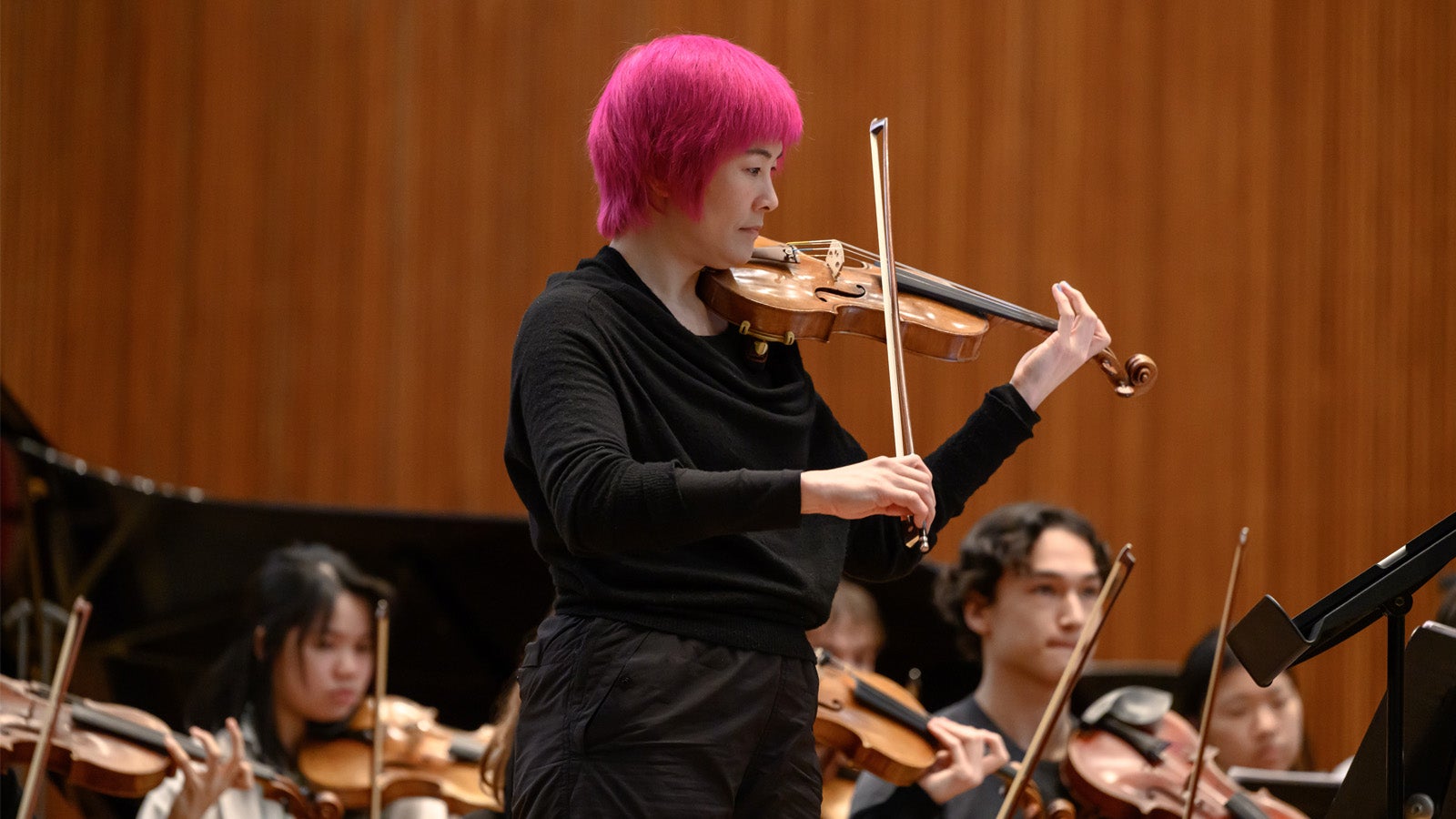
Header photo: In January 2026, Jennifer Koh '97 performed with the Oberlin Contemporary Music Ensemble in Warner Hall.
Header photo credit: Yevhen Gulenko
At the Obama Presidential Center in Chicago, among the works of art is a blue-tinted photographic collage of jazz musicians and instruments. The installation, The Cool Blue Wind, by the American artist Carrie Mae Weems, is accompanied by a recorded soundtrack.
One piece begins with violin and flute, played in unison as a series of slow, sustained pitches. Soon, the ensemble joins in and the musicians create a machine-like groove, fitting irregular melodic fragments together, before the violin begins to dance ahead.
The music, “Assembly,” is the final movement of composer Vijay Iyer’s concerto, Trouble, for violin and chamber orchestra. During this year’s Winter Term, star violinist Jennifer Koh ’97 recorded Trouble in full with the Oberlin Contemporary Music Ensemble, directed by conductor Tim Weiss. This performance appears on Koh’s The American Concerto, Volume One, released August 14 on Cedille Records, alongside another concerto with Oberlin ties: composer Courtney Bryan ’04’s Syzygy. As with Trouble, Bryan’s piece was performed by Oberlin Contemporary Music Ensemble with Weiss conducting.
The American Concerto, Volume One is the inaugural recording in a new series based on Koh’s American Concerto project, which she started in 2017. “The concerto is an interesting metaphor for what our role in society is today,” says Koh, who also worked with Weiss while a student at Oberlin and has since premiered more than 100 works and won a Grammy Award in 2022 for Best Classical Instrumental Solo. “Do you only lead from the front? Are you sometimes overwhelmed and overtaken by a mob, a crowd? Can you assemble and bring everybody together and make it a collective statement?”
Koh recorded Iyer’s Trouble previously with the Boston Modern Orchestra Project; that recording was released in 2024. But the concerto also has a long history at Oberlin. In 2017, Weiss led conservatory students in a workshop of Trouble. As a result, Koh and Iyer made significant changes to the score in advance of the piece’s world premiere later that year at the Ojai Music Festival. (Several of the students who participated in the workshop also performed during the premiere.)
“There is a really healthy, rich, dedicated culture for new music at Oberlin,” says Weiss, who’s also professor of conducting. “It’s part of what creates these really interesting musicians and ensembles that come out of Oberlin, like International Contemporary Ensemble, Eighth Blackbird, and quartets like Jasper and Pacifica.”
In fall 2025, a new slate of students performed Trouble and Syzygy with Weiss and Koh in the final concert of the semester. Then, in January, they reconvened for a two-week intensive, performing Syzygy and other pieces, including a premiere of Ennead by Associate Professor of Composition Jesse Jones, at the Cleveland Museum of Art. Finally, they worked with another Grammy winner, producer Judith Sherman, to record Trouble and Syzygy on site at Oberlin, about 50 minutes of music in total.
“It's really important for students to have the experience of what the recording process is like,” says Weiss, adding that there have been numerous such projects over the years at Oberlin. For a recording of a newer work, “it’s harder, in a certain way, because you don't have an existing document to refer to,” he adds. “But it can also be easier because you don't have the weight of history.”
Now that the recording is out in the world, Weiss says he’s proud of the students’ efforts and professionalism. “We made a really great, high-quality document. Everyone who performs this piece will use this. They will listen to this recording, and it will have an impact on them.”
The students who participated said they found the recording process to be “challenging” and “a little intimidating” at first, but concluded that it was an invaluable experience. “For the winds, we all had our individual mics,” said clarinetist Jared Sta. Ana ’27, adding that one of the movements took more than 100 takes. “Working with Vijay and Jenny and Judith gave me a taste of what it's actually like in the real world. They all had very clear ideas and specific ideas of what they wanted.”
Bryan’s concerto, meanwhile, took inspiration from visual art and nods to works by three women artists: Tree of Hope by Frida Kahlo, The Eclipse by Alma Thomas, and Eclipsed Time by Maya Lin. “It was less about any artistic style, and it was more that they each had work that had something to do with planetary themes and eclipses,” Bryan says, adding that Koh gave her advice on the technical aspects of the concerto as she was writing it. “I knew Frida Kahlo's work the most.And then I found this piece of Maya Lin that was a piece called Eclipsed Time, which used to exist in Penn Station in New York.” She titled her concerto Syzygy, a word that typically denotes an alignment of three planetary bodies, like the Earth, sun, and moon.
Koh paired Iyer’s concerto with Bryan’s piece because of their contrasts; Iyer’s begins with an “almost primordial movement that's almost like being born out of like the sludge of the beginning of the universe,” she says. Although Koh and Bryan didn’t overlap at Oberlin, Koh had encountered Bryan’s work previously and loved it enough to commission a new work; today, she describes Syzygy as feeling like “coming home” to play.
As to the connection with the Obama Presidential Center? The planets aligned there too: Koh had been collaborating with Weems on a separate project when the two began talking about Weems’ installation for the center, which is about “embracing the multitudinous voices and musical voices and artists of America,” Koh says. Weems invited her to collaborate — in fact, one of the photos in The Cool Blue Wind is of Koh’s hands — and the Oberlin Contemporary Music Ensemble-Koh take on “Assembly” ended up on the installation speakers, which Weems had also designed.
Koh says that she will continue working with Oberlin students to record additional concertos and anticipates returning to campus for another recording at a later date. “With students, there’s a kind of openness to experimenting and trying new things. There’s still fear, but there’s a willingness to work and play without fear. Honestly, that’s something special to Oberlin.”
The Oberlin Contemporary Music Ensemble is one of more than 30 large ensembles in the Oberlin Conservatory. These faculty-directed ensembles range in size and breadth of repertoire, encompassing vocal, instrumental and electroacoustic music. Additionally, the Conservatory has several active student-led ensembles that represent various areas of interest, innovations in music, and musical collaborations.
You may also like…
Creating Community in “Hänsel und Gretel”
Guest director Kevin Newbury makes his Oberlin production debut November 5-8 with Engelbert Humperdinck's Hänsel und Gretel, bringing the fairytale to life in 1970’s New York City.

Jane Wickline ’21 Finds Community in Comedy
A Q&A with the Saturday Night Live cast member and Dukes cofounder
An Obie’s Guide to the Juilliard String Quartet
“The most important American quartet in history,” now celebrating its 80th year, opens the Artist Recital Series at Oberlin on September 26.