Campus News
Your Music Career Has Entered the Chat
How do you make room for the music you want to create while earning enough to keep creating it?
November 6, 2026
Susan Ellinger
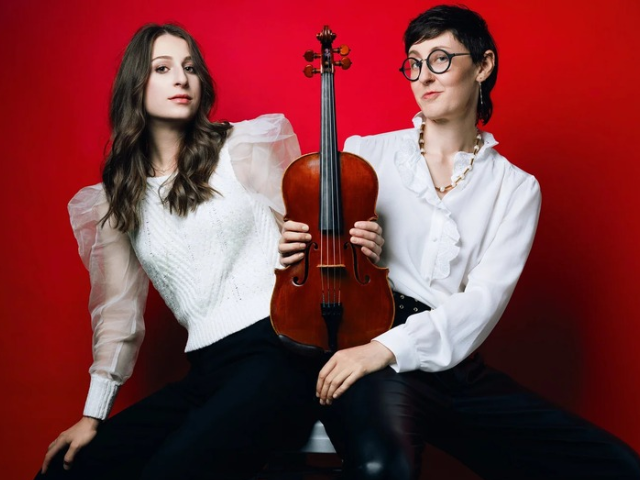
Violists Lauren Spaulding ’11 and Aria Cheregosha, who perform together as Tallā Rouge, brought that question to their recent Oberlin visit. Students asked about film scoring, freelance work, commissions, and recording. The duo shared the creative experiments, financial decisions, and everyday habits behind their own careers.
Your career can have several moving parts.
Teaching, performing, arranging, transcription, recording sessions: Tallā Rouge described the mix of work that can sustain an artistic life. When students asked about income beyond teaching, they encouraged them to find a useful specialty where their abilities and interests meet.
For students interested in film scoring, that might mean developing the audio-production skills to bring a score to life. A musician with an eye for notation could build a specialty in music engraving, turning a messy manuscript into clear, beautiful scores and parts. Building a specialty people need can help pay the bills and give your own creative projects room to grow.
There’s a lot behind an album cover.
What does it take to bring an album into the world? Tallā Rouge walked students through a project involving approximately $45,000 in investment and a long list of decisions beyond what happens in the recording session. Choosing repertoire, working with a production team, arranging publicity, and getting the music to reviewers all formed part of the work.
Their debut album, Shapes in Collective Space, was among the recordings recognized in producer Elaine Martone’s 2026 Grammy win for Producer of the Year, Classical. Behind that finished recording were the duo’s artistic choices, financial commitments, and efforts to help the music find listeners. A coordinated presale campaign was another part of the release: making the album meant thinking about how to introduce it to an audience, too.
For students wondering where funding might come from, Spaulding and Cheregosha suggested some practical detective work. Look at the acknowledgments on other artists’ websites, concert programs, and scores. Who supported projects like yours? Those credits can offer a starting point for researching potential funders and understanding the kinds of work they support.
Put the practical details in writing.
Students shared their own commissioning experiences, opening a discussion about fees, deadlines, instrumentation, premieres, and recording plans. Clear agreements help collaborators understand what they’re making and what each person needs to deliver.
Spaulding and Cheregosha also offered a performer’s perspective: rehearsal time is a real resource, especially when musicians live in different cities. What will make performers want to invest that time and return to a piece after its premiere?
Leave room to experiment.
Their performance of shapes in collective space, a graphic score by inti figgis-vizueta, made creative collaboration audible. The duo explained how visual notation and verbal prompts became sounds, contrasting sections, a larger musical shape, and cues for playing together.
For recording, they developed written reference points that allowed consistency across takes while preserving improvisational freedom. Students wanted to know where interpretation ended and composition began. Here was a chance to hear how much performers can contribute to shaping a work.
And yes, answer the email.
Prompt communication, preparation, and follow-through came up repeatedly. So did caring about people between professional opportunities. Go to a friend’s concert. Ask about their project. Keep in touch when you aren’t asking for a favor.
Tallā Rouge’s visit offered a candid look at how a musical life takes shape: through creative curiosity, practical decisions, and the relationships you build along the way.
Conservatory Professional Development helps students explore funding, work on application materials, or investigate freelance performance opportunities. They can also talk through a creative project and figure out what it would take to move it forward, or bring unfinished idea or a question you’re still working through, and the Conservatory Professional Development Staff can help identify a place to start.
You may also like…
Creating Community in “Hänsel und Gretel”
Guest director Kevin Newbury makes his Oberlin production debut November 5-8 with Engelbert Humperdinck's Hänsel und Gretel, bringing the fairytale to life in 1970’s New York City.

An Obie’s Guide to Jean-Guihen Queyras and Alexandre Tharaud
The French cello-piano duo, who have been playing together for three decades, celebrate their deep friendship with an Artist Recital Series performance on November 3.
An Obie’s Guide to the Juilliard String Quartet
“The most important American quartet in history,” now celebrating its 80th year, opens the Artist Recital Series at Oberlin on September 26.