Setting the Pace
June 24, 2026
Sloane DiBari ’27
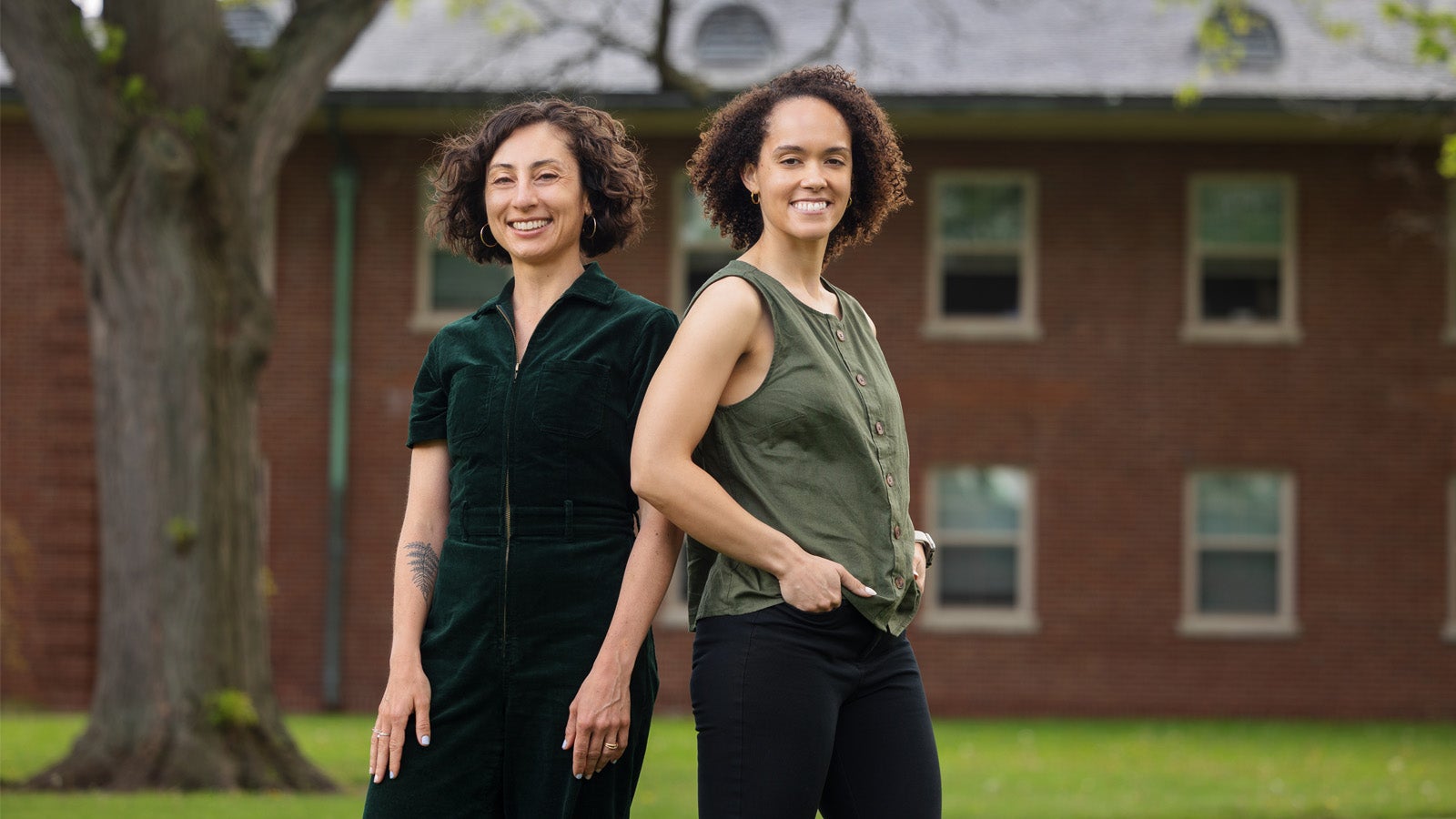
Header photo: Jo Line ’11 and Alicia Smith-Tran ’10 are cochairing an integrative concentration in sport studies and management.
Header photo credit: Tanya Rosen-Jones '97
At Oberlin, sport has long been something students do. Now, it’s something they can study. William G. Smith Associate Professor of Sociology and Comparative American Studies Alicia Smith-Tran ’10 and Program Director of Community-Engaged Research and Learning Jo Line ’11 are the inaugural cochairs of a new integrative concentration in sport studies and management. Launching this fall, the interdisciplinary program examines how sport intersects with economic power, social change, and cultural influence.
“There are more students who are interested in sport academically, but also as a career path,” Smith-Tran says.
Line agrees: “We have a lot of alumni who work in the sport industry, so there’s evidence that there’s interest and success for Obies going into this industry.”
Developed with input from faculty, administrators, athletics staff, and alumni, the integrative concentration draws from multiple disciplines. The foundational course, Introduction to Sport Studies and Management, introduces topics spanning communication, business, analytics, education, and health. Sociology of Sport, meanwhile, examines sport in relation to “identity, education, the body, fandom, and the economy.” Courses such as Documentary Production allow students to explore sport through filmmaking.
That the concentration is called sport studies—not sports studies—is deliberate. “This field examines sport broadly as a concept and social phenomenon,” Smith-Tran explains. “It asks why sport is so significant or what makes something a sport. It’s similar to why we don’t call the academic fields ‘genders studies’ or ‘races and ethnic studies.’ In these examples, researchers are studying gender and race as constructs and concepts with courses that think about how race and gender came to be prominent features of society.”
This field examines sport broadly as a concept and social phenomenon. It asks why sport is so significant or what makes something a sport.”
William G. Smith Associate Professor of Sociology and Comparative American Studies Alicia Smith-Tran ’10
Smith-Tran and Line particularly look forward to seeing how students approach the experiential learning component of the program. They envision students pursuing internships with professional teams, volunteering with Northeast Ohio sport-focused nonprofits, or coaching recreational teams.
These experiences could lead students down a multitude of career paths. “Within [the] professional sport industry, you could be [a] sustainability director and be responsible for thinking about anything from waste from large sporting events to the impact of constructing sport venues,” Line says. “Or you could be the HR director within a sport organization.”
The sport studies and management program can also build transferable skills and experiences for non-sport careers, Line adds. After an internship with a sport-focused nonprofit, for example, a student might find that they enjoy the nonprofit field in general and will work with different kinds of organizations later on in their career.
Both Line and Smith-Tran have built careers on the study of sport. Smith-Tran has studied the sociology of sport and physical activity in relation to topics such as race and racism and the experiences of Black women in recreational running. Line, who is also a lecturer in comparative American studies, has explored the experiences of women runners across different cultural contexts through a Thomas J. Watson Fellowship and continues to study sport team dynamics.
These interests led Smith-Tran and Line back to Oberlin—and eventually to each other—in leading the charge toward sport-related academics at the college. As undergrads, Smith-Tran played basketball, and Line ran track and cross country. While on different teams, both were part of the broader Oberlin athletics community. Their time as student athletes was deeply meaningful to both of them, which was another motivation as they built the sport studies and management program.
“To be able to be part of it as a faculty member and to get to work with Jo, who is an amazing athlete and scholar—it’s kind of awesome that the stars aligned and we get to do this together,” Smith-Tran says. “I love that we’re both alums and former student athletes and that our work is in this area and we can share it with students.”
This article originally appeared in the Spring 2026 issue of the Oberlin Alumni Magazine.
You may also like…
James Millette, Professor Emeritus of African American Studies, Dies at 92
Trinidad and Tobago native made a late-career transition to Oberlin, where he was a staunch advocate for Black students and a mentor to young faculty.
Jane Wickline ’21 Finds Community in Comedy
A Q&A with the Saturday Night Live cast member and Dukes cofounder

Oberlin Reimagines Humanities Education Through $1.487M Grant
New “HOPE” initiative centers humanities learning with real-world impact.