In the Fold
June 24, 2026
Annie Nickoloff
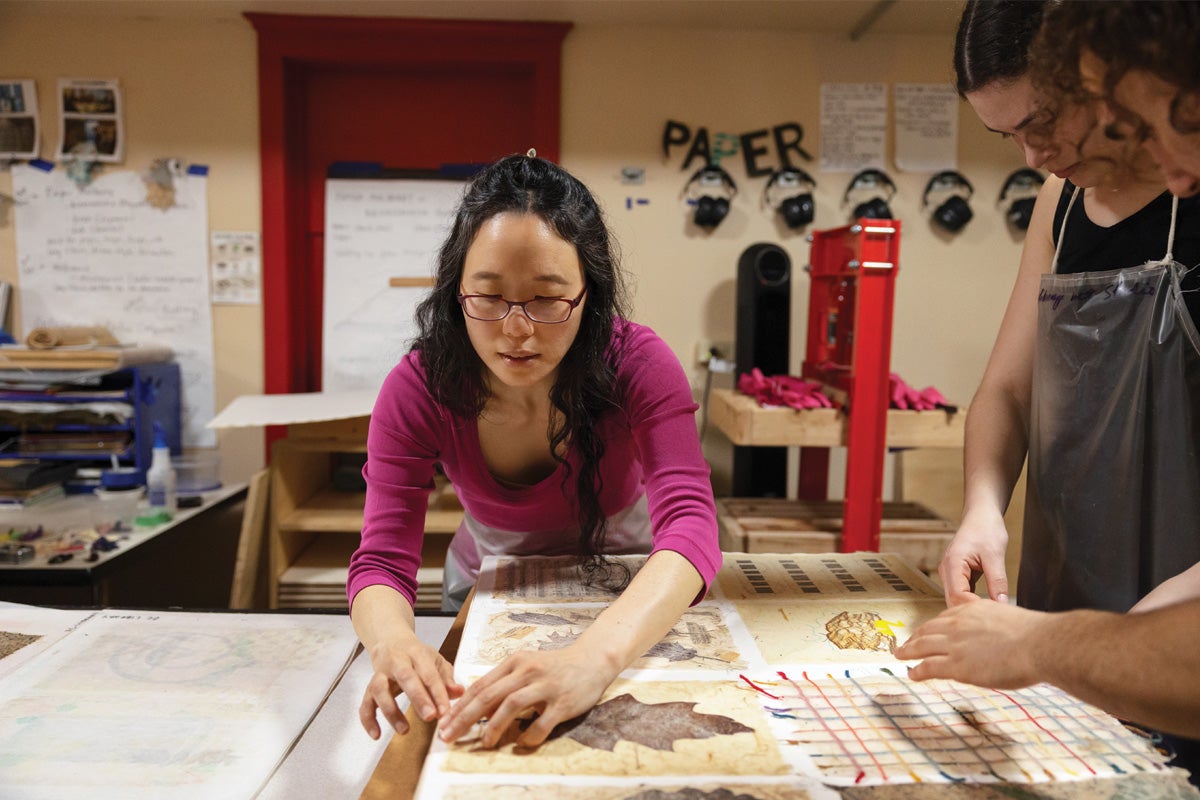
Eight students filter into a small classroom in the Special Collections area of the Mary Church Terrell Main Library and take their places at tables covered in paper. Some sheets are swirled with marbled ink, while others show stringy bits of plant fiber, flattened in natural textures. Pages that look like accordions stretch across desks: the makings of soon-to-be books.
Aimee Lee ’99 stands at the head of the room in front of her own neat stacks of papers, booklets, and zines.
Not all books are alike. She holds a notebook and, in one motion, unfurls it into a single sheet of paper that sports just a few cuts and folds. “This is what we call a snake,” she says. Then she picks up a geometric-looking doughnut shape, fidgeting the paper loop to reveal new faces around the center. “This is that 3D flexagon I mentioned.”
For the most part, the students don’t take notes. Instead, they pick up their own sheets of paper and start folding. Lee does the same, as an overhead camera captures, on a screen behind her, a zoomed-in video of her hands and tools as she explains the importance of following paper grain and double-checking measurements. It’s learning by doing.
A few weeks before this, at the start of Lee’s Winter Term class, students forged the paper they now fold. At the end of the course, each student will leave with at least 10 handmade books. This class has been enormously popular since Lee started teaching it in 2014. Approximately 90 students have taken the Winter Term class, and she says she has to turn people away every year.
“This class is basically improv,” Lee says, shrugging, in response to a student who’s inquiring about how many more book forms Lee will teach in the Winter Term.
To answer the question: At this stage in the class, at least five—maybe more.
This hands-on approach is how Lee first studied hanji, which translates to “Korean paper.” She was first exposed to making hanji as part of a design-focused Fulbright research fellowship to South Korea. (In 2021, Lee later returned as a Fulbright senior scholar to study hanji tools.)
In the years since, she has established herself as a renowned hanji scholar and teacher, writing the first English-language book on hanji and opening North America’s first hanji studio. Her works have appeared in galleries across the United States and in Taiwan, India, Australia, China, Chile, and the United Arab Emirates and are in the library collections of acclaimed institutions including the Metropolitan Museum of Art, Yale University, and the Museum of Modern Art (MoMA).
She makes more than just books. Hanji, made of inner mulberry bark, is renowned for its durability and versatility and has been used since ancient times as a writing surface and for various household goods and clothing items. Using hanji, Lee constructs dresses and other garments; densely woven ducks and chamber pots; expansive art books; and abstract fine art installations.
Before studying visual arts, she considered a career as a violinist. Having pivoted to paper, she now shares her knowledge of Asian and European papermaking styles with her students, emphasizing a global perspective that resonates.
“It’s all on the menu,” she explains. “I know they’re still working directly from the plant, seeing it all the way through to paper, and then they’re working with paper to see it all the way through to the book. I will always show them Asian styles, European styles. I will always give them cultural context, history, background, chemistry, science information so that they have a good grounding.”
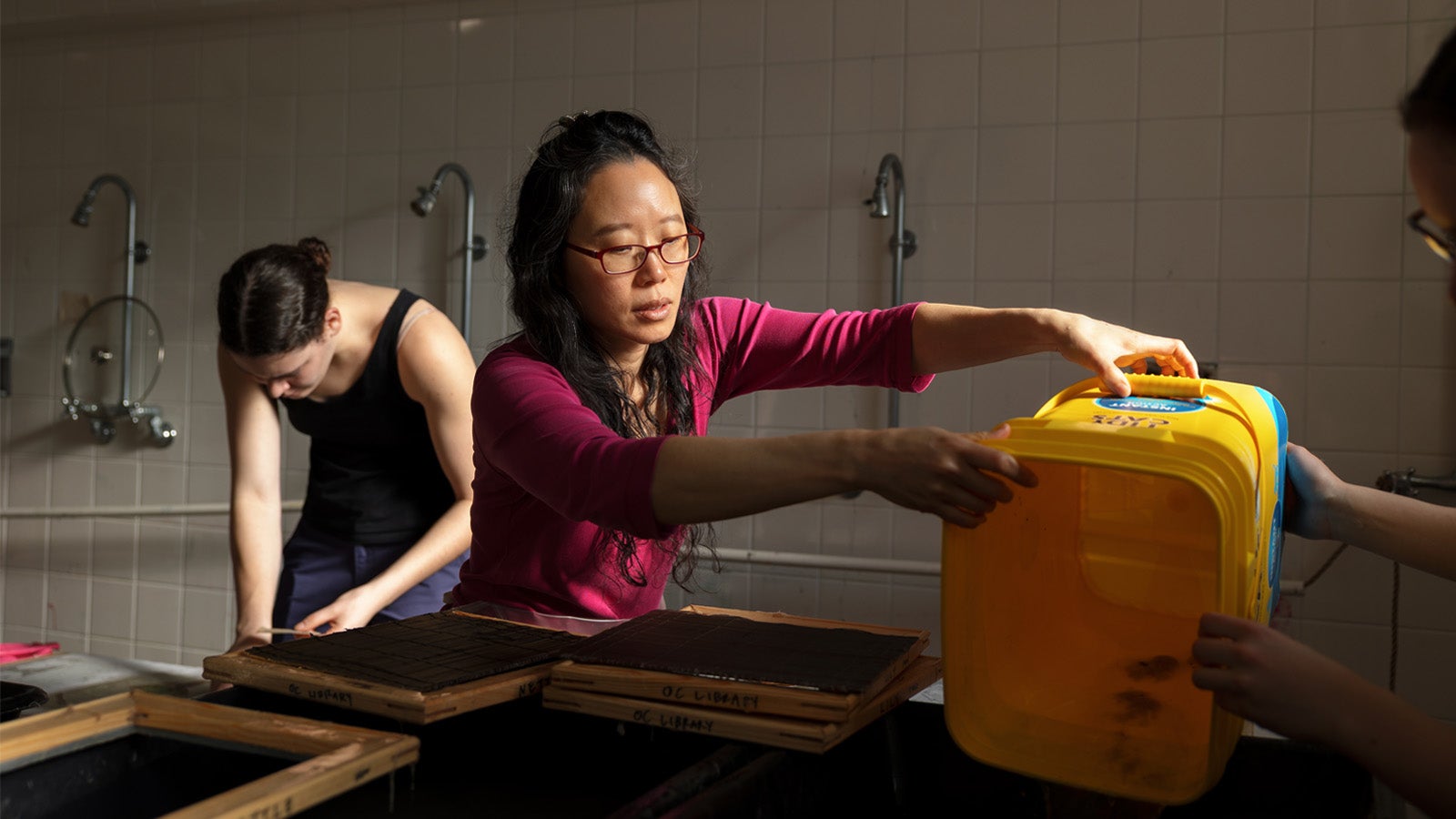
Weeks before transferring to their classroom in Special Collections, students start by squeezing into the small-but-mighty papermaking studio that Lee has built up, piece by piece, over the past decade in the basement of Hales Gymnasium. There, they start at the beginning of the papermaking process: stripping twigs and shredding fibers.
In this room, Lee has accumulated used equipment such as her prized stainless steel Hollander beater, which macerates fibers into pulp. Many of the tools are celebrated in her latest book, 2025’s As Good As Our Tools: Equipment and Tool Makers for Hand Papermaking.
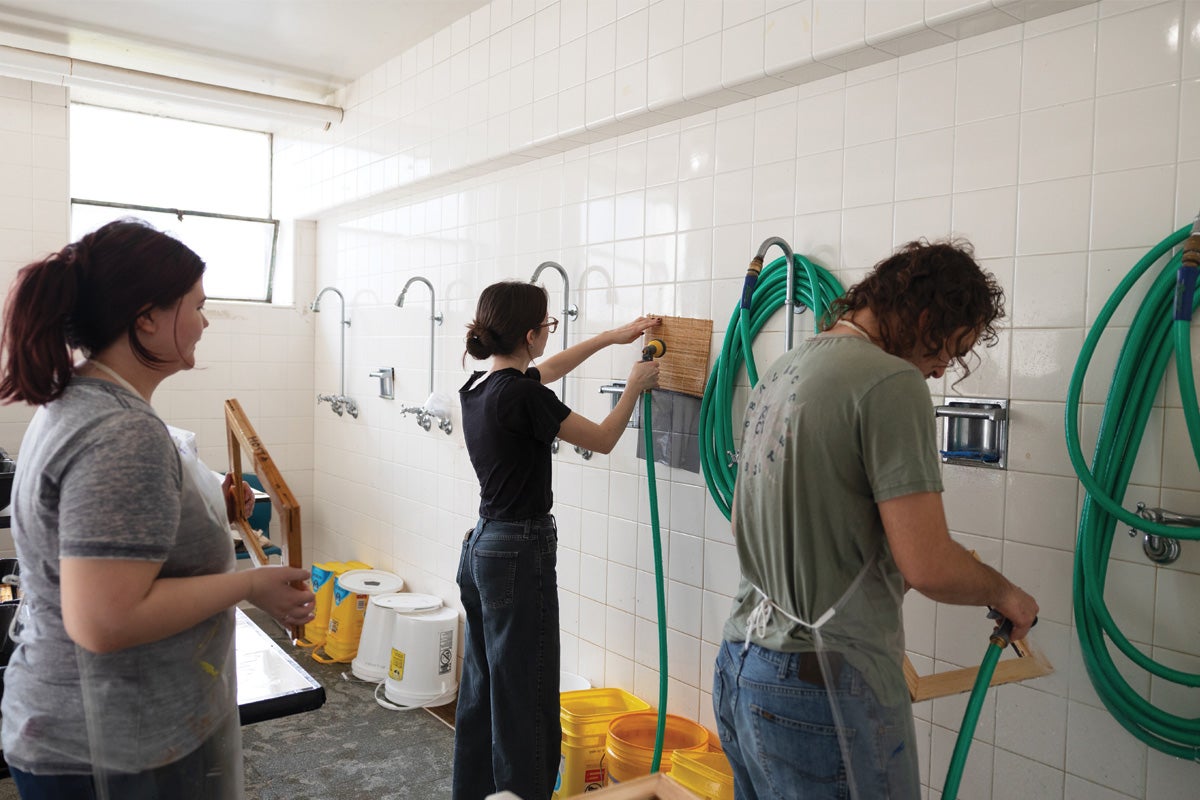
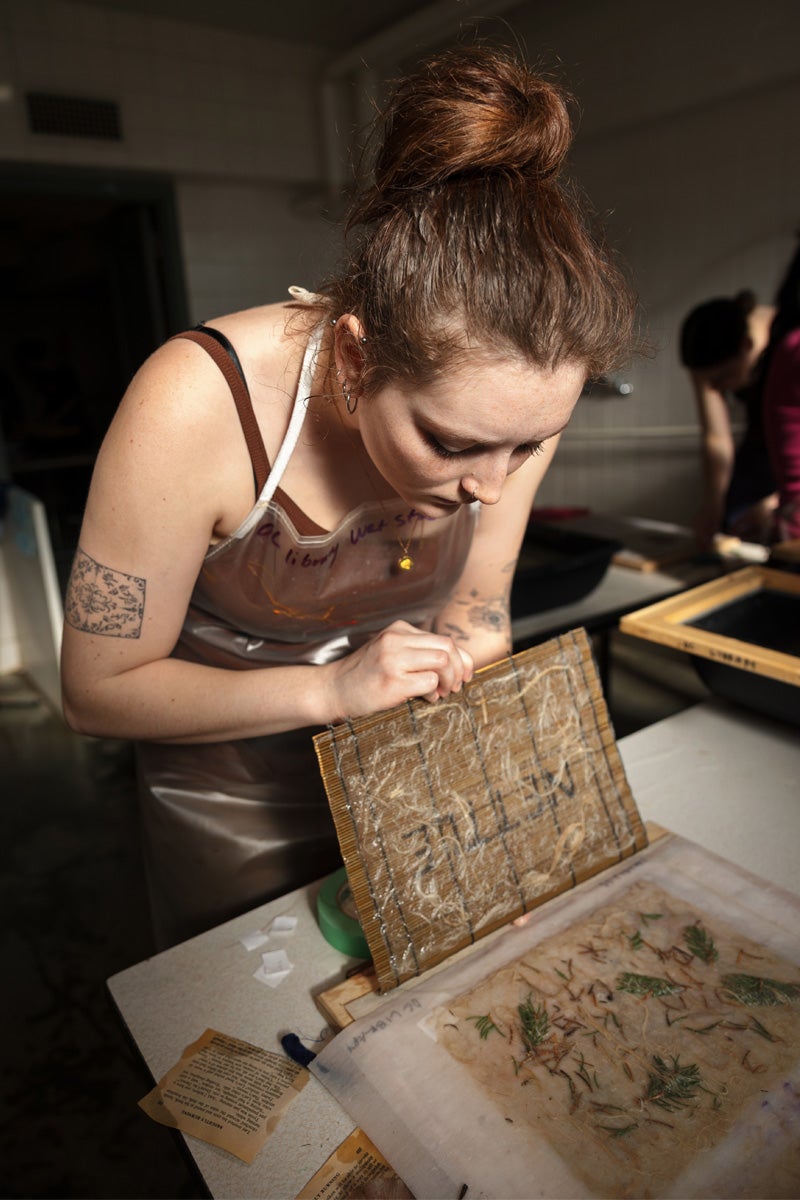
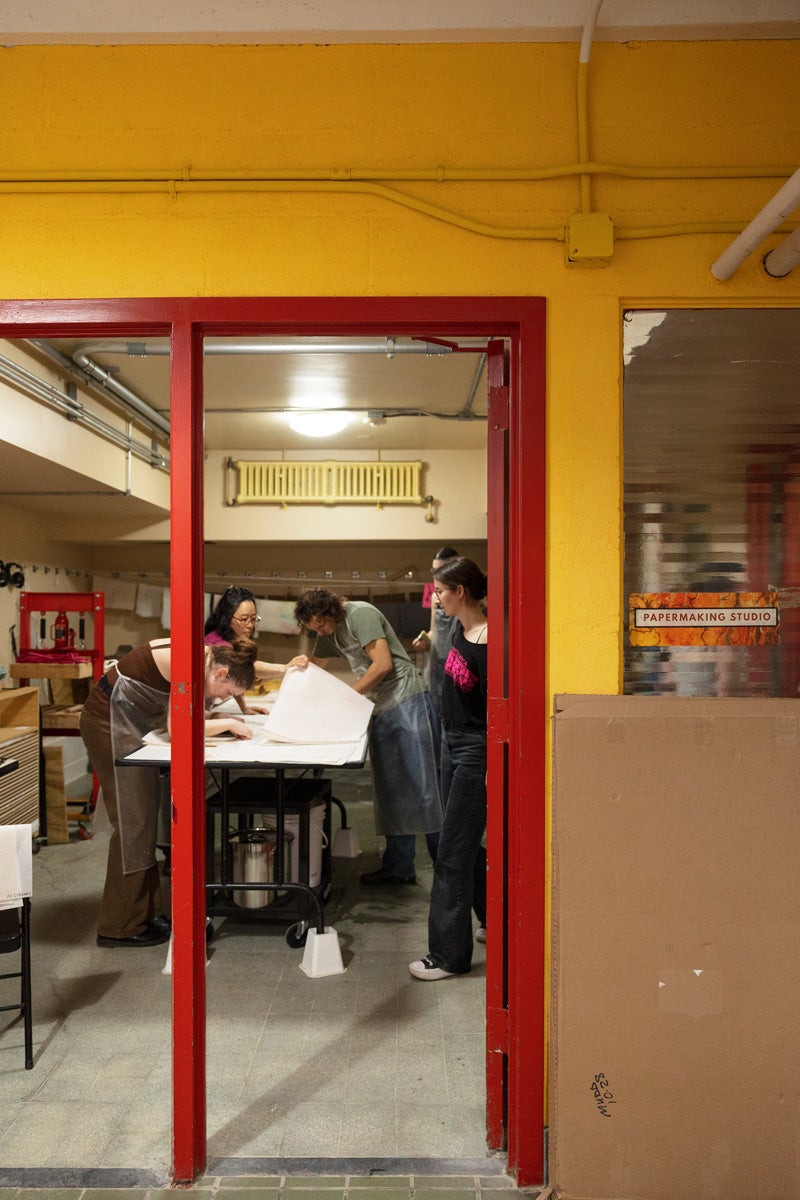
A fridge contains rows of former yogurt containers, which hold processed pulp, much of which was made from harvested milkweed stems or mulberry stalks. She hand-built the stacks of screen-and-frame tools that students swoop into vats of cloudy slurry to pull individual pages into existence.
Each screen is named after a different plant used to make paper.
“When you can connect to the actual land and the plants, it really calms you,” Lee says. “The process is very healing and therapeutic for me, and part of that process is including the landscape in this way. That, to me, is second nature.”
Lee has taken over this corner of the former Oberlin gym, where the shower room’s marble slab walls serve as an ideal surface for drying paper sheets. Here, Lee shares a world of techniques learned from decades of study around the world, especially in Korea.
Though Korean was Lee’s first language, she says she had “a very classic, first-generation-born American rejection of the culture.” That changed after one Chinese art history class at Oberlin. Then 19, Lee and her classmates were studying a Chinese landscape scroll painting at the Allen Memorial Art Museum when a key detail spiked her interest.
“The curator at the time was showing us one that he said was actually on Korean paper, because Chinese painters often preferred Korean paper,” Lee says. “That was kind of my ‘aha’ moment, where I was like, ‘Why am I studying Chinese art? I don’t know anything of Korean art. And how can I know anything about Korean art if I don’t speak Korean?’”
That summer, Lee enrolled in an intensive Korean language program. For the next decade, she practiced until she felt fluent enough to research hanji in Korea, following her Master of Fine Arts from Columbia College Chicago.
Through trial and error, Lee sought out a hanji teacher willing to take her on as a student, and she lived in a motel that was 20-minute walk away from a hanji mill. Then she learned jiseung—a Korean form of paper basketry—from another teacher.
“It just went on and on from there,” Lee says. “One thing would lead to the next.”
And on and on: Lee lived in New York while establishing her hanji practice in Northeast Ohio at an arts center called the Morgan Conservatory before relocating to Northeast Ohio full time in 2013. Ever since, she has built up her career in the region, regularly traveling for workshops, art shows, and stints of teaching. In her almost two decades of crafting hanji, Lee has saved odds and ends, amassing a library of paper scraps reflecting various moments of her artistic career.
Some of those pieces come together in a paper dress of patchworked colors and textures. For much of last year, the work of art, titled Multi, has hung on the wall at the Allen Memorial Art Museum along with several other smaller dresses and a jacket in the Fibers of Becoming exhibition.
The idea behind Multi came from Lee’s Oberlin class, adopting a term that some of her multiracial students used for themselves—a straightforward way to encapsulate a person’s varied and sometimes complicated cultural backgrounds.
Lee’s delicate dress is a centerpiece of Fibers of Becoming alongside the work of two other artists who practice East Asian papermaking, Sarah Brayer and Lin Yan.
The paper is art on its own in Lee’s hands. But it’s also a canvas.
Beneath the dresses is a glass case with an open artist book. Made of large sheets of blue-and-white paper, it’s inscribed with Lee’s handwritten original poetry on each page:
Walk into your own dark & unruly spaces
sit with yourself
It’s messy
There is chaos before there can be art. Lee’s bits of teenage inspiration. Art forms, slowly fading away in faraway corners of the world. The splashes of paper pulp.
Yet, the practice brings Lee a kind of peace. She ends the poem with a beginning of sorts:
Every time you return to yourself
you can recreate a whole world.
Joan L. Danforth Curator of Asian Art, Kevin Greenwood deliberately centered Lee’s work within the exhibition.
“She’s really at the forefront of this particular field and is a brilliant contemporary artist as well,” he says. “She’s educating this whole generation of students interested in Korean paper.”
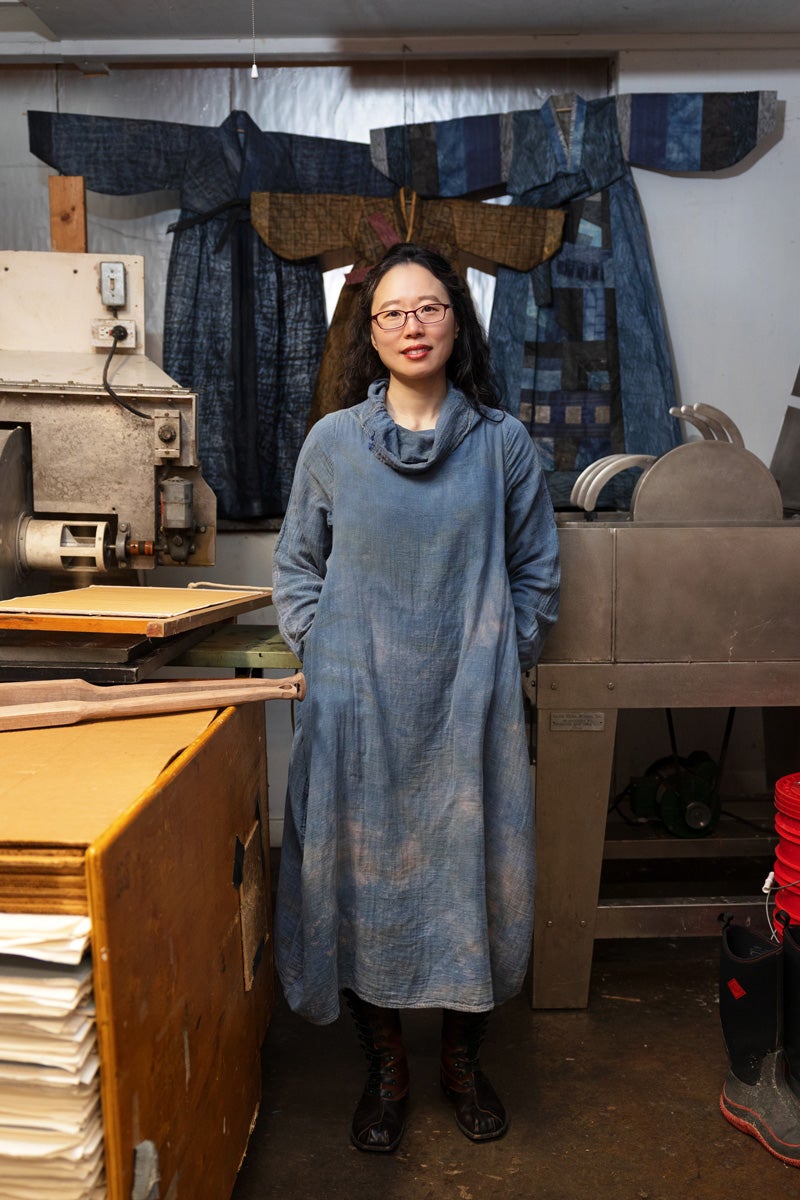
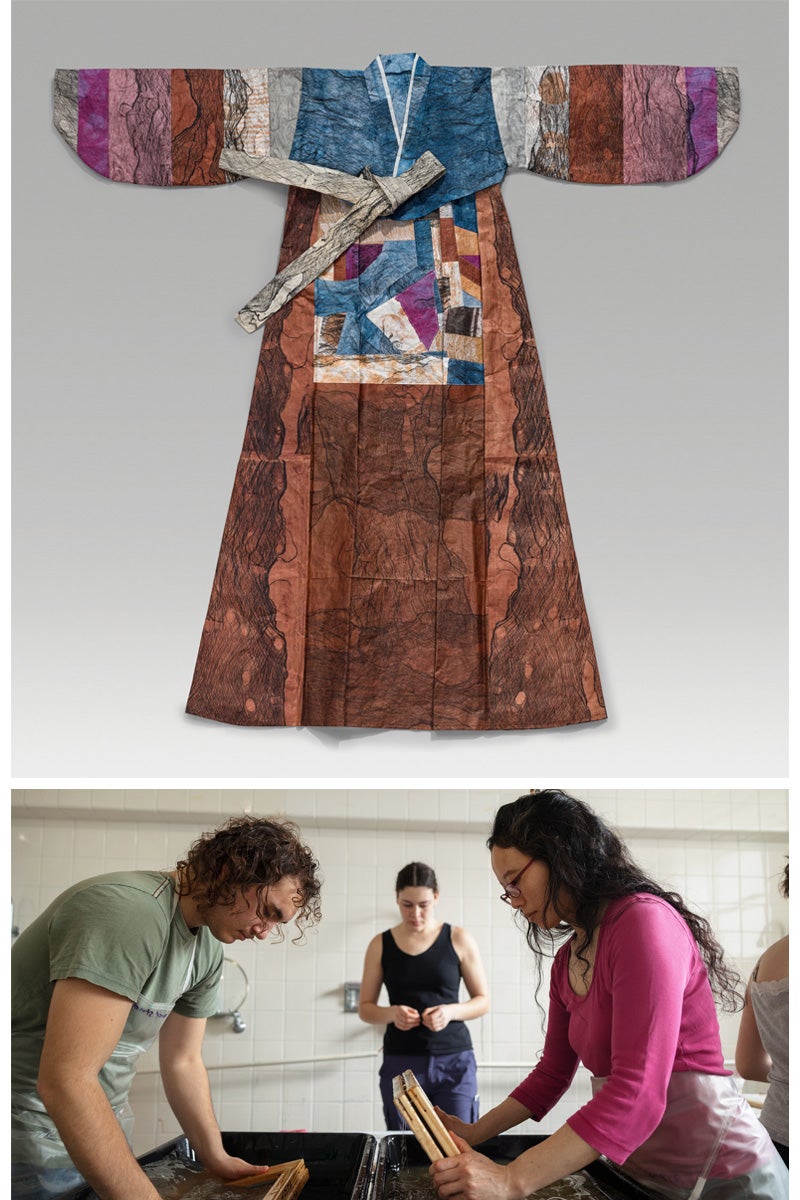
Photo credit: Tanya Rosen-Jones '97 (portrait); Stefan Hagen (artwork)
Lee has taught as an instructor and visiting artist at institutions both in and outside of Ohio, but most consistently at Oberlin, where she teaches the Winter Term course and leads a hanji retreat in the summer or fall. She prefers the shortened time frame, compared to semester-long courses.
“I don’t like being hemmed in by whatever grading rubrics; I hate things like that,” she says. “That’s why I love Winter Term. I love teaching. I just get it done in one month.”
It helps her stay organized in her busy art schedule, too. This year, Lee is featured in two solo shows: one from March to June at Bainbridge Island Museum of Art, another at Kent State University Museum in August. Then, in the fall, she’ll lead her first hanji summit—a two-week residency at the Penland School of Craft in North Carolina, in which Lee will bring together her former students of the Korean diaspora for an intensive papermaking experience.
A few years ago, in the A Consolation of Things show [see sidebar], Lee exhibited her traditional paper dresses alongside tightly woven pots, vessels, and lampshades. Multicolored ducks were perched near a window, where strings of paper bricks hung like a clunky beaded curtain.
The paper, in Lee’s work, is more than just a surface for scribbles. It’s a message in itself.
“You can get so deep in just a single sheet of paper,” Lee says. “Just within the materials themselves, there’s so much richness. There’s so much story.”
Turning the Page
In her practice, Lee stays connected with many of her former students. Michelle Li-Shen ’25, who has worked as Lee’s studio assistant in the past, says Lee’s papermaking class factored into her decision to go to Oberlin. Majoring in studio art and classical composition, Li-Shen connected with Lee’s own background as a violinist and papermaker.
“Aimee completely changed my world,” Li-Shen says. “Here was someone who comes from a background of music, but then she pursued visual arts, and then she’s done all this really cool research on Korean papermaking, and she’s really paved the way for Korean papermaking in the U.S. Overall, she’s really empowered a lot of people of color to look into their heritage and see what else is out there, other than the very Western, white-dominated fields.”
S.R. Lejeune ’15 took one of Lee’s earliest papermaking Winter Terms at Oberlin, marking the start of a passion for the art form. Today, they work as an artist and instructor in papermaking and paper casting, among other sculptural media.
“The opportunity to get into making paper felt really in line with what it felt like to be an Oberlin student,” Lejeune says. “Bringing this lens of criticality and trying to understand how things work, from the beginning—how things are made. I was just totally hooked.”
Lee and Lejeune were featured artists of the Cleveland Sculpture Center’s A Consolation of Things show in 2020 and 2021.The duo showcased a variety of objects and artworks, all made of folded or cast paper.
“On some level, I’ll always consider Aimee to be like a mentor and really look up to her,” Lejeune says. “That show also marked this moment where we were able to also develop a friendship and a presence in each other’s lives as artists. She’s been a very special influence in my life.”
This article originally appeared in the Spring 2026 issue of the Oberlin Alumni Magazine.
You may also like…
Jane Wickline ’21 Finds Community in Comedy
A Q&A with the Saturday Night Live cast member and Dukes cofounder
When Stars Align
The Oberlin Contemporary Music Ensemble shines on Jennifer Koh ’97’s "The American Concerto, Volume One."
Wright On, Sister
Would the Wright brothers have invented their airplane without the support of their sister, Katharine Wright Class of 1898? Probably. But they might not have been the first.