Oberlin Alumni Magazine
Pie in the Sky
Two Obies cowrite the ultimate pizza recipe book.
June 24, 2026
By Hanna Raskin ’98
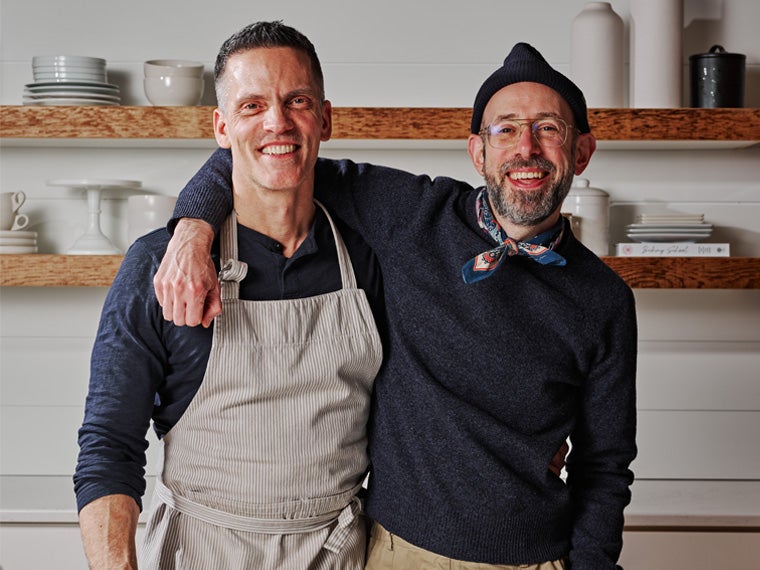
Martin Philip ’92 and David Tamarkin ’00 had an instant bestseller with their new pizza book.
Photo credit: Courtesy of King Arthur Baking Company
The men’s wing of Barrows Hall has been known as the Monastery for about as long as any resident of the first-year dorm can recall, even though there’s no specific belief system associated with it. But soon after Martin Philip ’92 moved in, he and his new friends felt called to correct that situation.
“Our first weekend, we went to Lorenzo’s,” Philip says of the pizzeria that opened on Main Street in 1982 and served a mid-rise crust that wowed the young men. “My roommate was like, ‘We’re going to start a pizza religion.’ We were going to eat pizza every week.”
Their faith fizzled, perhaps because of the discipline required to eat a pie at a designated time—or perhaps because of the self-control it takes not to eat pizza more frequently. But Philip’s spiritual relationship with what’s commonly referred to as America’s favorite food didn’t end there.
It informs the newly published, instant New York Times bestseller King Arthur Baking Company’s The Book of Pizza: Recipes for Every Pizza Maker. Martin, head baker for the Vermont-based company, cowrote the zippy and authoritative monograph with a fellow King Arthur employee, editorial director David Tamarkin ’00. (As Tamarkin describes the division of labor, “The knowledge is Martin’s; my job was to write.”)
The product of years of research and recipe testing, The Book of Pizza is a compendium of popular regional pizza styles, ranging from tavern to Grandma. Through illustrations and accessible language, the cookbook highlights the charms of home-baked pizza so brightly that reading it cover to cover nearly guarantees the incipient purchase of a pizza stone.
“Convenience is not the only possibility in terms of baking,” Philip says in a phone interview. “Food takes effort, but that doesn’t mean it shouldn’t be part of your life.”
Tamarkin, who shares Philip’s commitment to craft, staunchly agrees that pizza—which the two consider a sophisticated form of bread rather than a handy platform for melted cheese—shouldn’t be dismissed as an exigency option.
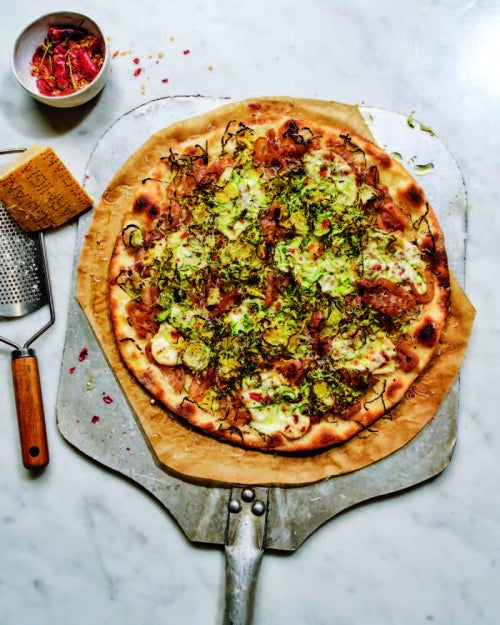
“Pizza making is a valuable use of your time because it can be so collaborative and so fun,” Tamarkin says. “If I’m having you over for pizza, I’m going to bake it while you’re there, and we’re going to eat it while it’s burning our fingertips. That’s a community experience. People talk about, ‘It’s taking up my evening,’ but it could be how you spend your evening.”
It’s not surprising that both Philip and Tamarkin are champions of the unhurried process. While they followed different paths to King Arthur, they proceeded along their circuitous routes at a similarly ambling tempo, dictated by their zeal for connection.
“I think of an Oberlin student as someone who is curious, engaged, and alive in the world and leaning into what they’re passionate about,” says Philip, whose daughter graduated from Oberlin in 2025. “I really feel who I am today is so much a representation of who I was as a student, even though I wasn’t the perfect student.”
Philip, who attended high school in the Arkansas Ozarks and hoped to parlay his love for singing into a profession, was initially rejected by Oberlin. But he ended up on campus for a summer seminar, at which vocal performance faculty members ruled the admissions committee had made a mistake.
“I got off the plane and said, ‘Well, Momma, looks like I got into Oberlin: All we need is $22,238,’” Philip recalls. ‘She said, ‘$238? No problem!’”
Post-graduation, Philip moved to California and then New York. After setting his sights on the opera, he eventually became an investment banker instead.
“Long story short, New York City kind of broke me,” he says. “Trying to make money, I ended up on the wrong track.” Although Philip was by then more than a decade removed from working an oven for pay—one of his stints was in North Olmsted, Ohio, at the Great Northern Mall location of Italian Oven, where he learned that a scattering of smoked Gouda pacifies pizza buyers seeking evidence of wood firing—he joined King Arthur in 2006.
As for Tamarkin, he grew up in Ohio. Like Philip, he amassed a string of failing grades in high school. “When I found out about Oberlin, that’s what motivated me,” he says. “I was not a shoo-in, so I really campaigned the admissions guy very hard.”
Once admitted, Tamarkin didn’t completely give up his scattered ways. For example, even though he tried out baking at Old Barrows, the co-op was reluctant to put him in charge of bread. “I didn’t understand anything, so they tricked me into being commando,” he recalls.
Still, he landed a job at CBS News after graduation. “My first day, the Concorde crashed, and then it was 9/11,” he says. “I had three very intense years, and I was increasingly like, ‘This is not for me.’”
Tamarkin shifted to food writing but eventually chafed at that role too. “It was taking a toll,” he says. “I was feeling gross and really struggling with the ethics of being a restaurant critic.” On a whim, he applied to King Arthur in 2021.
Finally, it was time for the collaborators to come together. And, as it happened, it was time for pizza.
“There has never been a better time to go out and get great pizza,” Philip says, emphasizing that the new book aims to interpret the current pizza renaissance for home cooks. “Trust me: These are the good old days of pizza.”
Recipe: New American Dough
(Makes 705 grams, enough for two 13-inch pizzas)
Ingredients
- 367 grams (3 cups plus 1 tablespoon) unbleached bread flour, plus more for dusting
- 45 grams (6 tablespoons) whole wheat flour
- 12 grams (2 teaspoons) fine salt
- 1/4 teaspoon instant yeast
- 12.5 grams (1 tablespoon) extra-virgin olive oil
- 8 grams (1.5 teaspoons) sourdough culture (optional)
- 7 grams (1 teaspoon) honey
- 253 grams (1 cup plus 2 tablespoons) cool water (60° to 70°F)
Instructions
In a large bowl, combine the flours, salt, and yeast; then add the oil, sourdough culture (if using), honey, and water. Mix to combine, then knead the dough by hand in the bowl until you have a rough but cohesive dough. Cover and let it rest at room temperature for 1 hour.
Lightly dust a work surface with flour and place the dough on it. Divide into 2 equal pieces (about 352 grams per piece). Tightly ball the dough, place seam side-down in a lightly greased container, and cover tightly. Let rise at room temperature for 8 to 10 hours.
At this point, the dough is ready to use, or it can be refrigerated for up to 3 days. Let the refrigerated dough rest at room temperature while your oven preheats, at least 1 hour.
Excerpted from King Arthur Baking Company’s The Book of Pizza: Recipes for Every Pizza Maker. Copyright © 2026 by King Arthur Baking Company. Reproduced by permission of Simon Element, an imprint of Simon & Schuster. All rights reserved.
Hanna Raskin ’98 is editor and publisher of The Food Section, an award-winning newsletter covering food and drink across the American South.
This article originally appeared in the Spring 2026 issue of the Oberlin Alumni Magazine.
You may also like…
Jane Wickline ’21 Finds Community in Comedy
A Q&A with the Saturday Night Live cast member and Dukes cofounder

When Stars Align
The Oberlin Contemporary Music Ensemble shines on Jennifer Koh ’97’s "The American Concerto, Volume One."

Wright On, Sister
Would the Wright brothers have invented their airplane without the support of their sister, Katharine Wright Class of 1898? Probably. But they might not have been the first.