Oberlin Adds Sport Studies and Management Integrative Concentration
Launching in fall 2026, the experiential program considers sport as a social institution and cultural phenomenon
December 2, 2025
Office of Communications
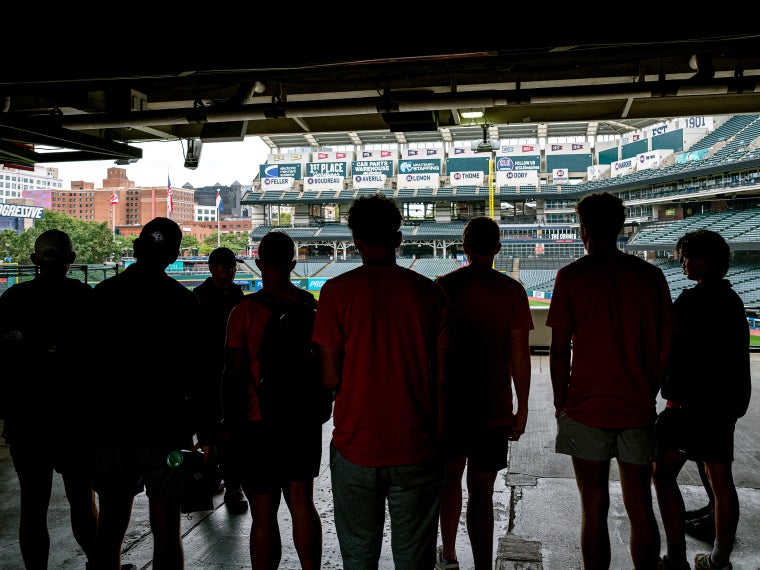
Oberlin students tour Progressive Field, home of the Cleveland Guardians. Cleveland also boasts NFL and NBA teams, with a WNBA franchise set to launch in 2028.
Photo credit: Mike Crupi
Sport is many things: a vehicle for personal inspiration and identity formation, a catalyst for social change, an economic driver, and a contributor to health and well-being. Given all this, sport is also the perfect way to explore social, cultural, and political phenomena from an interdisciplinary perspective.
That’s the foundation of Oberlin College and Conservatory’s new integrative concentration in sport studies and management. Launching in fall 2026, the program examines sport at every level—from tee ball to the Olympics—through a multifaceted lens.
“With this integrative concentration, Oberlin is putting a genuinely unique twist on the field of sport study,” says Dean of the College of Arts and Sciences David Kamitsuka. “By integrating classroom and experiential learning—and approaching sport via a combination of data analysis, critical thinking, and historical study—students will have a deeper understanding of this complex and potentially transformative global force.”
Students enrolled in the sport studies and management integrative concentration are required to take courses in statistics or data science and in history or sociology—and then choose electives in related fields like journalism, documentary filmmaking, business, psychology, dance, and marketing.
In true Oberlin liberal arts fashion, these classes place sport in context with other fields of study. For example, the course Moneyball (and Pucks): Sports Economics underscores how an economist acts as a social scientist when making decisions for individuals, teams, and communities. Sport, Power, and Society meanwhile, uses historical and current events to examine how we use individual and collective power to create communities in and beyond sports.
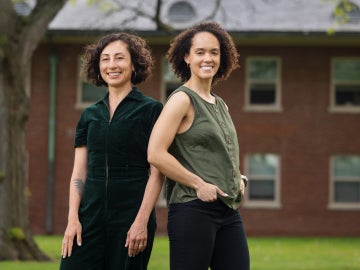
“This integrative concentration allows students to connect their personal experiences and interests in sport and physical activity to their academic interests,” says Jo Line ’11, co-chair of the integrative concentration alongside William G. Smith Associate Professor of Sociology and Comparative American Studies Alicia Smith-Tran ’10.
“Students will have the opportunity to explore how academic expertise in a variety of disciplines can prepare them for professional opportunities in the sport industry. They’ll also be empowered to consider how seemingly ordinary activities are implicated in larger societal issues and questions.”
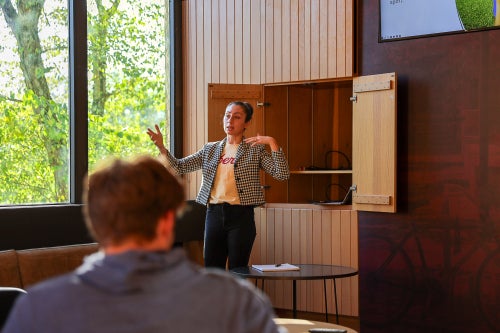
The integrative concentration also requires students to engage in hands-on experiences outside the classroom. For example, as part of the Introduction to Sport Studies and Management course, students will participate in a community-based learning project that will involve several of Northeast Ohio’s sport organizations.
“Oberlin is lucky to be in a region with a rich community of sports nonprofit organizations and professional sports teams,” adds Line, who is program director of community-engaged research and learning and a lecturer of Comparative American Studies. “This gives students the opportunity to apply what they learn in the classroom, build community across the region, learn from community members about the meaning that sport has in their lives, and explore a wide range of careers.”
For Rachel Reiter ’28, who’s double-majoring in business and Jewish studies, this integrative concentration “gives me an academic home for the sports-centered work I have already been doing across many departments at Oberlin,” she says. “From broadcasting games to studying sports marketing and Jewish athletes in the NCAA, to examining the role of sport in historical contexts—sports are the lens through which I understand the world.”
Reiter, who also plays lacrosse and works in the Athletics Communications office at Oberlin, adds that the concentration will provide her with the structure and mentorship she needs as she prepares for a future career in sports law. “I am especially looking forward to learning how the sports industry operates from a variety of perspectives and building the foundation and connections I need to enter the field with confidence.”
Oberlin’s integrative concentrations complement but do not replace majors and are open to students in both the conservatory and the college who are looking to pursue academic passions alongside their other coursework.
For more information about all of Oberlin’s academic offerings, visit oberlin.edu.
ABOUT OBERLIN COLLEGE AND CONSERVATORY: Since its founding in 1833, Oberlin College and Conservatory has led the nation in its commitment to educational access and opportunity. Oberlin was the first U.S. college to adopt a policy of admitting Black students and granting undergraduate degrees to women alongside men.
Located at the heart of a bucolic Northeast Ohio town, Oberlin uniquely combines an outstanding pre-professional school of music with a leading undergraduate college of arts and sciences. Oberlin students hail from nearly every U.S. state and more than 50 nations. Our alumni include 15 MacArthur “Genius Grant” Fellows, four Nobel Laureates, nine Pulitzer Prize recipients, and countless Grammy Award winners. In the last century, more graduates of Oberlin have gone on to earn PhDs than any other liberal arts institution.
You may also like…
Oberlin Reimagines Humanities Education Through $1.487M Grant
New “HOPE” initiative centers humanities learning with real-world impact.
The ABCs of STEM Research
At Oberlin, undergraduates work alongside faculty members on incredible scientific breakthroughs.