Andy Roshal '26 earns DAAD scholarship
The Hartsdale, New York, native will travel to Germany to expand on the Yiddish studies they began here at Oberlin.
August 5, 2026
Communications Staff
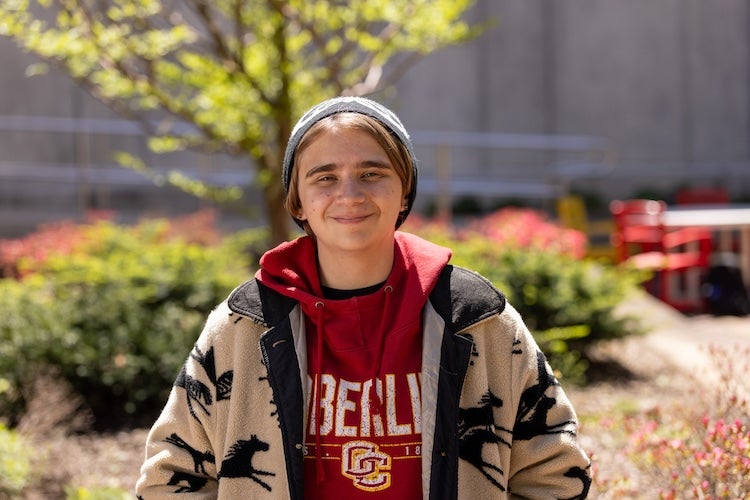
Andy Roshal ’26—who was president of the Oberlin Linguistics Society and taught at the Yiddish Tish on campus—had to choose between several scholarship offers to make a post-graduation plan. “I decided to pursue graduate studies in Germany through DAAD,” they say. “I am excited to continue to develop my research skills in a rigorous academic environment while also living abroad and engaging in an intercultural exchange.”
Tell us about the research you’ve done at Oberlin—and how it aligns with your career goals.
My senior linguistics capstone project is an ethnographic research study on American descendants of the Soviet Jewish diaspora who are learning Yiddish—an identity I myself hold. The final product focuses on how theories of post-vernacularity and perceptions of language death manifest in this narrow demographic. I will continue expanding this research project over the summer and beyond, drawing attention to how heritage languages develop and change in diasporic contexts, exploring the relationships between religious and secular speech communities, and developing an understanding of how concepts like vernacularity, post-vernacularity, and neo-vernacularity manifest themselves in the Yiddish-speaking world. I plan to continue working with the ethnographic data I’ve collected so far as well as to conduct new ethnographic research in the graduate context.
How have you grown and developed as a researcher from your time at Oberlin?
This year, I designed my own ethnographic research project for my linguistics capstone. This process involved being trained in research ethics and applying for approval from the IRB (institutional review board); these skills will serve me well in graduate school and beyond. I’ve also gotten to do smaller-scale research as in many of my classes. These ranged from analyzing multiple case studies on trauma-informed pedagogy in an education studies class to carrying out a collaborative research project on gender and vocal fry/creaky voice in a phonetics class. These experiences have given me a range of qualitative and quantitative research skills, and I’ve had lots of opportunities to explore different research methods. I wish I could go back in time and tell my first-year self that I’m conducting research in linguistic anthropology while speaking Yiddish. I think my 18-year-old self would have a hard time believing that I would have been able to gain these research and language skills in just a few years. My time at Oberlin has shown me that with the right support and the right community, we’re all capable of learning and accomplishing so much more than we think.
Why did you decide to apply for the DAAD scholarship and what are your plans with it?
Yiddish is a vibrant language with its own culture, complexities, and a strong contemporary revitalist movement aiming to preserve the language’s history and bring its beauty into the present and future. Especially at a time when some people in positions of power are attempting to enforce standard language ideology and monolingualism, it is critical to study ways in which we can breathe new life into the Yiddish language. Yiddish teachers are the beating heart of this movement.
Yiddish preservation, revitalization, and pedagogy have been the focus of my studies at Oberlin. I pursued an individual major in linguistics, along with a second major in creative writing, a minor in German, and an integrative concentration in education studies. My goal is to become a Yiddish educator, fostering Yiddish revitalization with a passionate and nuanced approach. I applied for a DAAD scholarship, which provides me with funding to pursue a master’s degree in Germany, because I was excited about the prospect of combining my interests and continuing my studies at the intersections of German and Jewish culture as well as linguistics and literature. I’m so grateful for this opportunity, and I look forward to continuing to develop my research and teaching skills at the graduate level, and engaging with the global academic community. I am excited to dedicate myself to preserving Yiddish and pursuing an understanding of what this means to the relevant cultural and religious communities. As a budding Yiddish educator, I hope above all to imbue my students with a sense of connection—connection between themselves and the language and culture, connection with each other, and a connection to Yiddish speakers across generations and across borders.
What’s the best advice you’ve received from an Oberlin faculty mentor?
Halfway through my second year at Oberlin, I was stuck in a rut when it came to reading and writing poetry. I went to Professor DeSales Harrison’s office hours to seek advice. Professor Harrison framed this rut not as an obstacle but as an opportunity for positive change. He said, “It’s not like you have a dog named Milkshake and a writing style named Carl.” It was a metaphor for the ways in which our identities and writing style and lives are always changing, and not to get too attached to how we think things will turn out or who we think we should be at any given moment… Especially now, as I’m preparing to graduate, I’m ready to welcome this new beginning and all the changes that will come along with it. I’m so grateful for the connections I’ve formed with my classmates and professors along the way, and will really treasure my time at Oberlin.
Connect with Fellowships & Awards to learn more about opportunities for Oberlin students.
You may also like…
Reyna Berry ’27 earns a 2026-27 Newman Civic Fellowship
The theater major will continue her work supporting prison and detention center programming

Nissa Berle ’24 earns Fulbright Study/Research Award
The psychology major will earn a master’s degree in disaster and emergency management at York University
Maya McDermott '26 Earns Fulbright to Argentina
The English and politics double major will work as an English Teaching Assistant (ETA) at a teacher-training institution.