Leo Hidy ’23 Earns 2026 Marshall Scholarship
The Oberlin alum will embark on two years of funded graduate study in London, researching how immigrants shape neighborhood economies and how government policy can better sustain these vital spaces.
December 9, 2025
Office of Communications
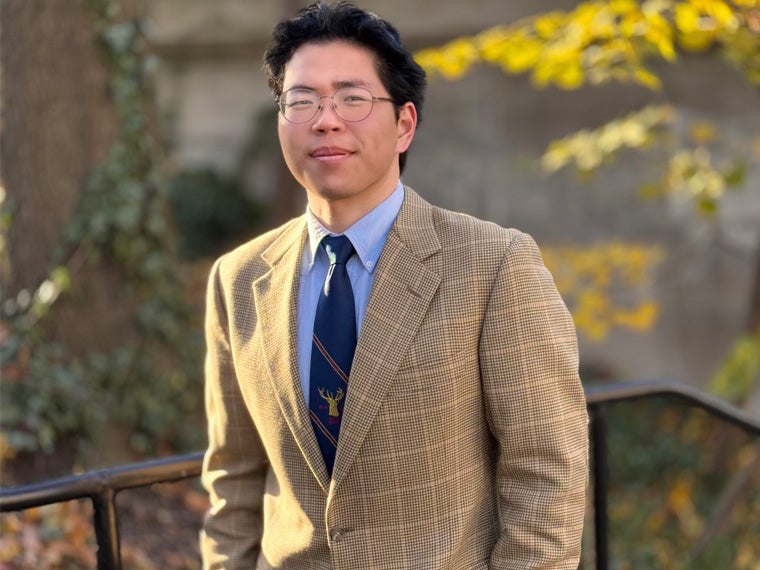
“The Marshall application and interview process was intense, and I'm so grateful I had support at every step. I couldn't have done this without Oberlin's community,” says Leo Hidy ’23.
Photo credit: Courtesy of Leo Hidy ’23
Leo Hidy ’23, a comparative American studies major who also studied business and economics while at Oberlin, has received a 2026 Marshall Scholarship.
The prestigious award funds two years of graduate study in the UK, providing Hidy with the opportunity to research how immigrants shape neighborhood economies and how government policy can better sustain these vital spaces. “I'm deeply honored and humbled to receive the Marshall Scholarship,” he says. “It's an opportunity I couldn't have imagined when I first set foot on campus.”
Hidy will first earn a Master of Science in City Design and Social Science at the London School of Economics, followed by a Master of Public Administration at the University College London's Bartlett Faculty of the Built Environment.
“This two-year sequence lets me first understand how immigrant communities create their own economic and urban spaces, before applying those insights to reimagining supportive policy frameworks,” he says. “London's historic legacy of immigrant entrepreneurship and evolving approaches to high street revitalization offer an ideal setting for this work. I'm eager to bring these perspectives back to public service in the U.S. and to policy that empowers immigrants as the essential architects of vibrant cities.”
The Marshall Scholarship builds on Hidy’s post-graduation work as a New York City Urban Fellow and an Oberlin Shansi Fellow in Japan. During the award application process, the San Francisco native also received crucial guidance from the Fellowships and Awards office, faculty support from Professor of Comparative American Studies Gina Pérez and Professor of Sociology Greggor Mattson, and encouragement from Obies everywhere.
“I couldn't have done this without Oberlin's community,” he says. “The Marshall application and interview process was intense, and I'm so grateful I had support at every step.”
“What moved me most, though, was my Oberlin friends,” Hidy adds. “When I was preparing for the Marshall interviews, Obies from all over the world—people who had graduated, moved to different countries, started their own careers, even some I'd never met—made time to call me, help me practice, and offer much-needed encouragement. It really does take a village, and I'm so beyond grateful for mine.”
What does it mean to you to receive the Marshall Scholarship—and how will this help you move forward with your proposed career plans?
It gives me the chance to study with scholars who are guided by the same questions as I am and who are reimagining urban policy from the ground up.
I’m currently working as a policy advisor for the City of New York. The Marshall Scholarship will allow me to return to municipal government with an eye toward transforming how cities support immigrant entrepreneurs and neighborhood economies.
Tangibly, the Marshall Scholarship means I can pursue the question that has driven my work at Oberlin and beyond. Whether it be through my courses or extracurricular activities, I kept coming back to the same question: How do institutions—dormitories, schools, towns, cities, and states—decide which identities belong and which do not?
In typical Obie fashion, the next question burning in the back of my mind is always, What can we do about it?
I couldn't have done this without Oberlin's community. The Marshall application and interview process was intense, and I'm so grateful I had support at every step.
Leo Hidy '23
In what ways did Oberlin prepare you for this honor?
Oberlin's motto of “Learning & Labor” taught me to ask better questions and then act on the answers. Academically, my American studies coursework pushed me to examine whose voices are centered in institutions and whose are marginalized.
In one of my favorite classes, Latinx Oral History, we met with Puerto Rican Vietnam War veterans in Lorain. We learned to listen deeply and interrogate our own assumptions about war, militarization, and patriotism. These skills shaped how I approach public service today.
The “labor” side was just as formative. As co-chair of the Student Finance Committee, allocating $2.4 million in student funding forced me to make consequential decisions about which groups would be resourced.
Additionally, working as a consent educator, Barefoot Dialogue facilitator, and an RA all taught me how to build community and translate academic insights into institutional change. These roles provided me with the leadership skills, humility, and curiosity essential for the work I want to accomplish as a Marshall Scholar.
Anything else you want to add?
I couldn't have done this without the support of Oberlin's community. The Marshall application and interview process was intense, and I'm so grateful I had support at every step.
The Fellowships Office guided me through the complexities of the application, helping me articulate ideas through many (and I mean many) drafts. My professors, especially Gina Pérez and Greggor Mattson, not only wrote incredible letters of recommendation but pushed me to clarify the driving questions behind my work.
Additionally, the Oberlin Shansi Fellowship gave me the ambassadorial skills that became central to my Marshall proposal, and the Shansi community continues to shape how I think about cross-cultural exchange and learning.
Connect with Fellowships & Awards to learn more about the fellowships and awards opportunities and support available to Oberlin students and alumni.
You may also like…
Jane Wickline ’21 Finds Community in Comedy
A Q&A with the Saturday Night Live cast member and Dukes cofounder
Reyna Berry ’27 earns a 2026-27 Newman Civic Fellowship
The theater major will continue her work supporting prison and detention center programming

When Stars Align
The Oberlin Contemporary Music Ensemble shines on Jennifer Koh ’97’s "The American Concerto, Volume One."