Redefining the Canvas: Meena Hasan ’09 Expands the Boundaries of Painting
The RISD professor explores identity, history, and materiality through work that challenges traditional definitions
February 24, 2026
Eva Recinos
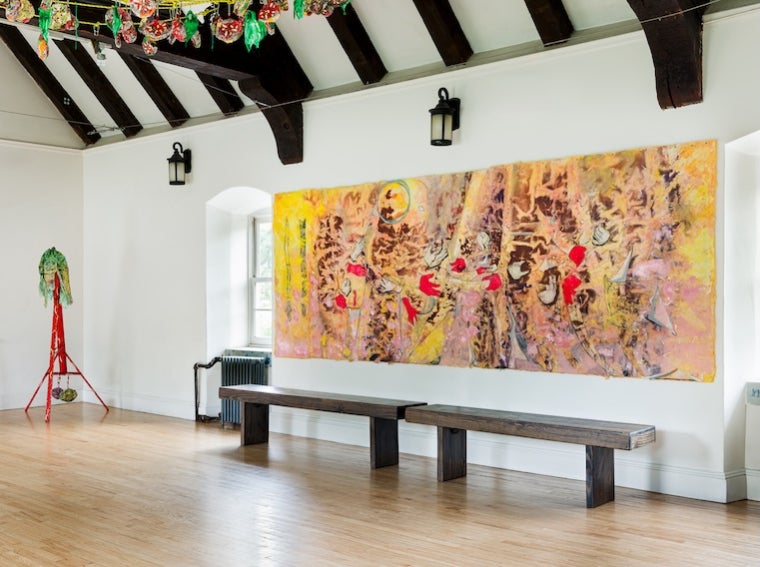
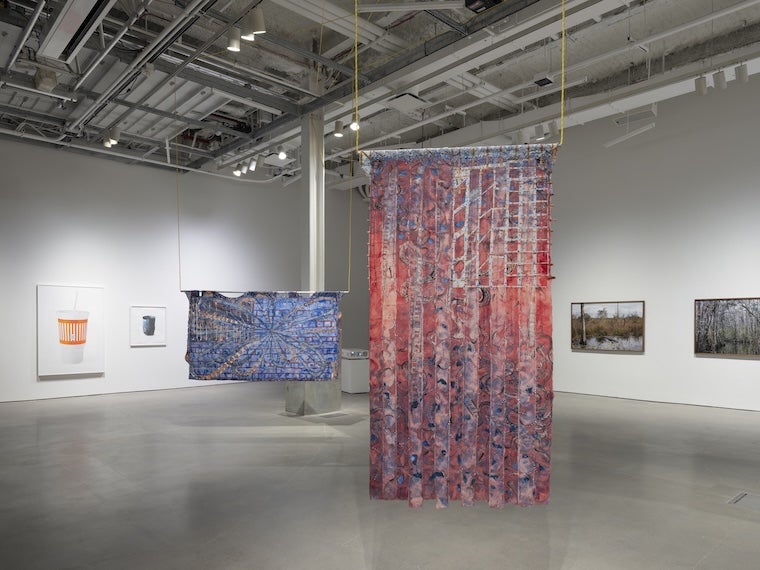
Whether working on a soft sculpture or an artwork suspended from the ceiling, Meena Hasan ’09 brings it all back to painting.
“A lot of my practice is about questioning what a painting is or can be—and whether it even has to be a surface that's on the wall,” she says. “Can it hang in the middle of a space and become a wall in and of itself, or even the whole environment? I’m really interested in complicating the limits and boundaries that define mediums.”
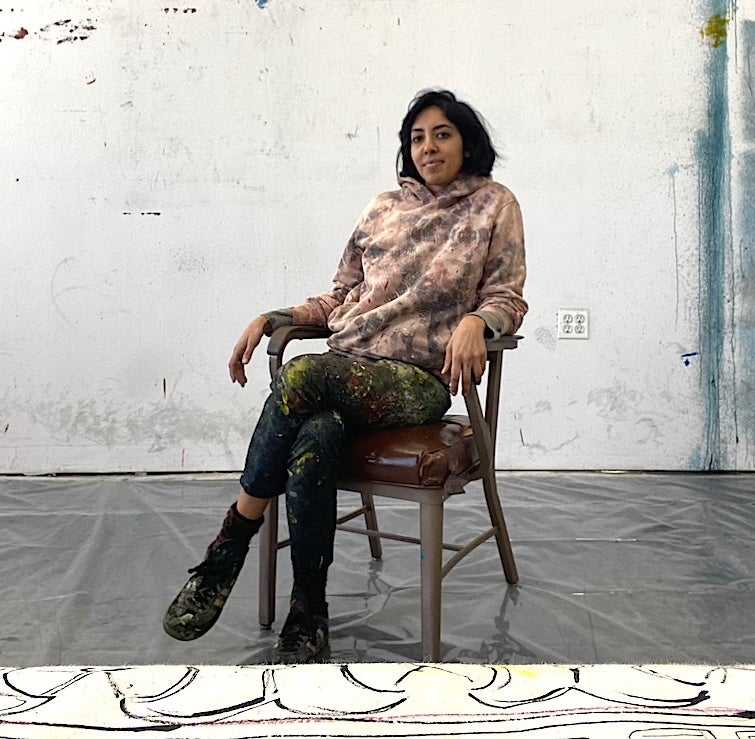
Hasan says that her early years at Oberlin allowed her to stretch these strict definitions, both within traditional mediums and in her own thinking about a career in art. As a studio art major, she focused largely on ink drawings. In a class with Professor Susan Umbenhour, she created drawings based on a nude model who was half-Egyptian, which became a significant connection for her. “Drawing from her poses just inspired me so much and made me feel seen in terms of my own family, heritage, and upbringing,” Hasan says. She incorporated those figure drawings into collages made with fabric, transparencies, vellum, and Bangladeshi textiles sourced from her family.
In the class The Nature of the Abstract, taught by then-Young-Hunter Professor of Art John Pearson, Hasan worked with open-ended prompts that allowed her to consider how her art might expand into larger bodies of work. Another faculty member, Don Harvey, encouraged her to try animation and stop motion; she also dipped into silk screening and sculpture.
Beyond her art, Hasan followed her interest in psychology, taking multiple courses in the discipline. She later became a copy and photo editor for the Oberlin Review and the art editor of the student-run literary magazine The Wilder Voice. “I collaborated with a lot of students,” she says. “The community I made with my classmates was hugely formative and has continued to feed and serve me well.”
After graduating, Hasan moved back to her native New York City. She split her time between internships, part-time jobs, and making art, often commuting long distances and spending late nights at a shared studio space in Gowanus.
An opportunity to spend three months as an affiliated fellow at the American Academy in Rome helped clarify her future goals. “Being there with mid-career and late-career artists—who had made whole lives out of their work—was huge for me,” she says. “I was able to see the future I wanted.”
Hasan used the time to create a body of work for her graduate school application. That work helped her move beyond thinking about identity politics “in an overly didactic and binary system between East and West,” and instead reflect on the gray areas within her identity as a New Yorker. She subsequently earned an MFA in painting and printmaking at Yale, where she was one of a handful of students who had attended a liberal arts college rather than an art school.
“We all had this strange benefit of not having been trained in a particular way,” she says. “We were all making work that was really authentic to who we were. That's what you're in grad school to figure out—your voice and your distinct way of communicating. I came in already having that.”
Today, Hasan is an associate professor and graduate program director in the fine arts painting department at the Rhode Island School of Design (RISD). In her teaching and studio practice, she is interested in “historic objects and textiles that are housed in Western institutions,” studying them as “affected, living objects with stories and narratives beyond those that have been assigned to them.”
In spring 2025, Hasan presented a series of works at the Old Stone House of Brooklyn, a reconstructed historic house located at the site of the 1776 Battle of Brooklyn. In the exhibit, Hasan made connections between the revolutionary history of America and that of India, referencing Tipu Sultan, the Indian ruler who fought against British forces.
One work portrays Tipu’s helmet draped on a free-standing painting easel, with two carabiners hanging at the bottom. The piece incorporates Higgins India ink, acrylic and Flashe paints, and Okawara paper—in line with Hasan’s explorations of what a painting can look like.
While admittedly often indecisive, Hasan says that her decision to focus on art came from a place of “intention, assuredness, and gratitude.” Her early years as an art student were especially important.
“I have to allow myself to doubt what I'm doing for as long as possible—to make sure that I'm confident,” she says. “And to make sure I’m not doing it just because I’m good at it, or because it's convenient. I feel lucky that I was able to explore so many different disciplines —and be around people who were really committed to them. Being at Oberlin made that possible.”
Oberlin’s BA+BFA in Integrated Arts program combines the rigor of an arts school with the well-rounded, interdisciplinary education of a liberal arts college. Learn more about this five-year program that’s tailored to each student’s academic and artistic interests.
You may also like…
Oberlin Welcomes New Integrated Arts Faculty
Visiting artists Ian Page ’08 and Scott Crandall bring their talents to new BA+BFA program.
Jane Wickline ’21 Finds Community in Comedy
A Q&A with the Saturday Night Live cast member and Dukes cofounder

Center for Media and Integrated Arts Taking Shape
New Center for Media and Integrated Arts to debut in fall 2027.