Leah Yonemoto-Weston ’24 Named NYC Urban Fellow
The Boulder, Colorado, native will work on urban policy issues during a nine-month fellowship.
April 14, 2026
Office of Communications
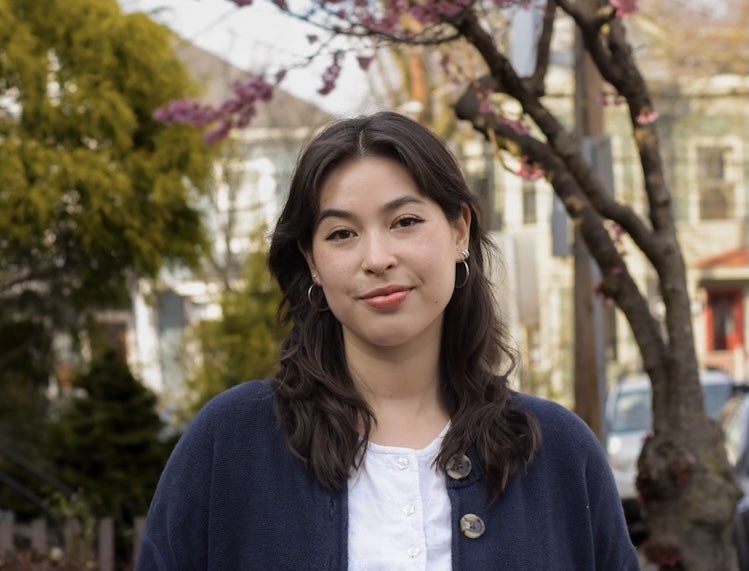
Photo credit: courtesy of Leah Yonemoto-Weston
Leah Yonemoto-Weston ’24, a comparative American studies major while at Oberlin, has been selected for the NYC Urban Fellows Program, a highly selective, nine-month public service fellowship that places recent graduates in full-time roles within New York City government agencies. She answered these questions about her fellowship:
Describe what you will be doing as an NYC Urban Fellow.
I’ll work in a New York government agency, helping develop and implement public programs and policies that address urban challenges. I’ll also participate in a series of seminars designed to deepen my understanding of how cities function. Through this combination of hands-on work and structured learning, I hope to gain insight into how local government operates and how policy decisions impact communities on the ground.
What made you want to apply?
I was drawn to this fellowship because it offers a unique opportunity to work directly within the policy systems that shape communities. Over the past several years, I’ve worked in client-facing roles focused on housing justice and eviction prevention, where I’ve seen firsthand how policy decisions impact individuals and families. That experience motivated me to apply those on-the-ground insights to broader, systems-level change. I hope to deepen my understanding of city-level policymaking while building the skills needed to contribute to more equitable and effective communities.
How does this align with your career goals?
It aligns closely with my goal of working on urban issues at the local level, particularly in housing justice and community development. I’m interested in bridging direct service and policy to advance more equitable systems, and I believe the NYC Urban Fellows Program will help me build the skills and knowledge to do so. It will also serve as strong preparation for future graduate study in urban planning, social work, and/or public policy.
How does this fellowship build on your previous studies and activities at Oberlin?
It builds on my comparative American studies work at Oberlin, where I explored how community, policy, and social justice intersect. Courses such as Latinx Oral Histories, where I interviewed Latinx veterans in partnership with the Lorain Historical Society, as well as Asian American History, and Medical Anthropology taught me to analyze identity, power, and community in nuanced ways, skills I will bring to the Urban Fellows Program.
The fellowship will also allow me to build on the teamwork and justice-oriented skills I developed through Oberlin’s extracurriculars. In OSCA’s Third World Co-op, I learned how to organize a community and build support networks. My work on the Resource Conservation Team taught me how to collaborate creatively and engage with local stakeholders, and my work at the Sexual Information Center emphasized public health, mutual aid, and managing complex budgets.
How did Oberlin shape or influence you as an academic, thinker, and person?
My classes were really interdisciplinary, and I learned how to approach questions from multiple angles rather than staying in one lane. Oberlin’s culture of collaboration also stayed with me. Through group projects, research partnerships, and extracurriculars, there was a real expectation that you would contribute to something larger than yourself. That environment helped build my academic instincts and fostered a genuine sense of responsibility to engage thoughtfully with communities and consider the broader impact of my work.
What’s the best advice you received while you were at Oberlin?
Wendy Kozol, my former advisor and CAST faculty member, told me during my first year that the most important thing in both school and the working world is finding your own reason to return to the work, even when it gets hard. You have to find motivation from within, rather than from outside pressure. In any meaningful work, you need to know what keeps you grounded, engaged, aligned with your values, and excited!
Connect with Fellowships & Awards to learn more about opportunities for Oberlin students.
You may also like…
Reyna Berry ’27 earns a 2026-27 Newman Civic Fellowship
The theater major will continue her work supporting prison and detention center programming

Andy Roshal '26 earns DAAD scholarship
The Hartsdale, New York, native will travel to Germany to expand on the Yiddish studies they began here at Oberlin.
Nissa Berle ’24 earns Fulbright Study/Research Award
The psychology major will earn a master’s degree in disaster and emergency management at York University