Bringing Data Science to Investigative Journalism
At the Howard Center for Investigative Journalism, Declan Bradley ’26 combined programming, analysis, and reporting as a Dow Jones News Fund intern.
March 16, 2026
Office of Communications
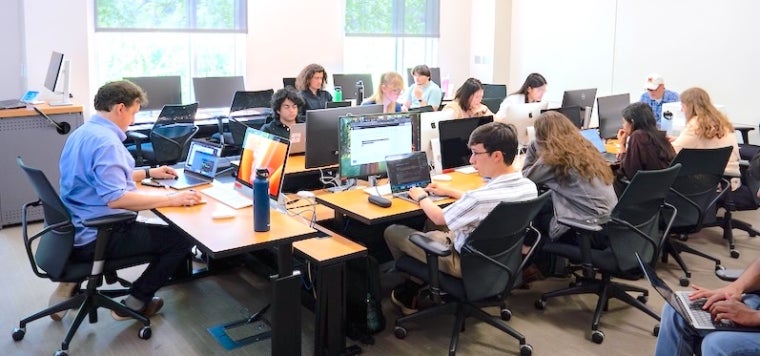
Dow Jones News Fund interns in 2025.
Photo credit: Courtesy of Declan Bradley
Declan Bradley ’26 is a computer science and data science double major with a minor in English from Rockford, Michigan. At Oberlin, he is a senior staff writer for The Oberlin Review and an active participant in ExCo.
Can you describe your summer internship?
As the Dow Jones News Fund data reporting intern for the Howard Center for Investigative Journalism at the University of Maryland, I specialized in data analysis using the programming languages R and Python. My day-to-day work involved conducting in-depth research for the Howard Center’s investigative stories, which drew on months of reporting by University of Maryland students, faculty, and newsroom partners.
As a data intern, my contributions ranged from creating visualizations in R or D3 to writing data analysis memos explaining key findings from my research.
During my first few weeks at the Howard Center, I analyzed national data on the transport of hazardous materials, isolating insights that opened new avenues of inquiry for the team. I also scraped and cleaned datasets from the CDC and EPA to support other reporters’ investigations and built internal tools in HTML and JavaScript that made key portions of the 250-gigabyte database under study accessible to team members without computer science experience.
How did Oberlin influence you to pursue your internship?
As a transfer student, I chose Oberlin for the way it combines expertise in the sciences with a strong liberal arts grounding. I took a statistics course with Professor Bob Bosch, who emphasized the importance of critical and ethical thinking when applying statistical methods in research.
His teaching prepared me well for my work at the Howard Center, which combined the computational study of large datasets with the real-world ethics of investigative public service journalism.
How did your internship align with your post-college goals?
I plan to pursue a career as a computational journalist, and the Howard Center was an excellent opportunity to apply my studies in computer and data science to grounded news reporting. I admire the work of nonprofit investigative outlets such as ProPublica and hope to contribute to a newsroom like that after graduation.
How has your liberal arts education shaped the way you think about science or research?
My study of history and literature informs my work in journalism a great deal. As a data reporter, I investigate complex systems through a computational lens. But those systems are the product of politics, culture, and history. Understanding the wider historical and social context behind the stories we cover can make them richer and more informative for our readers.
What drew you to your major?
In 2022, I attended a week-long residency workshop on computational reporting taught by members of the data journalism team at The Washington Post. Their passion for their work inspired me to apply my own computational skills to public service reporting—a goal I have pursued ever since.
You may also like…
Maike Anthony dos Santos Silva '28 interns at Princeton University
The math major from Belo Horizonte, Brazil, used his summer internship to delve deeper into his studies.
Roxie Freifeld '27 had a big-league summer
The senior from Brooklyn, New York, interned in professional softball.
Advancing AI Accessibility and Policy
Oberlin student Tanisha Shende ’26, a Goldwater Scholar and STRONG program participant, bridges the gap between generative AI innovation, disability accessibility, and international tech policy.