Advancing AI Accessibility and Policy
Computer science and math major Tanisha Shende ’26 combines high-level AI research with global policy to create equitable technology.
March 23, 2026
By Kate Martin ’26
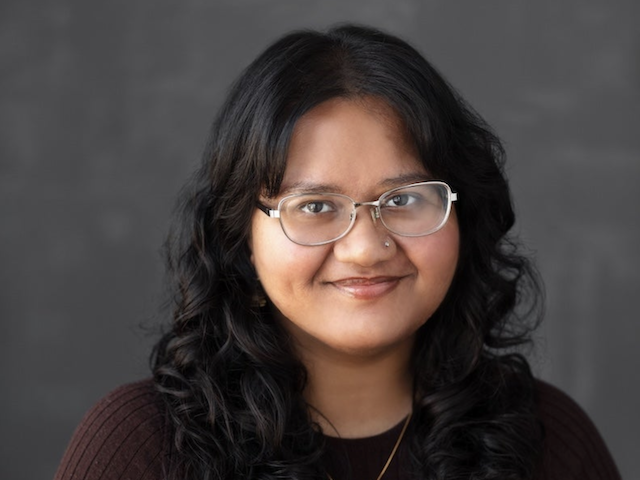
Photo credit: Tanya Rosen-Jones ’97
The Center for Engaged Liberal Arts (CELA) has given Tanisha Shende ’26 the tools to grow not only as a computer science researcher but also as a caring and civic-minded researcher.
Shende entered Oberlin as a STRONG Scholar. Run by the Office of Undergraduate Research (OUR), the STRONG Scholars Program provides first-year students with specialized mentoring and resources to help them adapt to and thrive in their STEM journey. As her first research endeavor, Shende spent her first-year winter term in a computational astrophysics lab with Professor Jillian Scudder.
Soon after, Shende earned a research role with XR Access, a Cornell Tech initiative that aims to make virtual reality programs more accessible for people with disabilities. There, she found a deeper sense of purpose in the human impact of her work.
Shende continued her journey as a computer science researcher during her second year, where she clarified her interest in making technologies such as AI more accessible across sectors. One of her projects was designing a generative AI program to make visual art more accessible to blind and low vision (BLV) users, which led her to publish a paper and present at the 2024 AAAI Conference on Artificial Intelligence.
At Oberlin, where she’s majoring in computer science and mathematics, Shende is active in the undergraduate research community. She joined BRANCHES as a community leader, helping to create inclusive programming and support networks for STEM students. She later became a research ambassador for OUR, guiding students as they entered the undergraduate research space.
Shende also utilized resources from the Career Exploration and Development (CED) office to expand her understanding of technology from policy and economic viewpoints. She worked with the U.S. State Department’s Diplomacy Lab and served as a student delegate to the Athens Democracy Forum, examining AI and other technologies from the perspective of governance and public policy.
In addition, Shende volunteers at the Educational Service Center of Northeast Ohio, where she supports adult learners navigating barriers such as childcare and technology access. “I am building a provider–service database and prototyping a web platform and Large Language Model-based assistant that guides learners toward appropriate programs and enables smoother, more accountable handoffs.”
Shende was selected as a Goldwater Scholar and spent last summer at the MIT Summer Research Program in the Media Lab. “Altogether, my CELA experiences have grounded my academic journey in purpose, equity, and community. They shaped the researcher I am now and the one I hope to become as I move into graduate study and work at the intersection of technology, policy, and society.”
Shende is a nominee for the CELA Award, recognizing outstanding engagement and achievement in connecting academic pursuits with experiential learning.
You may also like…
Reyna Berry ’27 earns a 2026-27 Newman Civic Fellowship
The theater major will continue her work supporting prison and detention center programming

Nissa Berle ’24 earns Fulbright Study/Research Award
The psychology major will earn a master’s degree in disaster and emergency management at York University
Oberlin Uses Co-Designed Tech to Bridge Adult Education Gaps Amid AI-Driven Change
That message came through clearly at the Association of Independent Colleges & Universities of Ohio (AICUO) Collaborative Conference held June 4 at Otterbein University, where Oberlin faculty and...