Sustainability in Action: From Oberlin to the Ohio EPA
Geosciences and musical studies major Isabel Hyman ’26 spent her summer helping the Ohio EPA advance recycling and environmental education across the state.
March 17, 2026
Office of Communications
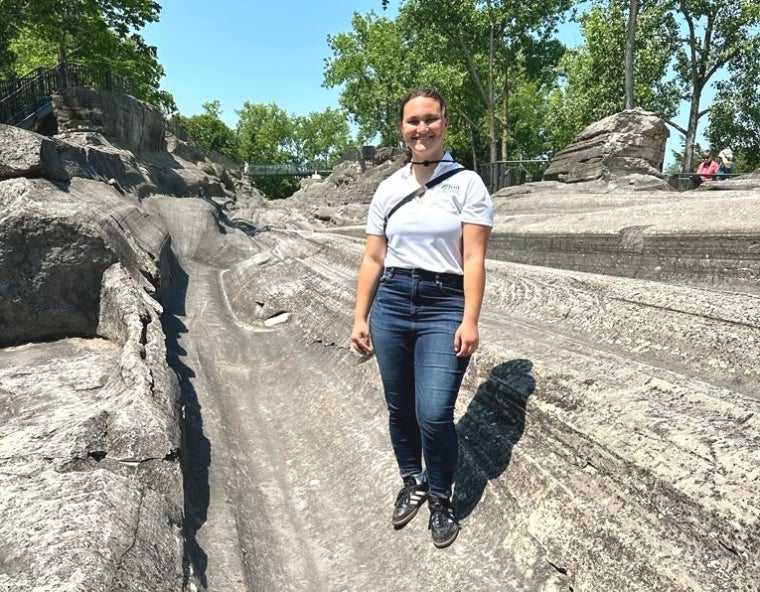
Isabel Hyman ’26 at the Kelley's Island Glacial Grooves in Ohio.
Photo credit: Isabel Hyman ’26
Isabel Hyman ’26, a geosciences and musical studies major from Los Angeles, spent summer 2025 interning with the Office of Environmental Innovation at the Ohio EPA. On campus, her leadership has spanned several disciplines: co-president of the Deception Games Club, a varsity soccer player, an ExCo instructor, and a lead eco-rep in the Office of Energy and Sustainability.
Can you describe your summer internship?
I worked as an intern in the Office of Environmental Innovation in the Central District Office of the Ohio EPA. I primarily worked with the Pollution Prevention (P2) team, which provides free, confidential, and non-regulatory sustainability assistance.
During the summer, I visited three state parks across Ohio to support recycling, composting, and energy efficiency efforts. I assisted with site visits, report writing, developing tools for organizations to track their progress, and other team needs.
I also collaborated with colleagues and another intern to redesign the office’s website to improve navigation and better highlight its work, as the office is less than a year old. I finished my internship by writing a comprehensive guide on how students can create more sustainable college campuses, based on my experiences at Oberlin and what I learned at the EPA.
How did Oberlin influence you to pursue your internship?
My work as a lead eco-rep on campus and my boss, Heather Adelman, were the biggest influences. Eco-reps help to modify student behavior to align with Oberlin’s sustainability and carbon neutrality goals by bridging the Office of Energy and Sustainability with the student body and leading educational initiatives. That work related to the P2 site visits I conducted at the Ohio EPA. I love the concept of helping people improve before pursuing regulatory action, as it can foster a stronger culture of sustainability.
How did your internship align with your post-college goals?
It opened my eyes to the ways the government can simply help people, rather than just enforcing rules. I have a much better understanding of the regulatory aspects of managing solid waste and how waste is processed. If I decide to go into waste management or pollution prevention, the skills and lessons I learned will help me transition quickly. Even if I pursue another route, I have the necessary context and expertise to help me in any job in the field.
What surprised you or made a big impression?
I learned just how much waste is landfilled that could be recycled, composted, or repurposed. The most landfilled item was paper, followed by organics. When organics decay in a landfill, they release large amounts of methane, a greenhouse gas. I also learned that reducing waste from the source is the number one solution to waste management.
How has your liberal arts education shaped the way you think about science or research?
I learned that human experiences shape how people view sustainability. There are places and parents in our country that don't teach sustainability to their children, which is why environmental education is so important.
You may also like…
Maike Anthony dos Santos Silva '28 interns at Princeton University
The math major from Belo Horizonte, Brazil, used his summer internship to delve deeper into his studies.

Roxie Freifeld '27 had a big-league summer
The senior from Brooklyn, New York, interned in professional softball.

Bringing Data Science to Investigative Journalism
Declan Bradley ’26 discusses his summer internship at the Howard Center for Investigative Journalism and how Oberlin’s focus on ethics in statistics prepared him for a career in computational reporting.