Audrey Weber ’24 earns Fulbright to teach English in Ecuador
The young alum, from George Town, Grand Cayman, will serve as a teaching assistant in university-level English classes.
October 1, 2025
Communications Staff
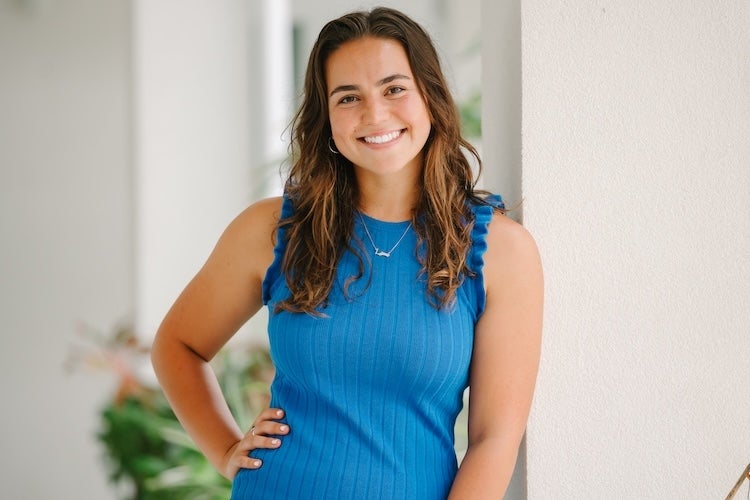
Photo credit: Daria Keenan
Audrey Weber ’24 triple majored in anthropology, Hispanic Studies, and Latin American Studies at Oberlin. During that time, she volunteered as an America Reads tutor and interned with Catholic Charities, Diocese of Cleveland in the immigration legal services division. “There I had the privilege of listening to the stories of Latin American immigrants—people navigating displacement, legal uncertainty, and the legacies of political and economic upheaval,” she says. “My coursework helped me understand the broader structural forces behind those stories, while also reinforcing the importance of approaching such narratives with humility and care.”
What have you been up to since graduating from Oberlin?
After graduation, I returned home to the Cayman Islands, where I’ve been working at a newly opened primary school as a learning assistant. I work primarily with nine to 11-year-olds, supporting them through reading and math interventions and introducing them to Spanish. The role felt like a natural extension of my experiences at Oberlin, including my time as an ExCo instructor and teaching assistant in the Hispanic Studies department. It’s been incredibly fulfilling to help young learners grow in confidence and curiosity, but I’m also looking forward to stepping into my next adventure.
How does pursuing the Fulbright align with your post-college life and career goals?
Fulbright bridges my academic interests and my long-term goals. I’m deeply committed to cross-cultural communication, which has been at the heart of my work in both education and advocacy. My experience with Catholic Charities solidified my desire to pursue a career in human rights law, with a focus on nonprofit work alongside Latin American communities. The Fulbright fellowship will allow me to immerse myself in Ecuadorian culture, strengthen my language skills, and continue learning in dialogue with others. As an anthropologist, I believe that living and working in the community is one of the most meaningful ways to understand–and more justly represent–the people I hope to one day serve.
Where specifically will you be/what will you be doing—and what are you looking forward to the most?
I’ll be working as an English teaching assistant at a university in Ecuador. Outside of my teaching hours, I’m excited to engage in community life and continue exploring themes from my undergraduate thesis, which focused on Andean ontologies and indigenous resistance to extractive industries such as mining. Ecuador offers a vital context to further understand these dynamics, and I look forward to learning from the perspectives and lived experiences of those most directly affected.
I am most excited about forming relationships with my students and creating an environment for open discussion. Since I’ll be working with university students, I look forward to returning to the dynamic environment of a college campus and learning from their perspectives on language, identity, and contemporary Ecuadorian life. I am equally excited to volunteer with local organizations, explore Ecuadorian food, and see what sorts of sports I can get involved with!
How did Oberlin shape or influence you to pursue the Fulbright?
Oberlin encouraged me from day one to think deeply about the world and my place in it. Courses like Introduction to Cultural Anthropology with Professor Baron Pineda and Society and Environment in Latin America and the Caribbean with Professor Karl Offen challenged me to approach questions of culture, politics, and power with a multidisciplinary approach, listening to the perspectives of those affected.
The summer before my third year, I interned in Cusco, Perú at a non-profit organization that works with indigenous people in the Andes. This experience undoubtedly influenced the trajectory of my Oberlin career by inspiring numerous papers, and eventually my application to Fulbright. I’m especially grateful to my Hispanic Studies professors, Ana María Díaz Burgos, Sergio Gutiérrez Negrón, Patty Tovar, and Sebastiaan Faber, who supported me as I navigated interning in my second language and continually encouraged me to apply for this fellowship.
Connect with Fellowships & Awards to learn more about the fellowships and awards opportunities available to students.
You may also like…
Jane Wickline ’21 Finds Community in Comedy
A Q&A with the Saturday Night Live cast member and Dukes cofounder
Reyna Berry ’27 earns a 2026-27 Newman Civic Fellowship
The theater major will continue her work supporting prison and detention center programming

When Stars Align
The Oberlin Contemporary Music Ensemble shines on Jennifer Koh ’97’s "The American Concerto, Volume One."