Program Overview
Critical AI Studies
Technology through a liberal arts lens
Understand and shape the impact of artificial intelligence
Featured Facts and Stories
Bridges STEM and the humanities through our interdisciplinary learning approach that complements any BA, BS, or BM degree.
Agents of Change
Adam Eck, the David H. and Margaret W. Barker Associate Professor of Computer Science and Business, is studying how artificial intelligence-powered robots can fight wildfires more efficiently.
Study AI technologies at an institution committed to sustainability and proudly carbon neutral since 2025.
Year of AI Exploration
Oberlin College is passionate about giving students the tools they need to succeed, which includes equipping them with speakers, workshops, and hands-on opportunities and establishing policy and procedures to support their journeys.
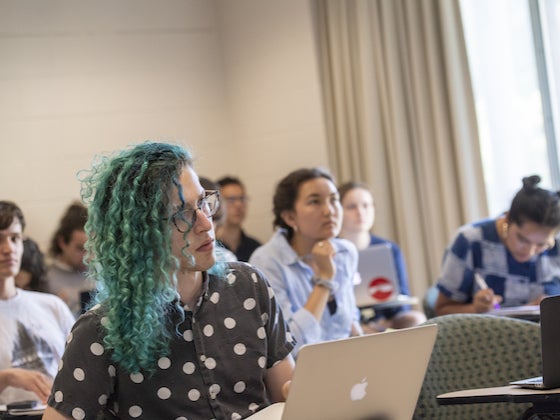
Integrating Analysis & Machine Learning to Predict Cancer Outcomes

“My favorite part of the research process is uncovering patterns in complex data and transforming numbers into meaningful insights that can inform real-world healthcare decisions. But more than that, I remind myself that each data point represents a real person.”
Featured Courses
CAIS 100
Introduction to Critical AI Studies
Students explore fundamental questions such as, “What is meant by the term ‘artificial intelligence’? How is this similar to and different from our understanding of human intelligence and creativity? How do AI systems actually function?” Students also probe how social and historical factors shape the underlying theories, concepts, technologies, development pipelines, and policies that support AI systems as we know them.
- Taught by
- Michael McCarrin, Nicholas Anderman
POLT 230
Odyssey of Critical Theory
This course provides a survey of critical theory tradition of thought beginning from the influential critiques of the Enlightenment by Marx, Freud, and Nietzsche and extending to the twentieth century critical theories of the Frankfurt School, with a focus on the writings of Theodor Adorno, Max Horkheimer, Walter Benjamin, Erich Fromm, and Herbert Marcuse. The course will trace the shifts within critical theory’s long odyssey, while interrogating the possibilities and limits of this tradition today.
- Taught by
- Arwa Awan
DATA 101
Introduction to Data Science
The growth and use of data is increasingly vital for many disciplines, from natural sciences to social sciences, and business to humanities. This course introduces students to data science and informatics that study how to collect, manage, process, analyze, and visualize data from a computational perspective. Topics include computational thinking, understanding different types of data, database techniques, and a variety of data analysis approaches.
- Taught by
- Joshua H. Davidson ’12
EVSS 322
Energy and Society
Energy issues are often characterized as problems we can ‘supply’ our way out of by changing the resources we rely on, and less frequently as a problem of consumption. This course adopts a socio-technical perspective. The first part of this course explores physical, political, and economic aspects of energy supply through the examination of different energy sources (biomass, fossil fuels, electricity, renewables, nuclear). The second part of the course addresses social and political aspects of energy consumption.
- Taught by
- Paul Brehm
CRWR 237
New Media Writing
Can a poem change based on your weather data? What happens when a story moves nonlinearly through hyperlinks, or when the computer becomes your collaborator? This creative writing course explores new media writing-poems, stories, and hybrid works that use digital media to create innovative literary experiences. Our scope may include interactive fiction, video games, computational poetry, audio and video poems, hybrid installations, immersive storytelling, and more. Students will workshop their creative work with peers.
- Taught by
PSYCH 209
Complex Cognition
This course explores fundamental questions in the field of cognition such as, “How are we able to learn languages, make decisions, and predict the future?” It covers a variety of topics relating to the scientific study of high-level human cognition, including thinking, problem solving, language, and reasoning.
- Taught by
- Manasi Jayakumar
Program News
Critical AI Studies Kicks off Fall 2026
The new minor offers a humanities-grounded approach to artificial intelligence, a rapidly changing technology that’s becoming increasingly pervasive in our world. Find out how Oberlin is responding in ways that align with our mission and history.
Expressive Machines
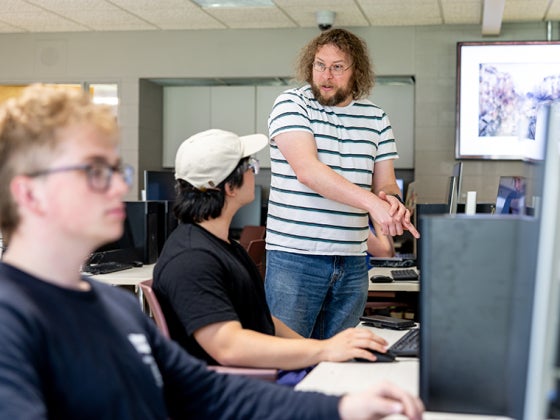
How do we think about musical expression, especially in relation to robots and machines? That’s the question Steven Kemper aims to answer in his research. In the age of artificial intelligence—and the various concerns surrounding it—Kemper’s research proves that robots can, in fact, enhance human creativity.

Goldwater Scholarship Recipient Tanisha Shende ’26 Aims to Make Virtual Reality More Accessible
Shende spent the summer conducting research at the MIT Media Lab in Cambridge, Massachusetts, working on the ethics and governance of technology at Harvard University’s Berkman Klein Center for Internet and Society.

Next Steps
Get in touch; we would love to chat.