
Oberlin Launches Critical AI Studies Minor in Fall 2026
The course of study offers a humanities-grounded approach to the transformative technology
February 20, 2026
Office of Communications
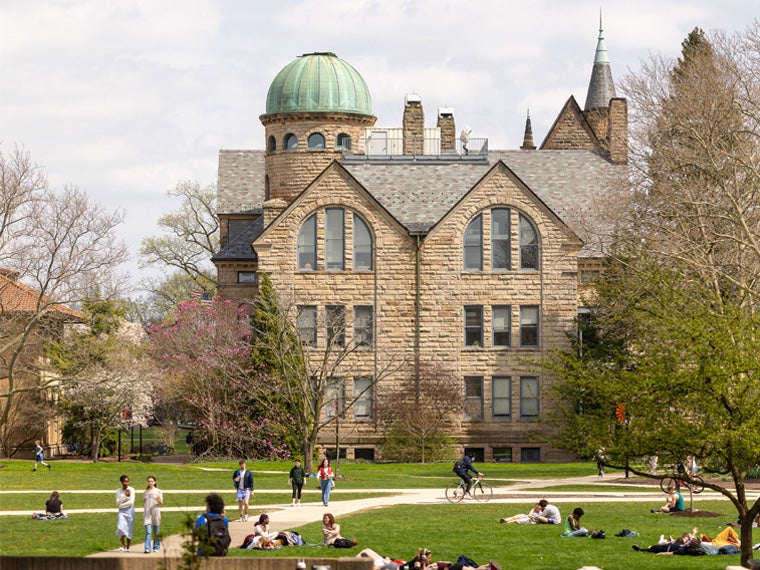
Photo credit: Bob Handelman
In recent years, higher ed institutions have been grappling with the best ways to respond to artificial intelligence, a rapidly changing technology that’s becoming increasingly pervasive in our world. As part of a Year of AI Exploration, Oberlin is responding in ways that align with its mission and history.
Oberlin’s faculty and staff are leading cross-disciplinary conversations about the opportunities and challenges of AI, especially in light of concerns over environmental impact, job displacement, intellectual property extraction, and cognitive debt.
Oberlin feels a deep responsibility to ensure our students become responsible stewards of AI. And as a liberal arts institution that centers undergraduate learning and responds to challenges with interdisciplinary creativity, Oberlin is uniquely equipped to be a leader in preparing students to navigate and engage with these sophisticated technologies.
Launching in fall 2026, Oberlin’s new critical AI studies minor has a solid foundation in both science and the humanities. As a result, students will understand and be able to analyze the ethical, cultural, environmental, political, economic, technological, and labor effects of AI.
“We're entering a world where, over the next five to 10 years, AI is going to impact most jobs and careers,” says Adam Eck, Oberlin’s David H. and Margaret W. Barker Associate Professor of Computer Science and Business and Data Science. “Oberlin’s minor focuses on helping students be better decision-makers in those spaces and prepares them for the 21st-century-plus world that they’ll inherit.”
Every student pursuing the minor is required to take two foundational classes: Intro to Critical AI Studies and a course on methods of critique. From there, they’ll take two electives within four broad categories: decision-making and learning, epistemology and the history of science, applications and practice, and societal impacts.
In practice, the minor complements multiple majors at Oberlin; students can choose electives in fields such as philosophy, anthropology, psychology, neuroscience, economics, music, and math. “If you're in STEM, you might take a course in AI applications,” says Assistant Professor of Computer Science Michael McCarrin. “If you're on the humanities side, your courses might be more on the history and epistemology of science.”
By offering this minor, Oberlin is a leader in critical AI studies—an emerging field informed by “a confluence of forces,” McCarrin says.
“It captures two necessary things,” he explains. “One is a critical theory of technology in general. It's important for computer scientists, but maybe everybody who's going through school right now, to have some sense of this.
“And the other one is just a response to the moment we’re in right now,” McCarrin continues. “If we did this 10 years ago, maybe it would have been called critical data studies. But AI has become such an overwhelming cultural phenomenon that we want to impress its relevance.”
The critical AI studies minor is distinguished by its emphasis on the humanities as well as the sciences, positing that these areas of study complement each other.
“In developing AI technologies, there are all kinds of assumptions at work about what human beings care about and need,” says Professor of Philosophy Katherine Thomson-Jones. “In the humanities, we can uncover, articulate, and critique these assumptions. In this way, humanists can provide scientists with a clear motivation and direction for the development and implementation of AI.
“It’s also a matter of having the ability to think clearly and critically about what is appropriate and ethical when it comes to having AI in our lives,” she adds. “More than anything, we want developers and users of AI to make principled, far-sighted, and open-minded decisions about AI, and to feel intellectually empowered to do so. The humanities enables this.”
Accordingly, Oberlin’s minor is deliberately accessible to any student interested in the field; the only prerequisite is an intro class in computer science, data science, or data structures.
“We want students to have some understanding of technical systems and how AI works,” Eck says. “They should have the ability to distinguish what's actually happening in these systems and understand, mathematically and algorithmically, what's actually going on behind the scenes.”
The flexibility of the critical AI studies minor means broad career applications for STEM-focused students. For example, computer science majors might guide ethical conversations around building AI systems, while global health majors can use their knowledge when creating policy.
The same flexibility holds true for humanities grads. “A humanities graduate can use this minor to become the person who can speak clearly about ethics, representation, and accountability in spaces that often want to reduce everything to ‘innovation,’” says Assistant Professor of Dance and Africana Studies Talawa Presto. “They can help organizations decide what kind of AI is being used—generative, retrieval-based, probabilistic—and what risks and responsibilities come with each.”
Multiple faculty members note that knowing AI’s technical side makes students better communicators of critiques and analyses, no matter which academic or career path they choose.
“A lot of large language model interaction is designed around approval,” explains Presto. “Systems like ChatGPT are often optimized to keep you engaged and to give you outputs you’re likely to like—sometimes even more than they’re optimized to be correct or to challenge you toward better thinking.
“That matters for education, and it matters for democracy,” he adds. “Critical AI studies should equip students to recognize that dynamic: to ask not only ‘Is this persuasive?’ but ‘Is this grounded, accountable, and true enough to act on?’”
Eck concurs. “Students will have an understanding of how the systems work, what their strengths and weaknesses are. And they’ll be aware of AI’s impacts so that they can factor that into their decision-making: Where should we be using AI? Where is it beneficial or harmful to us? How is it impacting the world?”
Learn more about Oberlin's minor in critical AI studies.
You may also like…
Research Roundup
Every day, Oberlin’s faculty and students produce scholarly work that uncovers new insights into how we understand the world, particularly in the areas of sustainability and the environment.

Three Things with Jillian Scudder
Oberlin’s astrophysicist-author shines a light on our dark universe.

My Cousin the Comb Jelly
The research of Darrin Schultz ’13 deepens our insights into animal evolution.
