Alumni Association

Alumni Awards

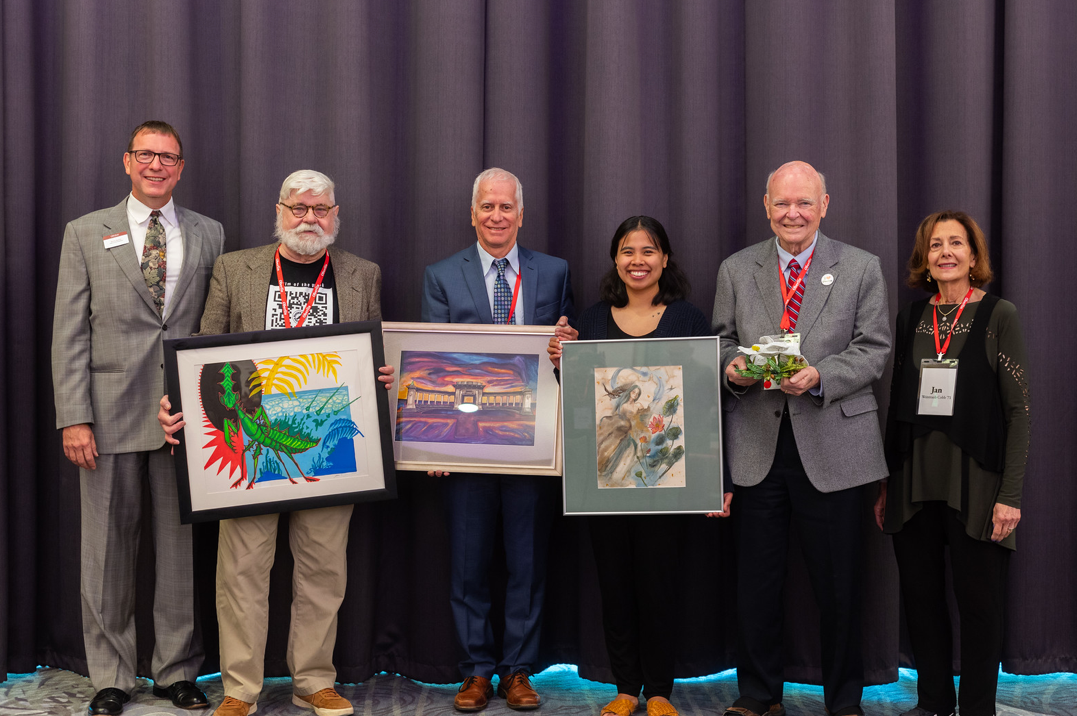
Patty Powell '76 presents 2023 Outstanding Young Alumni Award Honoree Alexandria Cunningham '16 with award
Patty Powell '76 presents 2023 honoree, Alexandria Cunningham '16 with the Outstanding Young Alumni Award.

The Oberlin Alumni Association has established five awards to recognize outstanding contributions and achievements to the College, to society at large, and to the Association: the Alumni Medal, the Distinguished Achievement Award, the Distinguished Service Award, the Outstanding Young Alumni Award and the Alumni Appreciation Award.

The Alumni Medal is awarded by the Alumni Awards Committee in the spring, and presented as part of Oberlin's commencement ceremony in May. 

The Distinguished Achievement Award, Distinguished Service Award, Outstanding Young Alumni Award and Alumni Appreciation Award are bestowed in the summer, and presented in the fall during Reunions at Homecoming Weekend.

Congratulations to this year's recipients!

Read below to learn more about each awardee:

The Alumni Medal is the highest honor that the Alumni Association awards. The Alumni Medalist exemplifies outstanding, sustained or unique service to Oberlin College. The Alumni Medal is presented during the commencement ceremony each spring.


Leah Modigliani '86

Leah Modigliani graduated in 1986 with High Honors in Economics.  When Leah’s daughter followed, she marked the fifth generation in their maternal line to graduate from Oberlin College.

Leah got an MBA from Harvard Business School. While at Morgan Stanley, she co-developed the M2 measure of risk-adjusted return which is now an industry standard included in Certified Financial Analyst materials, journals and textbooks.  She also developed a stock risk-rating system for Morgan Stanley worldwide.  Leah was a Portfolio Strategist, Research Analyst, Portfolio Manager and Executive Director.  Throughout her career, she advised mutual fund managers, hedge funds, pension funds, foundations and endowments on asset allocation, portfolio construction, and investment decisions.    Leah has been featured in media such as The Wall Street Journal, The New York Times, The Economist, Money Magazine, CNN and as a co-host on CNBC.   Leah also worked at the International Finance Corporation of the World Bank, Neuberger Berman, and Bridgewater Associates.

Leah joined the Oberlin Investment Committee of the Board of Trustees (as a non-board member) and served on the committee for 24 years, including 6 years as co-chair.  In her time on the committee, the endowment more than doubled in size to over a billion dollars in assets while funding substantial withdrawals for the college budget every year.  

Having belonged to a Co-Op herself, Leah later served as an official advisor to OSCA student leadership.

With a life-long commitment to social justice, Leah is a pro-bono consultant to numerous non-profits, President of the Board of Youth Communication and Advisor to the Hidden Legacies Project at NYU: Slavery, Race and Contemporary Institutions in the United States.

Leah lives with her family in New York City.

The Distinguished Achievement Award honoree has demonstrated in his/her life outstanding contributions and achievements that reflect Oberlin’s values in a career field.


Logan Fry '66

The life of William Logan “Bill” Fry ’66 after Oberlin is typified by imagination, persistence and resilience.  Upon graduation, he earned his degree from CWRU Law School and worked for the US Department of Justice, The Goodyear Tire & Rubber Company and Goodyear Atomic Corporation.

After leaving Goodyear Atomic, he set up his own law practice.  While he enjoyed the practice, he was intrigued when he learned to weave at a small fiber arts school on Washington Island, Wisconsin.  He bought a loom and began weaving the patterns of microchip design and brain scans.  His weavings have become part of the permanent collections of The Cleveland Museum of Art, Minneapolis Institute of Fine Arts, the Fine Arts Museums of San Francisco, and the Smithsonian American Art Museum.  He also took up painting on silk and wood panels, and making folk sculpture from gnarled logs.  With the help of an art consultant, he managed to sell his work to regional medical centers.

About the same time, he became intrigued with digital art, and created the world’s first art museum on a cellphone. His Internet-based Digital Museum of Modern Art was itself among the first of its kind.

Later, he became a background actor in Spider-Man 3, and continued background acting in nearly three dozen major motion pictures and televisions series.  Twelve years ago, Logan started making his own short films, seen in 80 countries around the world.  Logan now makes films with AI.  In less than a year, nine of his AI films have been selected for screening at film festivals in ten countries, including Spain, Italy, Germany, Georgia, Ukraine, France, Ireland, Great Britain, India and the United States.

It’s not that Logan couldn’t settle, he was just drawn to so many creative endeavors.  He attributes his success to the support of his wife Joanne ’69, and the wide-ranging education he received at Oberlin

The Distinguished Achievement Award honoree has demonstrated in his/her life outstanding contributions and achievements that reflect Oberlin’s values in a career field.


Gregory Stanton '68

Dr. Gregory H. Stanton is the founding president and chairman of Genocide Watch.  From 2010 to 2019, he was a research professor in genocide studies and prevention at the School for Conflict Analysis and Resolution at George Mason University, Arlington, Virginia, USA. From 2003 to 2009, he was the James Farmer Professor in Human Rights at the University of Mary Washington in Fredericksburg, Virginia.

Dr. Stanton founded Genocide Watch in 1999. He was the founder (1981) and director of the Cambodian Genocide Project and is currently the founder (1999) and chair of the Alliance Against Genocide, the world’s first anti-genocide coalition. From 2007-2009, he was the president of the International Association of Genocide Scholars.

Dr. Stanton served in the U.S. State Department (1992-1999) where he drafted the United Nations Security Council resolutions that created the International Criminal Tribunal for Rwanda, the Burundi Commission of Inquiry, and the Central African Arms Flow Commission. He also drafted the U.N. Peacekeeping Operations resolutions that helped bring about an end to the Mozambique civil war.

In 1994, Dr. Stanton won the American Foreign Service Association’s prestigious W. Averell Harriman Award for “extraordinary contributions to the practice of diplomacy exemplifying intellectual courage,” based on his dissent of U.S. policy on the Rwandan genocide. He wrote the State Department options paper on ways to bring the Khmer Rouge to justice in Cambodia.

After leaving the State Department in 1999 to found Genocide Watch, Dr. Stanton was deeply involved in the U.N.-Cambodian government negotiations that brought about the creation of the Khmer Rouge Tribunal, for which he drafted that court's internal rules of procedure.

From 1999 to 2000, Dr. Stanton served as co-chair of the Washington Working Group for the International Criminal Court.  In 2000, he published a proposal to establish an Office for Genocide Prevention at the UN.  With other members of the International Campaign to End Genocide, he met with U.N. officials to lobby for the proposal. In 2004 in Stockholm, U.N. Secretary-General Kofi Annan announced the creation of the Office of the Special Adviser on the Prevention of Genocide.

Before he joined the State Department, Dr. Stanton was a legal advisor to RUKH, the Ukrainian independence movement, where he was named the Ukrainian Congress Committee of America’s 1992 Man of the Year. He was the chair of the American Bar Association Young Lawyer’s Division Committee on Human Rights and a member of the A.B.A.’s Standing Committee on World Order Under Law.

Dr. Stanton comes from the lineage of Elizabeth Cady Stanton, a women’s suffrage activist, and Henry Brewster Stanton, an anti-slavery leader. Actively involved in human rights since the 1960s when he was a voting rights worker in Mississippi, he served as a Peace Corps volunteer in the Ivory Coast and as the Church World Service/CARE Field Director in Cambodia in 1980. He has been a law professor at Washington and Lee, American University, and the University of Swaziland.

Dr. Stanton has degrees from Oberlin College, Harvard Divinity School, Yale Law School, and a Doctorate in Cultural Anthropology from the University of Chicago. He was a fellow at the Woodrow Wilson International Center for Scholars (2001-2002).

The Distinguished Service Award recipient has demonstrated in his/her life service or volunteer activities that reflect Oberlin’s values by directly improving the quality of life for humanity.


Stephen Morris '82

Stephen Morris spent more than 20 years promoting cultural exchange and international collaboration on nature conservation, cultural heritage management, and national parks administration as part of his 37-year career in the US National Park Service.  As director of the Service’s Office of International Affairs, he was the lead technical expert for the US delegation to annual sessions of the World Heritage Committee and oversaw the US World Heritage Program, including the development and successful nomination of numerous US sites, public and private, to the UNESCO World Heritage List.   Under his leadership, the Office of International Affairs conducted the International Volunteers in Parks program which annually hosts more than 100 foreign nationals as volunteers in US national parks.  He developed the Learning from Our Colleagues Abroad initiative to provide opportunities for US national park staff to conduct donor-funded study trips to overseas parks and cultural sites.  The World Heritage Fellows program, also developed under his direction, used donor funds to facilitate more than two dozen managers from World Heritage sites in developing countries to interact with US counterparts on extended residencies at US sites.  In 2024, Stephen received the “Advancing International Friendship and Understanding Award” from the US National Committee of the International Council on Monuments and Sites.

As the child of foreign service parents and having lived on 3 continents before arriving at Oberlin from the Dominican Republic in 1978, Stephen early on recognized the value of exposure to other cultures and foreign perspectives.  He pursued a career in public service and after receiving a master’s degree in Urban and Regional Planning from George Washington University in 1987 joined the staff of the National Register of Historic Places at the Park Service.  He had various roles in the Service before joining the international affairs office, including serving as a program leader in the Service’s community assistance outreach arm and as a superintendent of a Civil War battlefield park.

He has spent more than 30 years restoring an 1877 Victorian rowhouse on Capitol Hill with his partner and has been actively involved in the Capitol Hill community.  Having logged many miles of international travel during his career, he continues to be an avid traveler to destinations around the world.

The Outstanding Young Alumni Award recipient must be 40 years of age or younger at the time of consideration and have distinguished himself or herself in one or more of the following areas: professional career, service to humanity, and service to Oberlin College.


Joelle Santiago '14

Joelle Santiago ’14 (they/she/siya) is an activist based out of unceded and occupied Lenapehoking land, also referred to as Philadelphia, Pennsylvania. They spent the past decade as a people’s attorney, representing individuals and families in detention and deportation proceedings and organizing lawyers and legal workers across the country in support of progressive movements. Joelle also teaches Filipino language, culture, and dance to young people in both community spaces and academia. 

While at Oberlin College, Joelle majored in Comparative American Studies and Environmental Studies; minored in Gender, Sexuality, and Feminist Studies; and concentrated in Peace and Conflict Studies. While on campus, they served as a student-leader with the Third World Coop, Oberlin-Grafton Educational Exchange Program, Asian American Alliance, Filipinx American Students Association, Multicultural Resource Center, Edmonia Lewis Center for Women and Trans People, Bonner Center for Service and Learning, Oberlin College Dialogue Center, Resource Conservation Team, and more. They also served on the staff of literary magazines, In Solidarity and As I Am, performed with And What!? and in Colors of Rhythm, and had a show on WOBC.

After graduating, they received their J.D. from CUNY School of Law in 2017 and received a dual degree Masters of Social Work and Master of Science in Nonprofit Leadership from the University of Pennsylvania in 2024 as a Social Justice Scholar. 

Joelle is blessed with an ever-patient spouse, three young children (four years old and under!), two rambunctious dogs, an insatiable love for the ocean and justice, and an unwavering, deep belief that another world is possible! End occupation everywhere!

The Alumni Appreciation Award honoree has performed a unique service or made a unique contribution to the Oberlin College Alumni Association.


Michael Meltsner '57

Bio of Professor Michael Meltsner Matthews University Professor of Law and former Dean at Northeastern Univ. School of Law. 

History major, political columnist for the Review graduating in 1957. Favorite OC Professor: “the great Robert Tufts”. Named Griswold Scholar to Harvard Law but attended Yale Law along with close friends Stan Fisher (OC 1957) and Harry Subin (OC 1957)

Hired by Thurgood Marshall (1961); named first assistant counsel to the NAACP Legal Defense Fund (LDF) in the 1960s, where he handled major civil rights cases. (He is also a licensed marriage and family therapist). Among his clients were Mohammad Ali, numerous death row inmates, and North Carolina doctors and dentists who ended Southern hospital segregation. Youngest lawyer to argue (and win) a capital case before the United States Supreme Court. In 2012, awarded an honorary doctorate by John Jay College (CUNY) and described as the "principal architect of the death penalty abolition movement" in the United States.

He co-founded the clinical program at Columbia Law and directed the first-year lawyering program at Harvard Law 2000-05. His latest book is a Movement era novel, Mosaic: Who Paid for the Bullet?.  Among other writings a memoir, The Making of a Civil Rights Lawyer, Cruel and Unusual: The Supreme Court and Capital Punishment and Short Takes, a novel. His 2011 play about Guantanamo, “In Our Name: A Play of the Torture Years,” has been performed in New York and Boston to great acclaim.

Professor Meltsner was awarded a Guggenheim Fellowship in 1977. He has served as a consultant to the US Department of Justice, the Ford Foundation and the Legal Action Center and lectured in Canada, Egypt, Germany, India, the Netherlands and South Africa. In 2000, he was named a fellow of the American Academy in Berlin. In 2010, he received the Hugo Bedau Award for excellence in death penalty scholarship. He had donated his papers to the Oberlin College Archives. He is married to Heli (Spiegel) Meltsner, has two daughters Jessica (OC 85) married to Brian Britt (86) and Molly and four grandchildren.


The Oberlin College Archives holds a collection of papers of Michael Meltsner that document his career as an author, a civil rights lawyer, and law school professor. The collection includes materials such as writings, talks, teaching materials, files related to his legal career, and awards and honors. The finding guide of the collection is found on the Oberlin College Archives’ website at https://oberlin.libraryhost.com/repositories/2/resources/19.

Nominations

Do you know exceptional Obies who are dedicated to serving Oberlin College and Conservatory? Nominate them for an alumni award by submitting an Awards Nomination Form.

More information on each award can be found below:

Alumni Awards Criteria