
Student Project Profile
Major and trace element zoning in garnets from Santa Catalina Island
Project Title
Major and trace element zoning in garnets from garnet amphibolites from Santa Catalina Island to search for evidence of multiple episodes of subduction and evidence of partial melting
Faculty Mentor(s)
Project Description
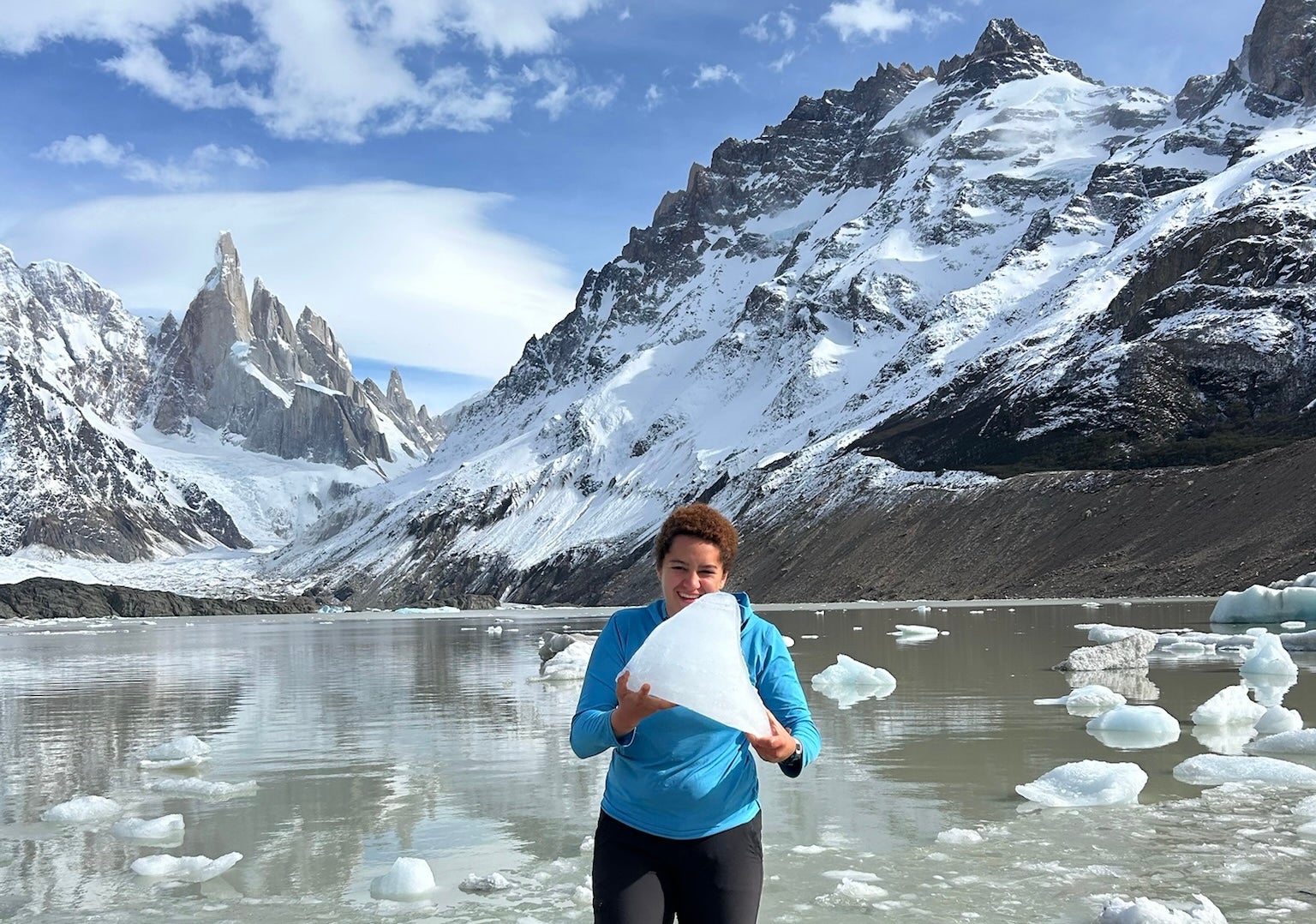
Grace Gordon '27 conducting field research.
Subduction zones occur when two tectonic plates collide and one plate overrides the other. Little is known about the conditions of the subducting slab at extreme depths because it is too deep and difficult to make direct measurements. However, it is important to understand the dynamics of subduction at depth because that is where the most destructive earthquakes occur. To better understand conditions in subduction zones we study the rocks and minerals that were metamorphosed at depth but have since been brought to the surface. Garnets in these rocks are excellent recorders of this history because as they grow and form they trap trace elements released by fluids, melts, or mineral reactions. In order to better understand these processes we employed major and trace element mapping of three different families of garnet from the Catalina Schist. The rocks were exhumed as blocks in a melange, and reaction rims or rinds, formed as they were exhumed from an ancient subduction zone 115 million years ago at the Pacific margin. Major element maps from samples show anhedral crystal shapes and diffusion of Mn consistent with resorption during cooling. Trace element maps reveal high core concentration of HREEs and multiple annuli suggestive of mineral reaction and/or partial melting events.
Why is your research important?
My research adds to the greater understanding of subduction zone and melanges as well as an integrated study of trace elements in garnet amphibolites
What does the process of doing your research look like?
My current research process is synthesizing the culmination of data that has been collected by the Oberlin Metamorphic Group (OMG) lab. Asking questions about what the sum of information tells us and finally collecting more data to answer the questions left unanswered.
What knowledge has your research contributed to your field?
Preliminary application in my research shows Heavy Rare Earth Elements (HREEs) as annuli within garnet growth characteristic of pulses of multiple metamorphic events. Light Rare Earth Elements (LREEs) show a titinite out reaction with increasing growth to favoring higher concentrations of vanadium and Sphene closer to the rim of the garnets.
In what ways have you showcased your research thus far?
I have showcased this research at the Oberlin Summer Research Symposium and will be showcasing this project at the Geological Society of America national meeting in October. I have also showcased previous research projects at the Oberlin Research Symposium and abroad.
How did you get involved in research? What drove you to seek out research experiences in college?
I was motivated to pursue research in college because it allowed me to see the current scientific applications of the theories and practices I learn in class. This has given me the opportunity to see what a career in research would involve before committing myself to a specific field of research within my field.
What is your favorite aspect of the research process?
My favorite aspect of the research process is field research. I love being able to go into the field and seeing the formations and concepts I learn about in class.
How has working with your mentor impacted the development of your research project? How has it impacted you as a researcher?
Working with my mentor has taught me the importance of knowing when to be independent in the research process and when it is time to ask questions.
How has the research you’ve conducted contributed to your professional or academic development?
My research has contributed to my academic development by forcing me to understand why the process we take for granted every day works and is the way they are. Research has forced me to recon with the amount of previous research that has had to happen for all fields of science to exist.
What advice would you give to a younger student wanting to get involved in research in your field?
Younger students wanting to get involved in geoscience research should reach out to the professor whose research they find most interesting. Once you have your foot into the lab door it is that much easier to learn what parts of research excite you the most and even see what the other labs in the department are up to.
Students
Grace Gordon ’27
- Major(s):
- Geosciences, Environmental Sciences