
Student Project Profile
Interview-based study of residential solar adoption in Oberlin
Project Title
Interview-based study of residential solar adoption in Oberlin
Faculty Mentor(s)
Project Description
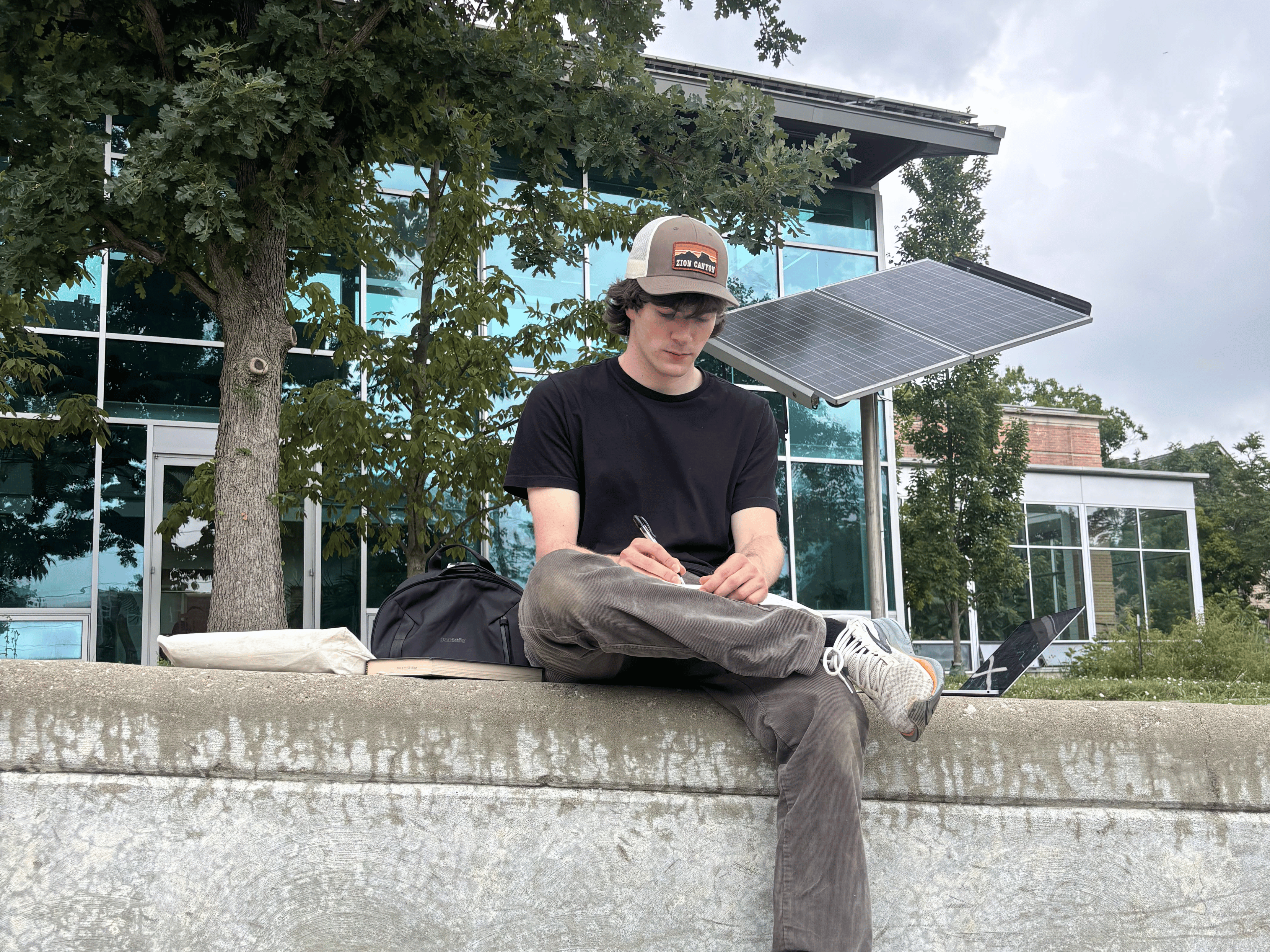
Noah reviewing notes in front of a solar panel.
This summer, I investigated the factors affecting rooftop solar adoption behavior within the City of Oberlin. During the first month of OSRI (Oberlin Summer Research Institute), I interviewed over 40 local homeowners using a questionnaire I designed. Homeowners were asked to identify motivations and barriers that affected their decision-making process in purchasing solar. By ensuring an equal split in solar ownership among respondents (50% had made the purchase; 50% had not), I was able to gather a more diverse range of opinions. For the second month of OSRI, I’m analyzing trends between respondents to better understand which predictors (age, political affiliation, financial stress) may significantly impact people’s decisions to purchase solar. My identification of common concerns between Oberlin residents creates the opportunity for further research and future local policy goals. I plan to use this research as a framework for directing larger projects here at Oberlin.
Why is your research important?
Between 2020 and 2025, OMLPS reported that Oberlin’s residential solar capacity had increased by 131%. This increase is remarkable, and a proper analysis of how it occurred would greatly benefit policy going forward. While the City of Oberlin and the OC EVSS department has arranged several community events to discuss climate action goals and electrification concerns over recent years, there hasn’t (to my knowledge) been a study where students collect the opinions of people at their doorstep. This approach guarantees a broader range of backgrounds and opinions among respondents, providing a further understanding of environmental goals and concerns held by Oberlin residents.
What does the process of doing your research look like?
During the first month of OSRI, I interviewed over 40 people by biking door-to-door throughout the streets of Oberlin. I talked to people of all ages, political affiliations, and financial situations to gather a holistic view of community perceptions on rooftop electricity generation. For every interview I conducted, I was turned away 3 more times by those who didn’t have the time, weren’t interested in the study, or didn’t believe their opinions were valuable to my project. Longer streaks of rejections could be discouraging at times, but I’m proud of myself for the perseverance I showed throughout the data collection phase. The second phase of my research involves much more desk work, using a mix of google sheets, R, and docs as I assemble a final report on the findings of my study.
What knowledge has your research contributed to your field?
While there is a substantial literature on green adoption patterns and behaviors among Environmental Studies scholars and academics, there are few studies that constrain their analyses to a hyper-local scale, such as the City of Oberlin. Several of these studies remark that consumer behavior is largely influenced by social factors, yet the population scales at which their surveys collect data from are often too large to navigate the subtle differences in social norms among respondents’ communities. As a student of Oberlin (and a temporary resident 8-11 months of the year), I hope to use previous studies’ survey frameworks, applying a fuller understanding of social norms to personalize this work to the community of Oberlin. This may elicit different findings among behavioral predictors than previous studies have offered.
In what ways have you showcased your research thus far?
Throughout my data collection, I had the chance to meet and discuss my research with EVSS faculty not directly involved in my work. I’ve also discussed my findings with the City of Oberlin sustainability coordinator, Linda Arbogast. On 7/6, I presented my research for the final session of OSRI’s lightning talk series.
How did you get involved in research? What drove you to seek out research experiences in college?
I’ve been very interested in pursuing a longer-form project at Oberlin for a while now. My OSRI project came from a desire of mine to carve out a niche for myself within the field of Environmental Studies, and deeply immerse myself in it throughout the 8 week program. As this work comes to its conclusion, I know that I’ve made this personal achievement for myself, and I feel better equipped for tackling projects and college research going forward.
What is your favorite aspect of the research process?
My favorite aspect of the research process is the first step; defining my project, my questions, and determining how I wish to tackle it. I think that this is the phase of research that requires the most creative thinking on the part of the researcher. It requires them to think deeply about not only what they’re interested in, but also about what they find fulfilling, as this project will take up a significant amount of their time and brainspace. I think that this can provide an important moment of self-reflection on the part of the researcher, as it helps them better define their personal goals and beliefs.
How has working with your mentor impacted the development of your research project? How has it impacted you as a researcher?
It has been extremely beneficial to conduct my research under the guidance of my professor and advisor, Paul Brehm. Our weekly meetings provide me with useful research deadlines, as well as constructive feedback and thoughtful goal-setting. As a first-time researcher, it has also been completely necessary for me to have someone with more experience in the field. I now feel much more comfortable with the idea of future research, following the advice and guidance offered to me by Professor Brehm.
How has the research you’ve conducted contributed to your professional or academic development?
OSRI has helped to provide me with new goals and project outlines for my next two years at Oberlin. This type of research, which is largely driven by community outreach, has given me a much deeper understanding and appreciation for the City of Oberlin. This appreciation has naturally manifested into a want to use my research for the benefit of the Oberlin community going forward, and has provided me with new ideas and tools on how to best do so. In terms of professional development, I now feel very comfortable with the prospect of community work being a major piece of my post-grad career.
What advice would you give to a younger student wanting to get involved in research in your field?
Understand that you’re probably going to mess things up when doing research for the first time, especially if you’re doing it independently. Learning how to manage your time, productivity, and the research process itself requires navigating a lot of things at once. As first-time researchers, it’s easy to feel overwhelmed, and to compare your work to the experts in the field that you’re reading from in your literature review. However, if you make mistakes, and you can identify how you could’ve managed your research better, that is valuable growth. That growth will surely aid you going forward, whether you wish to keep doing research or not.
Students
Noah Lyford ’28
- Major(s):
- Environmental Studies, Economics