Oberlin Alumni Magazine
Eclipse Energizes Oberlin Community
The scene at Oberlin during the 1994 annular eclipse.
March 28, 2024
Cynthia Nickoloff '88
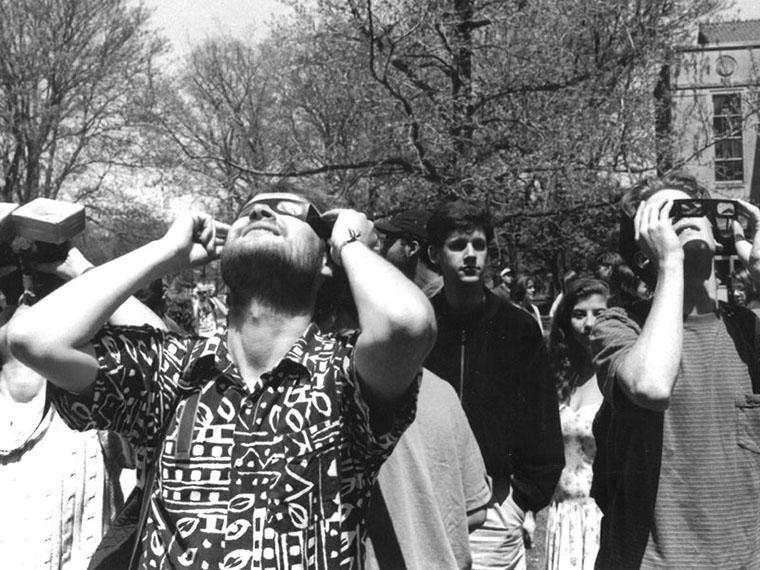
On May 10, 1994, Oberlin was one of the best places in the world to view an annular eclipse, as seen in this archival campus photo.
Photo credit: Rick Sherlock, Courtesy of the Oberlin College Archives
There is precedent to the excitement buzzing around Oberlin during the April 8, 2024, total solar eclipse. On May 10, 1994, Oberlin was one of the best places in the world to view an annular eclipse—as detailed in this Summer 1994 Oberlin Alumni Magazine story.
Oberlinians are used to their town being described by the adjective best: its liberal arts college is one of the best, its conservatory is one of the best, and—for a few brief moments—it was one of the best places in the world to view the annular eclipse of May 10, 1994.
Oberlin was a prime location in the “very narrow geographic band” that felt the full effect of the moon crossing the sun’s light path, says Professor of Physics Joe Snider. Most people saw only a partial eclipse—a small arc cut out of the sun—or nothing at all unusual.
While several solar eclipses occur each year, the chances of the full effects being visible in a specific location are about one in every 400 years, Associate Professor of Physics Dan Stinebring told the Oberlin Review.
This year Oberlinians got lucky. Even though the Co-op Bookstore and Gibson’s Bakery had stocked a large quantity of solar shields, there wasn’t a pair to be found within the city limits the morning of May 10, thanks to a media hoopla in the preceding days that also succeeded in drawing what seemed like every Oberlin citizen outdoors that afternoon.
About noon crowds armed with solar shields, colanders, tinfoil poked with pinholes, and white poster board began forming all over town—Tappan Square, downtown, Wilder Bowl, conservatory courtyard.
The biggest crowd gathered near Wright Laboratory of Physics, where the College’s solar telescope and a mirror mounted on an outside wall projected the eclipse’s image onto a screen set up in an inside stairwell. The image was also projected onto an outside wall of Severance Hall.
The festive crowds became more excitable as, at about 12:45 p.m., the moon started to become visible, slowly eating away at the sun. About a half hour later the crowds let loose with spontaneous applause, cheers, and song; the moon, appearing smaller than the sun, had moved dead center.
The temperature had dropped seven degrees, streetlights had come on, and what daylight was left emanated from a brilliant rim of light—the annulus—radiating from around the moon. The crowds continued to mill about outdoors as the moon continued its past eastward; a few die-hards stayed put until it had completely cleared the sun’s path.
Commenting on the difference between an annular and a total eclipse, physics professor Snider, who has traveled across North America to witness four of the total types, remarked that, while spectacular, annulars don’t have the same spiritual effect as totals.
He may be right, but Oberlin’s eclipse had a noticeable effect on the local population, creating a sense of camaraderie and lightheartedness that led several observers to remark “I wish we could have one of these every day!”
While that’s impossible (remember those odds) some Oberlinians will have a first-hand chance to discover if any difference exists—a total solar eclipse will pass right over Cleveland on April 8, 2024. Mark your calendars.
This story originally appeared in the Summer 1994 issue of the Oberlin Alumni Magazine.
You may also like…
An Obie Legacy Takes Flight
It’s a story as old as time: The strong woman, often a wife, plays a critical but largely unrecognized role behind a famous man. But in the case of Katharine Wright Class of 1898, it’s the strong...
Wright On, Sister
Would the Wright brothers have invented their airplane without the support of their sister, Katharine Wright Class of 1898? Probably. But they might not have been the first.