Oberlin Alumni Magazine
An Obie Legacy Takes Flight
More than 150 years after her birth, Oberlin graduate Katharine Wright is being celebrated through books, podcasts, and even an opera.
August 17, 2026
Helen Paxton ’73
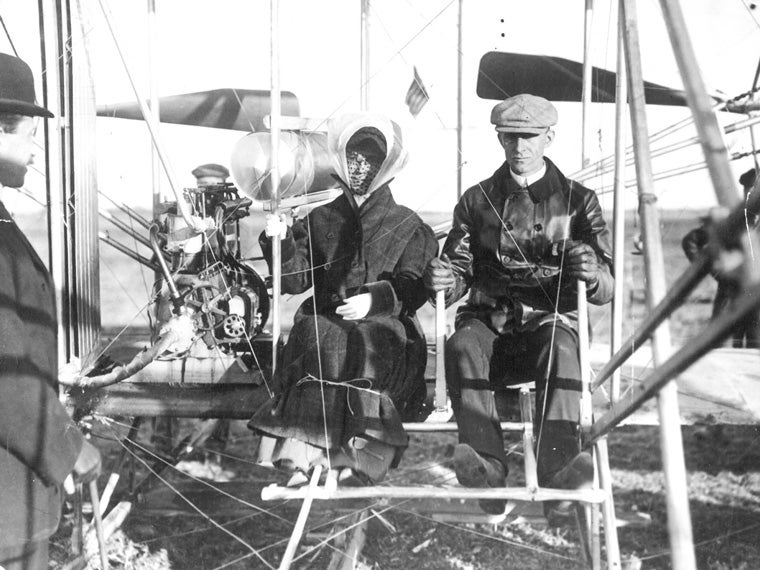
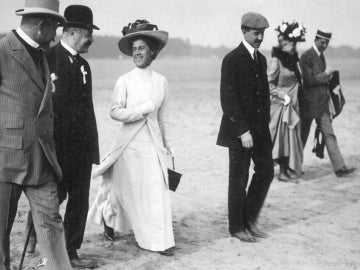
Katharine Wright Class of 1898 is the subject of ongoing literary fascination.
Photo credit: Courtesy of the Wright State University for the Oberlin Alumni Magazine
It’s a story as old as time: The strong woman, often a wife, plays a critical but largely unrecognized role behind a famous man. But in the case of Katharine Wright Class of 1898, it’s the strong sister behind her two famous older brothers, Wilbur and Orville Wright, who launched the world’s first successful powered flight in 1903.
For many years, Katharine Wright was a footnote in the biography of her siblings, save for a few notable exceptions. Doug McGinnis ’70’s Winter 2003-2004 Oberlin Alumni Magazine article “Wright On, Sister” gave us a good look at Katharine’s life and her Oberlin connections. This article followed Richard Maurer’s excellent 2003 biography of Katharine Wright, The Wright Sister, which was the first to give us a detailed look at her extraordinary life.
But in recent years, Katharine has received extensive recognition for her own life and achievements via historical novels, podcasts, and even an opera. Why now? Aside from rapidly expanding interest in women’s history, there is the enticement of writing about an intriguing family history, complete with a near Shakespearean-level tragedy among the siblings. And then there was the 150th anniversary of Katharine's birth in 2024, with attendant celebrations at the Dayton Aviation Heritage Historical Park and at Wright State University.
Here are five of the most compelling works within this resurgence of interest—all of which underscore that Katharine is surely among the most remarkable Oberlin graduates.
Tracey Enerson Wood, Katharine, the Wright Sister (2024), book
Told in alternating chapters in the voices of Wilbur, Orville, and Katharine, it might be the best place among recent media to begin knowing Katharine in the context of the Wright family history.
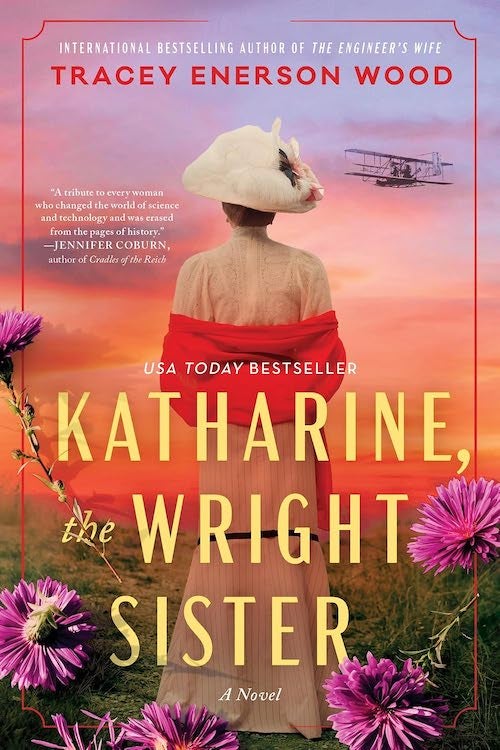
The novel introduces us to Wilbur and Orville as high school dropout entrepreneurs tinkering in their bicycle shop on Dayton’s West Third Street. As we travel from their early fascination with bird flight, to the experiments in the shop’s backroom, to their excursions to the windy dunes of Kitty Hawk, North Carolina, Katharine plays a starring role. She’s no mathematical or engineering expert, but she has the ability to see the “big picture” in the challenges of manned, powered flight, while her brothers are absorbed, perhaps even obsessed, with scientific research and complex calculations. Equipped with the social skills and graces that her brothers lack, Katharine becomes a key element in their success as she establishes and nurtures important connections with people and institutions.
Her influence culminates in a 1909 trip to France. While her brothers fly their planes over the heads of excited onlookers, Katharine perfects her French, a key to winning the admiration and respect that will cement the Wrights’ celebrity abroad, and finally at home. ”The American Girl Whom All Europe is Watching” in an April 1909 edition of World Magazine acknowledged Katharine’s increasingly important role.
In an interview, Enerson Wood insisted that without Katharine’s contributions, the Wright brothers likely would not have been the first to achieve manned powered flights—a first that established the superiority of U.S. air power and its ability to spy on the Germans, which affected the whole trajectory of World War I.
Enerson Wood’s book also draws us into the psychological morass of Katharine’s relationship with her brother Orville in the years following Wilbur’s death at age 45. This heartbreaking story, the author admits, is what drew her to writing the novel.
Harry Haskell, Maiden Flight (2016), book
In her 50s, Katharine succumbed to the charms of her lifelong friend, widower Harry Haskell Class of 1896, editor of the Kansas City Star. But she only consented to marry Haskell after many anguished months, as she worried about leaving Orville; the siblings had a close relationship and lived together in the Dayton-area mansion Hawthorne Hill.
The result? Orville refused to attend the wedding and cut her out of his life. After much pleading by family members, he only visited Katharine as she lay dying of pneumonia a few years later at the Haskell home in Kansas City. Having formed a seemingly unbreakable bond as three younger siblings, the double tragedy of Wilbur’s early death followed by Orville’s rejection of her meant that Katharine's few years of a happy marriage were deeply colored by sadness and some regret.
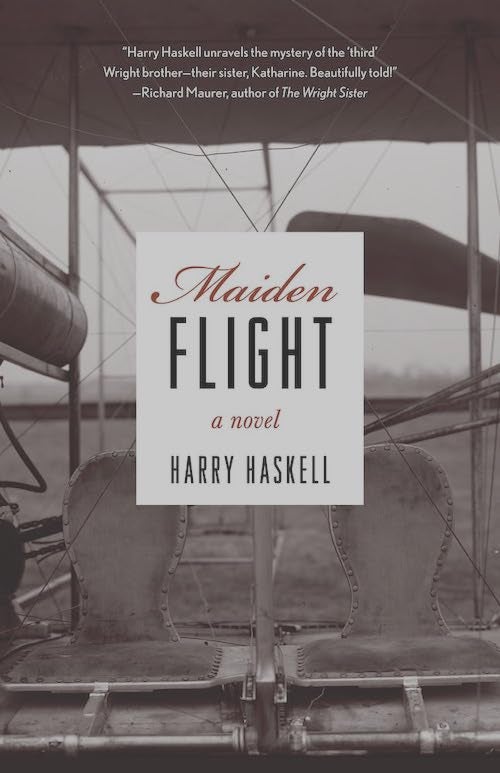
This fascinating story might best be told by Haskell’s grandson and namesake Harry Haskell, in his 2016 novel Maiden Flight.
“My book is not a novel, although my publisher insisted on marketing it as such,” Haskell says. This work of “creative nonfiction,” as Haskell describes it, is built on extensive primary source material. The first step was for him to dip into a rich family resource: more than 2000 letters from Katharine to his grandfather, kept in the Haskell household for decades. This was followed by research in the archives at Wright State University, the Library of Congress, and Oberlin.
“Our very own Muse of Aviation” (as Orville Wright called her) is revealed in this entertaining book centered on a woman who Haskell maintains is “...as remarkable as her brothers.” Told in alternating first person reminiscences, the book depicts Katharine as she muses on the halcyon days with her brothers in Europe, and concludes with moving fictionalized epilogues from Orville and Harry following her untimely death at age 54. The author excels in revealing the complex personalities and relationships of these brilliant Midwesterners who changed history.
Oberlinians will be pleased to learn that Katharine, the second female trustee of Oberlin College, “reveled,” according to Haskell, “in locking horns with her male colleagues and the college administration, making her influence felt in such areas as faculty appointments, gender discrimination, and building plans.”
Laura Kaminsky ’78, Finding Wright, opera (2023)
Might the Wrights’ intense family drama work on the opera stage? Librettist Andrea Fellows Fineberg and Dayton Opera general director Kathleen Clawson thought so, and sought out composer Laura Kaminsky ’78 for an opera to jointly celebrate women’s history and one of the city’s most notable citizens. Although Kaminsky had not previously known about the Wright sister, she says she was quickly taken by Katharine’s “intelligence, strategic mind, grit, and fearlessness.” Premiered in 2023 to positive reviews and audience response, Finding Wright weaves together Katharine’s story with that of a contemporary woman, aerospace engineer Charlotte Tyler.
Lucy Powell, Shakespeare’s Sisters, “Katharine Wright” (2023), podcast episode
Katharine is featured in an episode of the BBC-produced podcast Shakespeare’s Sisters, which celebrates five under-appreciated women in history. In 14 engaging minutes, podcaster/writer Lucy Powell illustrates Katharine’s role in the family and how she “was completely integral to her brothers’ success.” Powell describes a typical day during her time in France, beginning with two hours of French study, followed by business dealings over lunch, and an afternoon going out “to the flying field to handle the press and charm Europe’s glitterati, the prospect of which put both of her brothers into a white terror.” In France, the fearless 35-year-old Katharine becomes the third woman to fly in an airplane; later, back in the U.S., she vigorously promotes women’s suffrage and women’s rights.
Harry Haskell, In Her Own Wright (2022), podcast series
In a series of three podcasts produced in 2022 by Haskell and George Drake, Jr. we hear the (imaginary) voices of Katharine, Harry and Wilbur, interspersed with commentary by scholars and others familiar with Katharine’s life.
You may also like…
Jane Wickline ’21 Finds Community in Comedy
A Q&A with the Saturday Night Live cast member and Dukes cofounder

When Stars Align
The Oberlin Contemporary Music Ensemble shines on Jennifer Koh ’97’s "The American Concerto, Volume One."

Wright On, Sister
Would the Wright brothers have invented their airplane without the support of their sister, Katharine Wright Class of 1898? Probably. But they might not have been the first.