Wright On, Sister
August 17, 2026
Doug McInnis '70
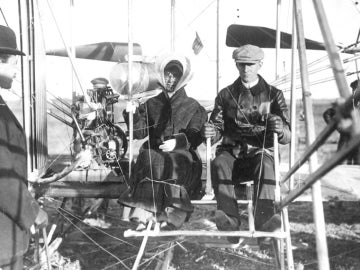
Header photo: Katharine Wright Class of 1898 was as much of a trailblazer as her more famous brothers. Courtesy of the Wright State University for the Oberlin Alumni Magazine.
In honor of Katharine Wright's birthday, August 19, 1874, we are reprinting "Wright On, Sister," the cover story of the Winter 2003-2004 Oberlin Alumni Magazine.
Father,
The Flying Machine is in process now. Will spins the sewing machine around by the hour while Orv squats around, marking the places to sew. There is no place in the house to live, but I'll be lonesome enough by this time next week and wish I could have some of this racket around.
Katharine
1901
Such was the tender lament of 24-year-old Katharine Wright, whose then little-known brothers were planning a 1901 trip to Kitty Hawk, North Carolina, for a test launch of their newest glider. As in the past, Katharine would stay behind in their Dayton, Ohio, home, teaching Latin classes at Steele High School and helping to pay the household bills.
Although Katharine had no role in inventing the airplane, she was the stalwart of the Wright trio—the emotional and organizational glue that held together the reticent bachelor brothers in the years leading up to their historic first flight in 1903—and afterward, when fame threatened to overwhelm them.
In this centennial year of her brothers' achievement, Katharine is emerging as an important figure in her own right; at Oberlin, certainly, she is among the College's most unsung heroines. She graduated from Oberlin in 1898 and later served as an Oberlin trustee—the second woman ever elected to the Board. She worked passionately on several committees, including that which nominated College President Ernest Wilkins, and, upon her early death, was remembered by Oberlin for her zest, intelligence, humility, and humor.
The youngest of five Wright children, Katharine came of age as two movements were reshaping America: the suffragette movement, which in 1920 won the constitutional amendment giving women the right to vote, and the rise of America as an industrial power, aided by its emerging dominance in steel, automobiles, and, of course, aviation. Katharine would play roles in both. She was smart, persistent, engaging, and, when needed, hard-nosed.
Colleagues and friends, for the most part, witnessed her charming side, but she wasn't one to mince words when angered. During her tenure as an Oberlin trustee in the 1920s, she referred to one College dean as "cold as ice and calculating as an adding machine." Other targets of irritation included her unruly high-school Latin students, and, of course, her brothers. When she relayed to Orville how she had gotten the boys in her Latin class into line, he quipped, "I'm glad to see someone else catching it besides us."
Members of the Wright family pursued their passions obsessively. Katharine's father, Bishop Milton Wright, precipitated a split in the Church of the United Brethren rather than back down on a moral issue that had divided his congregation. Her brothers—despite their lack of money and college education—relished intellectual challenge and emerged as the improbable winners in the race to be first to fly.
Katharine herself embraced the suffrage movement—she was a key organizer of the 1914 suffrage parade in Dayton in which her father and Orville both marched—and she often shunned everything else. "Orv used to say that women's suffrage was like Rome, in one respect. All roads led to it with me," she acknowledged in a 1924 letter to a friend. "No matter how or where the conversation started, I always managed to switch it onto the women's suffrage track. It wasn't quite as bad as that, but I was very much in earnest about it. Now that it's settled, I look around for other worlds to conquer."
Orv used to say that women's suffrage was like Rome, in one respect. All roads led to it with me. No matter how or where the conversation started, I always managed to switch it onto the women's suffrage track.
Katharine Wright, in a 1924 letter to a friend
Katharine also fought the broader battle of the sexes, as she'd had first-hand experience with discrimination. When funds ran short in the Dayton schools, the district solved the problem by cutting the pay of women faculty. She served as president of the local Young Women's League and was a founding member of the still-existing Dayton Women's Club, a social and networking organization for new college graduates. As an Oberlin trustee, she argued that women should be awarded honorary degrees and that female employees should be paid as much as men.
Letters she wrote in the mid-1920s to her future husband, Henry "Harry" Haskell Class of 1896, gave vent to her frustration. "I get so het up over living forever in a man's world, with so much discussion about what kind of women men like and so little concern over what kind of men women like. If you ask me, there was no reason, and never has been, why women should sit around and wait for men to turn up. I've always lived with men and don't look on them as such a wonderful ‘treat!' But you know perfectly well how the world has always been managed by men to promote that very idea."
Katharine was just as blunt on other matters, as excerpts from her correspondence illustrate. "I am reading Sinclair Lewis' new book (Elmer Gantry) today," she wrote to a friend in 1927. "He had one sent to Harry. I told Harry I wouldn't spend $2.50 on it, and what's more, wouldn't let him spend any money for such trash as it is."
But her vexation with men stopped when it came to her brothers; for them, she would sacrifice anything. In 1896, prior to her junior year at Oberlin, Orville fell ill with typhoid fever, the disease that would kill Wilbur 19 years later. In what became a familiar pattern—and a test of her competing devotions to career and family—Katharine put her brother ahead of herself, foregoing fall classes to nurse him to health. In 1908, when Orville's plane crashed at a U.S. Army flying exhibition and he was nearly killed, Katharine took emergency leave from her teaching position and spent six weeks at his hospital bedside in Washington, D.C. Orville's passenger, Army Lt. Thomas Selfridge, had perished—the first to die in a flying accident. Katharine was the only sibling of the three with a steady income to pay their collective living expenses. "School can go and my salary, too," she wrote to Wilbur. "Little brother shall not be neglected as long as I am able to crawl around."W
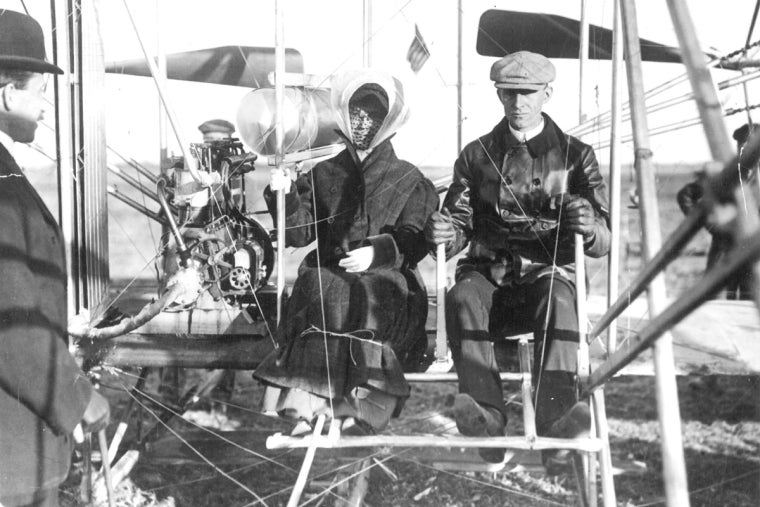
The Wright brothers were part of the highly competitive race to create a machine that could fly under its own power. What they lacked in money, they made up for in ingenuity—their airplane, by and large, was built of bits and pieces machined in their popular Dayton bicycle shop. They read widely in the sciences, and their inventions were legendary: a wind tunnel that measured the performance of various wing shapes to determine which produced the greatest lift; a wing warping method that controlled an aircraft's maneuvers in the air; and a system of carefully designed wings and a propeller that lifted a machine off the ground and kept it airborne.
In the race to be the first, the Wrights trounced such heavily financed competitors as the Smithsonian Institution's Samuel Langley, whose aircraft ripped apart in mid-air and plunged into the Potomac River in December 1903. Nine days later—December 17—it was the Wright brothers who made history with four flawless flights at Kitty Hawk. But the feat was largely ignored, even in their hometown press.
Katharine continued to teach while Orville and Wilbur returned home to work out the kinks in their airplane. There were many. In the cold heavy air of Kitty Hawk, and with the aid of an ocean headwind, the plane could fly, but not in the higher elevation of Ohio, with its lighter air and light winds.
Slowly, they resolved the problems. The world, meanwhile, forgot about the Wrights, believing still that powered flight was impossible. Katharine discovered as much upon inviting her students and fellow teachers to watch a flight one afternoon. No one showed up. "Scarcely anyone believed in [the airplane] until he actually saw it with his own eyes," Orville remarked.
The Wind Beneath Their Wings?
The role of Katharine Wright in the invention of the airplane has been debated for a century. Early news accounts credited her for helping to finance the invention from her small teacher's salary and for aiding her brothers in mathematical computations involved in flight. Other accounts claimed she spent her evenings sewing wing covers for the early gliders.
Historians tend to dismiss these claims and instead portray her as cheerleader and source of emotional support. The truth may lie somewhere in between.
The Wrights didn't discuss money publicly, but several facts emerged from their correspondence and working papers. The airplane was built for just under $1,000—less than $20,000 in modern currency—and during its construction, the brothers ignored their profitable bicycle business for months at a time, causing business to suffer. "There are limits to the neglect a business can endure," Wilbur remarked in late 1901.
Because the airplane was made cheaply, the brothers may not have needed their sister's money to finance it. But her teacher's salary did likely prop up the household budget, which freed Wilbur and Orville from the need to make more money and speeded their invention of the airplane. Time was crucial in the race to be first.
Katharine evolved from cheerleader to strategist in the pivotal summer of 1901, when technical problems with the plane seemed insurmountable. Wilbur was offered an invitation to speak at a Chicago conference of the prestigious Western Society of Engineers. A shy man who suffered from a near mortal fear of public speaking, he'd planned to refuse. But Katharine, recognizing the importance of the gathering, was unrelenting in her insistence that he go. Wilbur finally gave in.
His decision (fueled by Katharine's resolve) proved to be a turning point. In preparing for Chicago, Wilbur was forced to review every scrap of the brothers' research, which led to a sudden realization. Only three problems stood between man and powered flight, and he and Orville had solved two of them—wing design and an engine. The last hurdle was how to control the aircraft in flight.
"When this one feature has been worked out, the age of flying machines will have arrived," he said in his speech. Newly energized, the brothers went back to work and crafted the first functional steering system. Twenty-seven months later, Wilbur was airborne at Kitty Hawk.
Not until the Wrights began a series of flying exhibitions did the public take notice, pulling Katharine gradually into the world of aviation. She began handling her brothers' growing volume of business correspondence and paid the bills when household cash was short. Always poised and gregarious, she guided the men through a maze of fame that rippled, swelled, and then threatened to overwhelm.
An urgent letter from Wilbur to his father in 1907 hinted at what was to come. Wilbur needed an immediate American Express money order to pay for two new suits. "I cannot hobnob with the Emperor when I get to Berlin without some clothes," he wrote.
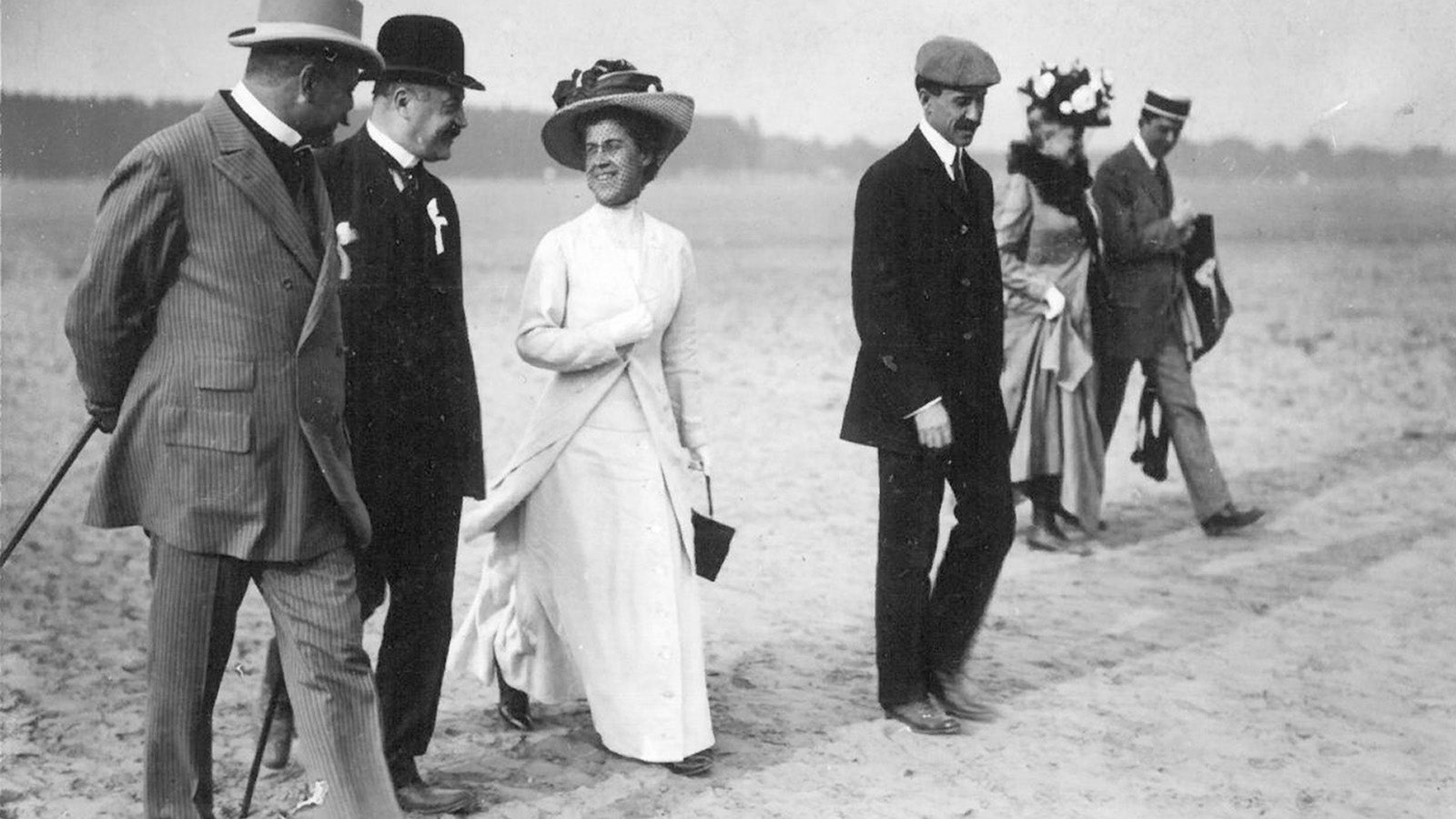
By 1909, the Wrights were the celebrated figures of their era; the world wanted a piece of them as they prepared for a grand tour of Europe. But the brothers, tongue-tied as ever, were ill-equipped to mingle with the European elite. "They're not the kind of guys you would want to invite to dinner," says biographer Richard Maurer, author of The Wright Sister—Katharine Wright and Her Famous Brothers. "You could picture them coming over for dinner and not saying a word."
So the brothers asked Katharine to be their social secretary during their European encounters with the rich and royal. Katharine hesitated; she would lose her job if she accepted, but she had never traveled to Europe, and Wilbur promised to improve upon her $6-a-day teaching salary.
She agreed to the offer and began learning French (Wilbur and Orville had made clear they had no intention of doing so), and with their sister breaking the ice, the trio was soon meeting the Who's Who of Europe—dukes, counts, and a trio of kings—Victor Emmanuel III of Italy, Edward VIII of England, and Alfonso XIII of Spain. "We have to bounce out early tomorrow morning and take the seven o'clock car to the country," wrote Katharine to her father from Italy. "The King is to come at eight o'clock. The Kings are a nuisance all right. They always come at such unearthly hours."
The Wrights' new circle of acquaintances was not limited to royalty. "We had J. Pierpont Morgan, his sister, daughter, and a friend out to visit yesterday," Katharine remarked in a letter from Rome. "They were very pleasant people." Morgan was then the most powerful financier and industrialist on the globe. Clearly, the former schoolteacher and her mechanic brothers had moved up in the world.
Always, the trio traveled together, and Katharine became as illustrious as her brothers—especially among the French, who were convinced she was the brain behind the airplane: all three siblings were awarded the French Legion of Honor. Back home, she helped with the family's burgeoning airplane manufacturing business, the Wright Company, and later became an officer.
But fame did not last. Wilbur died in 1912, just three years after their tour, while Orville faded from the aviation scene and largely dropped from public view. Katharine turned her energies to the suffrage movement, and later to her duties as an Oberlin trustee.
Katharine became as illustrious as her brothers—especially among the French, who were convinced she was the brain behind the airplane: all three siblings were awarded the French Legion of Honor. Back home, she helped with the family's burgeoning airplane manufacturing business, the Wright Company, and later became an officer.
In those years, she and Orville rattled around Hawthorne Hill, the Dayton-area mansion he had built on 17 acres of land with his aviation fortune. Neither he nor Katharine had married. She was his closest friend, his confidant, and he assumed she would be there for him as he aged. Then, in what Orville perceived as the ultimate family betrayal, Katharine fell in love. She was 51.
Her suitor was Henry "Harry" Haskell, a widower and old friend from Oberlin who worked at the Kansas City Star. One of America's leading journalists, he would win two Pulitzer Prizes and was instrumental in hiring a young Ernest Hemingway for his first writing job as a reporter. Eventually, Harry became the paper's editor and part owner.
In 1901, Harry had married Oberlin classmate Isabel Cummings, with whom he'd been a frequent guest at the Wright home. When Isabel died in 1923, Harry resumed a lively correspondence with Katharine and proposed marriage—via a letter—two years later. Katharine was stunned. The two had been friends for years, yet she was unaware that his interest had turned romantic. But soon love was mutual. "They were two Victorian people caught up in a passion that neither understood," says Harry's grandson, Harry Haskell, a Connecticut-based writer. "They were swept off their feet by each other."
Katharine feared Orville's reaction to her marrying, as she expressed to Harry: "I am sure no one can imagine how inseparable the relation is now between Orv and me. I can't desert him now." Friends, however, convinced her that Orville would come around, so she prepared for a wedding at Hawthorne Hill. But as the event approached, Orville became increasingly distant, and Katharine no longer felt welcome at home. The wedding took place at the home of former classmates living in Oberlin—Professor and Mrs. Louis Lord—and was presided over by College President Henry Churchill King. Orville did not attend, and, although he never stopped loving his sister, he remained separated from her until the last hours of her life.
Katharine and Harry moved to Kansas City, but she was forever pained by the split with her brother.
"I go to Oberlin again in three weeks for a trustee meeting," she wrote a friend in 1927. "I'll not stay longer than my business keeps me, since I can't go home to Dayton. In my imagination, I walk through our Dayton house, looking for Little Brother, and all the dear family things that made my home. But I never find Little Brother, and I have lost my old home forever, I fear."
Just two years later, while preparing for a trip to Europe, Katharine caught a cold. The cold turned to pneumonia, and she began to slip away. Orville arrived one day before she died on March 3, 1929. She was 54 years old. Oberlin's Board of Trustees adopted a moving statement at its next meeting: "Her sudden death removed from the service of Oberlin and the world a devoted friend, but it cannot remove her spirit."
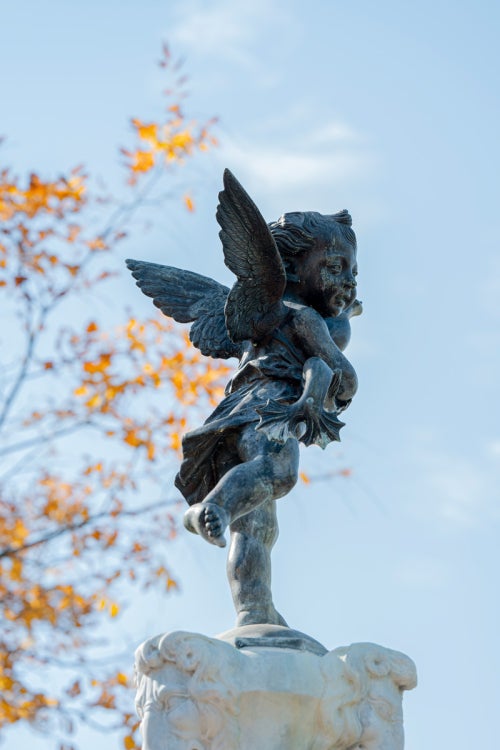
Two years after Katharine's death, in the depths of the Great Depression, 25 crates of hand-cut Italian marble were delivered to Oberlin. The boxes contained the stone for a fountain that was assembled in the plaza in front of Allen Memorial Art Museum. It was a gift from Harry in honor of Katharine.
To crown the fountain, Harry had commissioned a precise replica of a bronze figure by the 15th-century Florentine artist Andrea del Verrocchio. The bronze featured a small boy playing with a dolphin—a small, delicate sculpture, easy to overlook against the museum's ornate facade. But a close look revealed this as no ordinary boy. He was, in fact, an angel, and he was lifted into the air by wings.
The Wright Brothers: Honorary Oberlinians
Katharine was just 15 when her mother died of tuberculosis. Bishop Milton Wright, determined that his own strait-laced values be reflected in a college for his daughter, chose Oberlin, where students rose at 6 a.m., went to bed at 10 p.m., and were forbidden to smoke or drink. Daily chapel was mandatory, as were essays on moral conduct. Katharine arrived at Oberlin in 1893, opening ties between the Wright family and the College that continue to this day. (Katharine's husband, Harry Haskell, also leaves Oberlin legacies with granddaughter Judith Haskell Zernich '72; her husband, Milas Zernich '72; and their daughters, Haley ’07 and Morgan ’05, are graduates.)
Neither of Katharine's famous brothers attended college, but they came to adopt Oberlin, which in turn, embraced them. Both were honorary members of Katharine's Class of 1898 and received honorary degrees in 1910 at the height of their fame. "The brothers had a great deal of affection for Oberlin," says Katharine's biographer, Richard Maurer. "Orville loved to go to Oberlin football games." When the brothers received their honorary degrees, they shared the podium with another inventor, Charles Martin Hall, Class of 1885. Hall had founded the firm that eventually became ALCOA after discovering the process for cheaply producing aluminum from ore. The lightweight metal, which the Wrights used in parts of their engine, helped their early flier off the ground.
Norman Craig '53, emeritus professor of chemistry at Oberlin, says it may have been more than coincidence that the brothers and Hall were honored together. "Somebody connected these people and rightly so. There are things we wouldn't have without aluminum. One is flight."
Despite Orville's estrangement from Katharine in later years, his ties to Oberlin continued after her death in 1929. He bequeathed more than $300,000 to the College—the equivalent of millions of dollars today—upon his death in 1948, presumably in honor of Katharine. The gift was roughly equal to what the College had spent in the early 1940s for its physics building, which was renamed the Wilbur & Orville Wright Laboratory of Physics.
After Orville's death, the College contracted to publish the Wright brothers' papers, which had been left in a jumble to the Library of Congress. "Orville was not a very literary guy, and he never took the time to organize them," says Bruce Richards, an emeritus professor of physics and Wright historian. The 1,278-page volume set was published in 1953 to mark the 50th anniversary of the world's first powered flight.
In fall 2003, the physics department displayed the College's collection of Wright memorabilia, including two pieces of the primitive airplanes that pioneered powered flight, a bit of fabric from the wing of the brothers' first plane, and a rib from the wing of its successor, the 1904 Wright Flier.
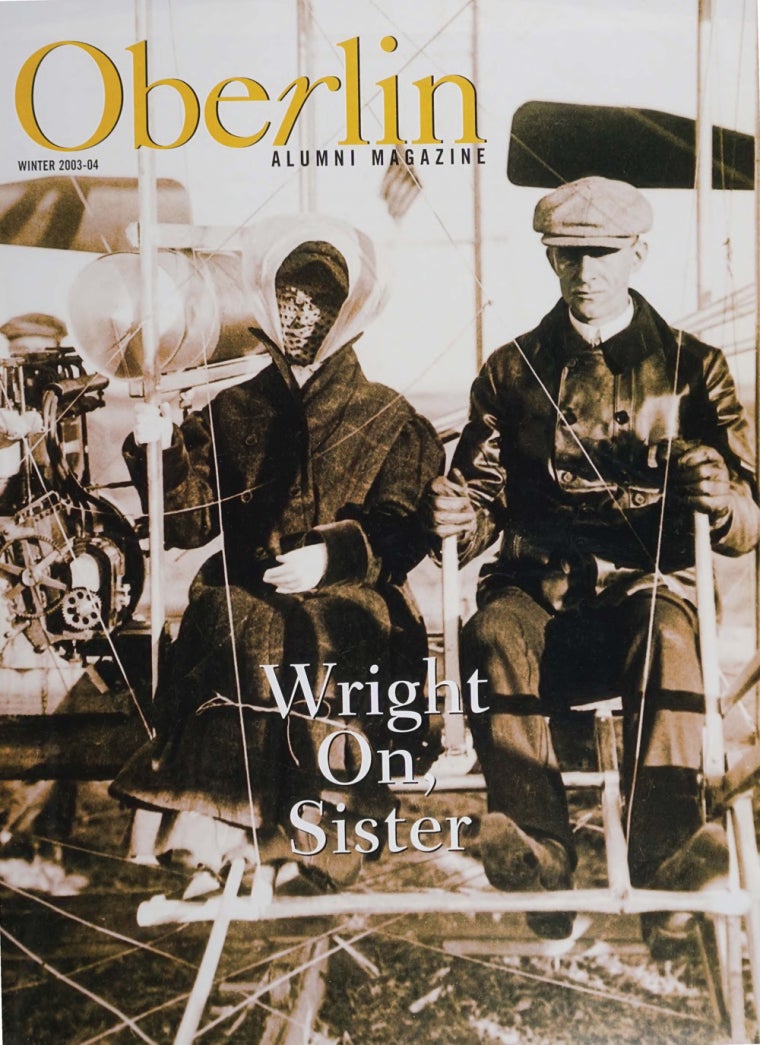
“Wright On, Sister” was the cover story of the Winter 2003-2004 Oberlin Alumni Magazine. Doug McInnis ’70 is a freelance writer in Casper, Wyoming. We thank the staff of the Oberlin College Archives for their assistance with this story.
Related Story
Eager to learn more about Katharine Wright’s life?
You may also like…
Jane Wickline ’21 Finds Community in Comedy
A Q&A with the Saturday Night Live cast member and Dukes cofounder

When Stars Align
The Oberlin Contemporary Music Ensemble shines on Jennifer Koh ’97’s "The American Concerto, Volume One."
An Obie Legacy Takes Flight
It’s a story as old as time: The strong woman, often a wife, plays a critical but largely unrecognized role behind a famous man. But in the case of Katharine Wright Class of 1898, it’s the strong...