
Research Roundup
January 8, 2026
Annie Zaleski
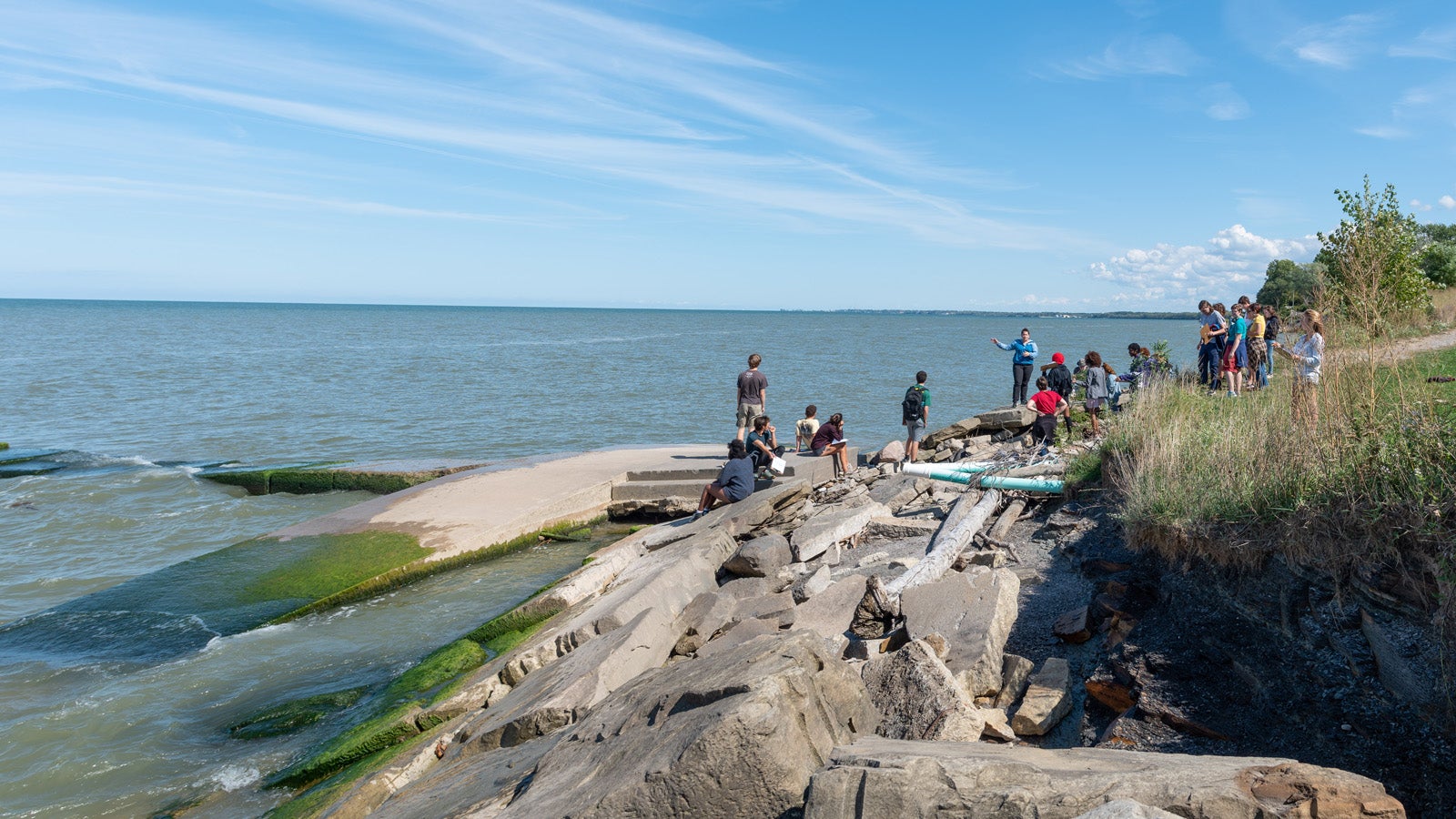
Header photo: In Geology 120: Earth’s Environments class taught by professor Rachel Eveleth, students spent the day visiting parks in nearby Vermilion, where they sketched the shoreline and thought about erosion and deposition of sediment and how that’s controlled by water movement.
Header photo credit: Michael Hartman
Every day, Oberlin’s faculty and students produce scholarly work that uncovers new insights into how we understand the world, particularly in the areas of sustainability and the environment.
The New Pollution
When Professor of Chemistry and Biochemistry Matt Elrod started studying pollutants, the major topics of conversation in his field were the detrimental health effects of ozone pollution (e.g., smog). Today, he says, the research is focused on small particles—for example, the pollutants produced by wildfire smoke or industrial processes. “Particle pollution is now understood to be a big public health problem around the world,” Elrod says. “[In my Environmental Chemistry class] I talk about it in terms of, ‘There are multiple threats in the air that we breathe.’ The small-particle kind of air pollution kills many more people worldwide than ozone pollution.”
One mystery is how these pollutant particles end up in the atmosphere. Not all of the gases produced by industrial plants are dangerous. Instead, chemical processes happening in the air transform these harmless substances into damaging ones. But how exactly does this happen? It’s a question Elrod posed in a 2025 ACS Earth and Space Chemistry article based on six years of research that looked at how a chemical emitted by trees “interacts with acids which humans have added to the atmosphere and creates these particles,” he explains.
Working in tandem with Associate Professor of Chemistry and Biochemistry Jason Belitsky and student researchers—including Rebecca Fenselau ’22, Ali Alotbi ’23, Caroline Lee ’24, Julia Cronin ’25, and Daniel Hill ’21—Elrod discovered something surprising. “The chemicals that come from trees can cause pollution, but only in combination with human-added chemicals,” he says. That’s where the acids come in: They are a by-product of energy production with fuels containing sulfur. “Sulfur leads to acid formation—and acid formation is what allows these particles to form from natural chemicals.” In other words, he notes, this pollution is a “human-caused problem”—and any regulation taking aim at particle formation needs to target things that produce acids.
Solving this problem led Elrod and his lab to solve another problem related to how human-caused nitrogen pollution leads to particle formation; they published their findings in August 2025 in ACS ES&T Air. Three alums from the first paper were coauthors, alongside Molly Foley ’26, Serena Gaboury ’27, Daniel Pastor ’25, Drew Dansby ’23, and Galen Brennan ’17.) Elrod notes that it can take years for research to impact policy, but his lab’s discoveries have the potential to make a difference in the future.
Great, Great Lakes
Associate Professor of Geosciences Rachel Eveleth grew up on Lake Michigan seeing how much people rely on the Great Lakes for things such as drinking water. At Oberlin, she saw an opportunity to expand the research on these crucial bodies of water.
“People weren’t thinking as much about the climate impacts on the Great Lakes,” she says. “They were more focused on harmful algal blooms themselves rather than the interactions with climate and carbon.”
Given her background in oceanography—she earned a doctorate in Earth and ocean sciences at Duke University—Eveleth began to apply some of the methods she was using in the open ocean to a system that “had more immediate, direct human impact,” she says. “Big picture, my research program is looking at interactions between climate and water, and mostly that looks at carbon cycling.”
Among other things, Eveleth and several other institutions have worked on a NOAA-funded collaborative project on the potential effects of the acidification of the Great Lakes. Her research also examines the impact of the decline in ice coverage over the water during the winter. “There’s variability from year to year, but the trend is downward and [the expectation is] that this will continue,” she says. “What does that mean for the ecosystem? What does that mean for the chemistry of the water, the water quality?”
Getting water samples via field work is key; for example, this could include going on boats on the western basin of Lake Erie. As part of a group called the Great Lakes Winter Network, Eveleth and her research collaborators from U.S. and Canadian institutions (including student Nyrobi Whitfield ’26) have also come together to do a series of “winter grabs” of samples. The Oberlin team augured through the ice off a dock in the Lorain Harbor.
The goal is to determine a baseline to inform research going forward. “We don’t know what the carbon budget looks like for Lake Erie, and we’re starting to put that together and figuring out what that means for long-term trends,” Eveleth says, noting that the algae blooms in particular affect whether the lakes are emitting or absorbing carbon dioxide.
Based on the carbon budgets they’ve seen so far, Lake Erie is “acting as a sink, so it's taking up carbon dioxide from the atmosphere rather than releasing it,” Eveleth says, even in the winter. “How we put these carbon dynamics from the lake into large-scale climate models can impact what future climate projections look like. But it also can change our future predictions about pH.”
Marketing For Good
Are there ways to leverage advertising psychology for the good of the planet? Paul Sears Distinguished Professor of Environmental Studies and Biology John Petersen ’88 and Professor of Psychology and Environmental Studies Cindy Frantz say yes: The pair coauthored a field study in the journal Sustainability that demonstrated digital signs were effective in fostering positive environmental norms and behaviors. Read more about this work in the Oberlin Research Review.
This article originally appeared in the Fall 2025 Oberlin Alumni Magazine.
You may also like…
Oberlin Launches Critical AI Studies Minor in Fall 2026
With a solid foundation in both science and the humanities, this minor ensures students to understand and be able to analyze the ethical, cultural, environmental, political, economic, technological, and labor effects of AI.
Three Things with Jillian Scudder
Oberlin’s astrophysicist-author shines a light on our dark universe.

My Cousin the Comb Jelly
The research of Darrin Schultz ’13 deepens our insights into animal evolution.
