A Path to Healthcare
For Brycen Lesikar ’25, Oberlin’s liberal arts education led to research, intellectual inquiry and medical school to become a surgeon.
September 23, 2025
Kira Goldenberg
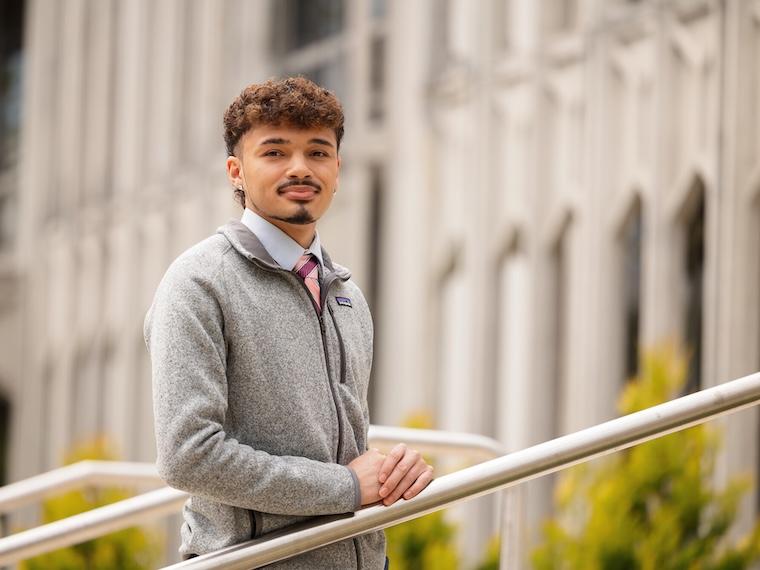
Photo credit: Tanya Rosen-Jones ’97
In high school, Brycen Lesikar ’25 was a decorated pole vaulter. At 16, one vault went awry, landing the Baltimore native in the R Adams Cowley Shock Trauma Center at the University of Maryland, where he was treated for a traumatic brain injury.
“When you enter a trauma bay, especially as a patient who’s not familiar with how it works, it can be disorienting, because everyone swarms around you all at once,” says Lesikar, who graduated with a double major in neuroscience and biology, a minor in chemistry, and an integrative concentration in global health. But the doctors at Shock Trauma “made me feel taken care of and safe in the situation,” he says.
That first-hand experience as a patient, combined with watching his grandparents grapple with chronic degenerative illnesses, influenced his post-Oberlin plans to enter medicine. In fall 2025, Lesikar is entering the MD/MPH dual degree program at Johns Hopkins Medical School, with plans to become a surgeon and a researcher.
Though he solidified his close focus on medicine pre-college—he later volunteered at Shock Trauma, which led to him becoming an EMT and then an ER tech—Lesikar credits Oberlin for fostering his interdisciplinary impulses.
“I wanted to get a more well-rounded liberal arts education,” he says. “I like having been able to build really close relationships with a lot of my mentors and professors, and being really involved in the research process.”
I wanted to get a more well-rounded liberal arts education. I like having been able to build really close relationships with a lot of my mentors and professors, and being really involved in the research process.
He spent three years working in Associate Professor of Neuroscience Christopher Howard’s lab, helping lead a research project looking at the effects of Parkinson’s Disease in animal models. Lesikar and collaborators examined mechanisms that either slowed the neurodegenerative process or promoted regrowth.
“He’s very hands off, so it pushes the students to be very hands on,” Lesikar says of Howard. “When I needed him for advice, he was definitely there, but I think it pushed me to be more independent, inquisitive, and self-motivated.”
Robert W. & Eleanor H. Biggs Professor of Neuroscience Gunnar Kwakye also played an integral role in encouraging Lesikar to consider “the interdisciplinary nature of medicine, science, and the humanities.”
That intellectual inquiry, along with experiences such as volunteering at the Lorain County Free Clinic, led him to his planned post-college focus on the relationships between societal inequality and surgical outcomes.
“I’m interested in exploring the ways in which structural barriers influence the likelihood of developing acute surgical emergencies,” Lesikar says. “Having witnessed the things that I witnessed in terms of healthcare disparities, I was able to contextualize them a lot better with the classes I had here.
“Oberlin’s liberal arts education really helped me see that healthcare and public health don’t happen in silos.”
See how Oberlin’s research opportunities and liberal arts education prepares future physicians through our pre-medicine and healthcare careers program.
You may also like…
Jane Wickline ’21 Finds Community in Comedy
A Q&A with the Saturday Night Live cast member and Dukes cofounder
When Stars Align
The Oberlin Contemporary Music Ensemble shines on Jennifer Koh ’97’s "The American Concerto, Volume One."
Wright On, Sister
Would the Wright brothers have invented their airplane without the support of their sister, Katharine Wright Class of 1898? Probably. But they might not have been the first.