
From Lab to Bedside: Exploring Neuroscience Research and Patient Care
Anna Fritz ’26 studied Parkinson’s disease and shadowed specialists across multiple fields at Boston Medical Center.
March 16, 2026
Office of Communications
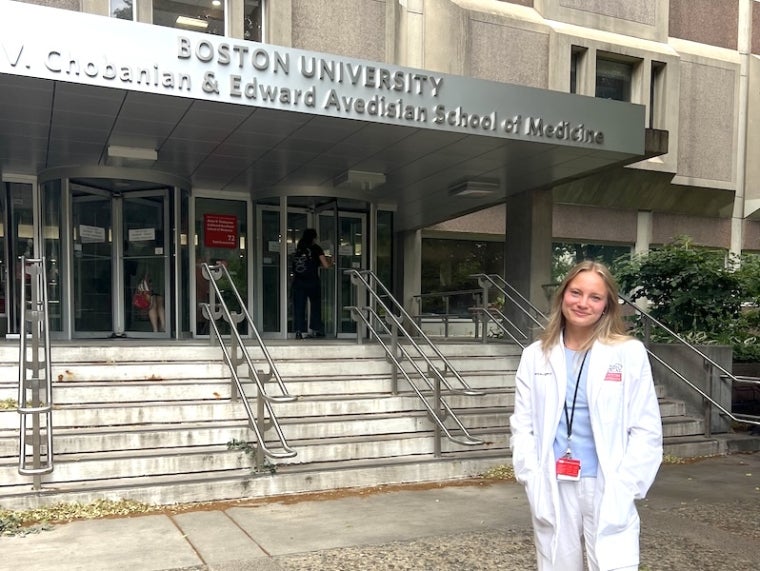
Anna Fritz interned in a neuroscience program at Boston University.
Photo credit: Courtesy of Anna Fritz
Anna Fritz ’26 is a neuroscience major who grew up in Oberlin, Ohio, and competes on the women’s varsity track and field team. Last summer, she participated in the Boston University Summer Program in Neuroscience, an intensive eight-week program based at Boston University and Boston Medical Center.
Can you describe your summer internship?
My internship at Boston University combined individual mentored research, clinical shadowing across a range of neuroscience specialties, and weekly didactics and professional development seminars. I worked in the STEPP Lab, a sensorimotor rehabilitation engineering lab, on a project related to speech disorders in Parkinson's disease.
Along with my cohort, I also had the opportunity to observe neurosurgeries and shadow neurologists, neurocritical care specialists, neurosurgeons, neuropathologists, psychiatrists, ENT physicians, neuropsychologists, and ophthalmologists. It was hands-down the most amazing experience I've ever had.
How did Oberlin influence you to pursue your internship?
My studies in neuroscience at Oberlin motivated me to seek hands-on experience in research and clinical environments. Although I found this program while browsing summer opportunities online, my experiences with professors like Michelle Johnson and Gunnar Kwakye encouraged me to look for opportunities like this in the first place.
How did your internship align with your post-college goals?
I became confident that I want to pursue patient-centered care in a neuroscience specialty while conducting translational research into neurodegenerative diseases.
What surprised you or made a big impression?
Shadowing at Boston Medical Center—a safety-net hospital serving predominantly low-income and underinsured populations—left a lasting impression on me. It was eye-opening to see how structural inequities in healthcare impact patient outcomes in treatment, recovery, and long-term support.
The resilience of patients and the resourcefulness of the care teams reinforced my commitment to pursuing a career where I can address both the biological and systemic realities of neurological disease.
How has your liberal arts education shaped the way you think about science or research?
It taught me to approach science not just as a technical discipline but as a human-centered, ethical, and socially informed endeavor. Courses outside neuroscience, such as Topics in Philosophy of Mind with Professor Todd Ganson, pushed me to ask deeper questions about the context and consequences of scientific work, including research with laboratory animals, sometimes described as “sentience candidates.”
What drew you to your major?
I have always been fascinated by the brain, but experiences at Oberlin—such as Professor Kwakye’s Laboratory in Neurotoxicology and Neurodegeneration and Professor Michelle Johnson’s Developmental Neurobiology—solidified my interest. Working as a nurse aide during the pandemic and volunteering at University Hospitals further deepened my interest in clinical care.
You may also like…
Michael Dolton '27 strategizes with economics
The scholar-athlete from Trenton, Ontario, used his major to find creative solutions in his summer internship.

Johana Horvath '28 finds professional growth at a non-profit organization
The business major from Ann Arbor, Michigan, enjoyed an educational and confidence-building internship.
Jacob Day '27 explores international business in Brussels
The Oberlin football player and Entrepreneurship Club founder enjoyed an inspiring summer internship.
