Nuclear Policy, Combat Sports, and Rock and Roll: Lucas Daley ’26 Forges His Own Path
The triple major in politics, economics, and Russian earned a Critical Language Scholarship and James C. Gaither Junior Fellowship.
April 7, 2026
Elizabeth Weinstein ’02
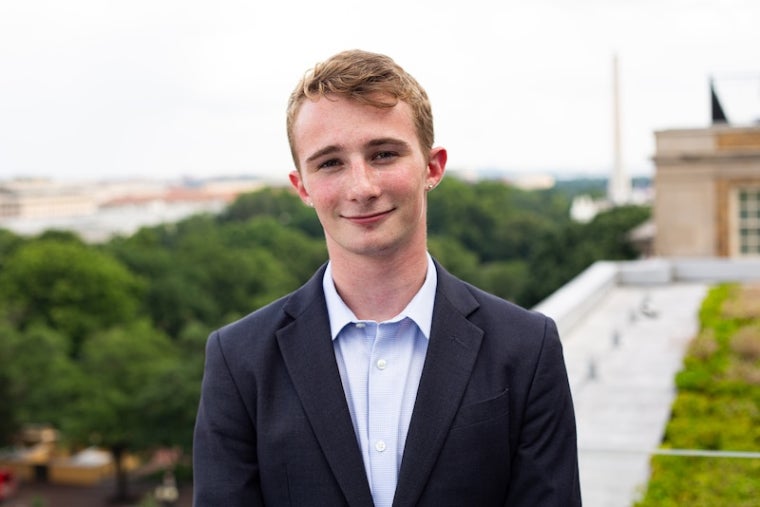
Photo credit: Courtesy of Lucas Daley
Depending on the day, Lucas Daley '26 is a nuclear policy researcher, a student of Russian and Hindi, a guitarist in a band called Sloth, and a devotee of combat sports. The politics, economics, and Russian triple major has interned with the U.S. State and Defense departments, is completing an honors thesis on Russian nuclear energy diplomacy, and is the recipient of two major post-graduation honors.
What connects all these threads for Daley?
“That question gets at what drew me to Oberlin in the first place: the ability to pursue different fields of study in depth, simultaneously,” Daley says. “At most schools you’d have to choose. To me, they’re deeply connected.”
Daley received a Critical Language Scholarship, which is a U.S. State Department program supporting intensive language study, and will study Hindi in Jaipur, India, this summer.
Then, in the fall, Daley will join the Carnegie Endowment for International Peace as a James C. Gaither Junior Fellow, working on the Return of Global Russia initiative at Carnegie’s Russia and Eurasia Center. Daley was one of 18 students selected nationwide.
Daley recently spoke about their approach to learning languages (an MMA gym plays a role), the value of diverse internship experiences, and much more.
This Q&A was edited for length and clarity.
How did you find out about Critical Language Scholarship (CLS), and what made you want to apply?
I first learned about CLS in the fall of my sophomore year. I was studying Russian, and I applied for Russian that year but wasn’t selected. That summer, I interned at a think tank in New Delhi, where it quickly became clear that communicating beyond the classroom—talking to rickshaw drivers and the guy selling mangoes next to my apartment—requires more than English.
I’d lived in India in first grade, so I had some background, but I could bargain for mangoes and not much more. Last fall, going into senior year, I applied again, this time for Hindi, and here we are.
What will your summer in India look like?
I’ll be in a language program with at least four hours of classes every morning, followed by practice with assigned conversation partners, while living with a Hindi-speaking host family. Essentially, it’s Hindi 24/7.
What do you remember from living in India as a child?
The relationships. For example, when I was back in India for the internship, I tracked down someone who had cared for my family when I was a child and spent time in her village. She still remembered all my favorite foods, and even named her daughter after my sister.
How has your interest in languages evolved over the years?
I learned Hindi as a kid but lost it quickly after returning to the U.S. I took Russian 101 my first semester at Oberlin, pretty much by accident. I needed a class to fill my schedule and it was at a convenient time. I figured I’d do one semester, but I really enjoyed it, so I kept going. Studying Russian taught me how to learn a language: what strategies are effective, what timelines are realistic and how you can pursue immersion in a non-immersive environment.
Studying abroad in Kazakhstan, I found the easiest way to avoid mistakes when learning a new language is to stay inside and not engage with the host community—but that's also the easiest way to avoid learning the language. Asking questions and following curiosity into niches within the host community—music, sports, the outdoors, whatever resonates—makes all the difference.
When I was in Kazakhstan, training with local boxers helped my Russian enormously and gave me friendships and a depth of understanding I wouldn’t have had otherwise.
At Oberlin, Senior Lecturer in Russian, East European, and Eurasian Studies Maia Solovieva also taught me a lot about language learning beyond just Russian—the theory behind it, how to approach skill gaps and how to keep progressing past the intermediate plateau.
You’ve had an impressive run of internships. What have they taught you?
At the State Department, I focused on social media analysis in one Pakistani province. In India, the work was much more macro, on great power competition and strategic framing. The practical skills were different too: how to write for policy outlets, how to get published in newspapers.
At the Department of Defense last summer, the focus was strengthening relations with security partners in the Middle East. I interfaced directly with senior military leaders from across the region, hearing their perspectives on events in their own countries.
Your honors thesis is on Russian nuclear energy diplomacy in the Global South. How does it all connect: the thesis, India, Hindi, and where you see yourself heading?
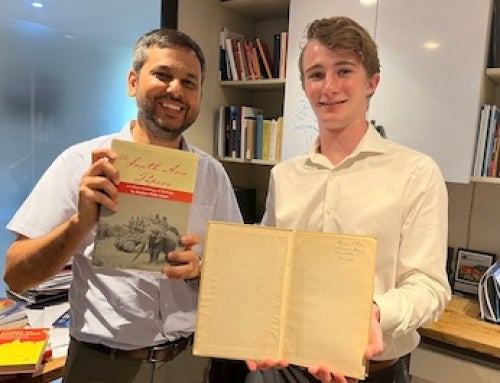
The project grew out of research I started two summers ago in India. I co-authored a report and op-ed with Constantino Xavier, a senior fellow at the Centre for Social and Economic Progress in New Delhi, that examined Russian and Indian cooperation in India’s “Neighbourhood First Policy.”
In that work, I came across the Rooppur nuclear power plant in Bangladesh: a 2,400-megawatt facility being built by Russia with Indian assistance. This raised a question: Why did Bangladesh choose Russia over other countries with equal capabilities? As countries across the Global South expand their clean energy infrastructure, understanding why certain partnerships are chosen over others matters enormously for U.S. economic statecraft.
You were named a James C. Gaither Junior Fellow at Carnegie Endowment for International Peace. What can you share about the work you’ll do there?
I've been following Carnegie's work for years and relied heavily on the Russia and Eurasia program's reports for my honors thesis research on nuclear reactor exports. When applying to the Gaither Fellows program, I had a hard decision to make regarding which program to apply for, as my research interests span Russia, South Asia, and non-proliferation issues. Eventually, I settled on the Russia program, as I can connect my interest in other regions through analyzing Moscow's international engagement.
Anything else you want people to know?
I’m also a musician. I play lead guitar in a band at Oberlin—Sloth—and I’ve been doing combat sports my whole life. I want to study Indian classical string instruments and join an MMA gym.
Editor’s Note: In mid-April, Daley was named a recipient of the Boren Scholarship. This U.S. Department of Defense-funded award provides up to $25,000 for the study of languages and regions vital to national security. Daley has declined the scholarship and remains committed to his current plans.
You may also like…
Reyna Berry ’27 earns a 2026-27 Newman Civic Fellowship
The theater major will continue her work supporting prison and detention center programming

Andy Roshal '26 earns DAAD scholarship
The Hartsdale, New York, native will travel to Germany to expand on the Yiddish studies they began here at Oberlin.
Nissa Berle ’24 earns Fulbright Study/Research Award
The psychology major will earn a master’s degree in disaster and emergency management at York University