Campus News
James Millette, Professor Emeritus of African American Studies, Dies at 92
Trinidad and Tobago native made a late-career transition to Oberlin, where he was a staunch advocate for Black students and a mentor to young faculty.
October 23, 2026
Communications Staff
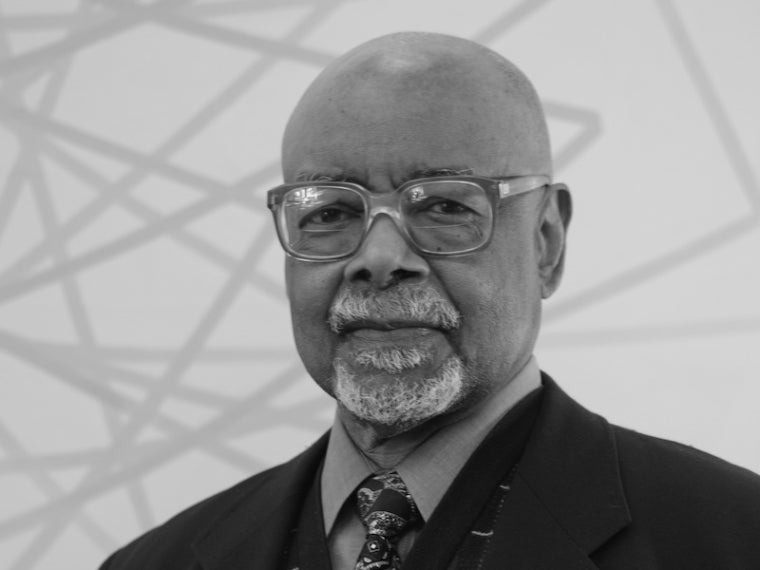
James Millette, a longtime professor of African American studies at Oberlin and a key supporter of Black initiatives on campus, died October 12 after a brief illness. He was 92.
A native of Trinidad and Tobago, Millette joined the Oberlin faculty in 1991. Initially a visiting professor with a résumé spanning more than two dozen years of university teaching in the Caribbean, he soon became a fixture in the African American Studies (now Africana Studies) Department and a beloved mentor to faculty and students alike.
“Professor Millette was a brilliant scholar of Caribbean history committed to the Africana Studies Department, Afrikan Heritage House, and to the Oberlin College mission,” says Professor of Africana Studies and Comparative American Studies Meredith Gadsby.
Millette earned a bachelor’s degree in history at the University of the West Indies, Mona, Campus, in Jamaica. On Christmas Day 1957, he met his future wife, Mildred Veronica Hardie; whom he married in 1960. Soon after, Millette pursued an MA and PhD in history at King’s College London. Upon completing his studies, he returned to Trinidad, where he worked at the University of the West Indies’ St. Augustine campus for 26 years, teaching history and serving as dean of the College of Arts and General Studies.
As a young educator, Millette grew increasingly immersed in Caribbean politics and activism, becoming a vocal member of the New World Group, a political network—fueled by academic figures and intellectuals like Millette—that championed Black power and postcolonial independence for Trinidad and Tobago and other Caribbean nations. He was a member of the editorial board of the New World Journal and served as general secretary of Trinidad’s United Labour Front Party.
In the early 1970s, Millette founded the socialist-leaning United National Independence Party and the influential weekly newspaper MOKO, which espoused the party’s agenda.
During that time, while many opposition leaders were arrested during the leadership of Trinidad’s conservative Prime Minister Eric Williams, the outspoken Millette emerged unscathed. “I think the government never arrested me because they thought I would gain even more power in prison,” he later told the Chronicle-Telegram. “So they left me alone.”
At Oberlin, Millette was a leader of the Association of Black Concerns, a group of Black staff and faculty that advocated for fair and equitable treatment. He played an integral role in the college’s strategic planning initiatives, with his focus locked on advocacy for Black students.
“As a labor historian, he recognized the importance of collective struggle to the past, present, and future success of Black people internationally,” says Gadsby.
Millette’s 19-year tenure at Oberlin included four years—from 1999 to 2003—as chair of the African American Studies Department. He taught courses on Caribbean, African, African American, and imperial history, as well as the core course Introduction to Black Studies, and he was part of the team that created the Comparative American Studies Program and the Oberlin College Dialogue Center.
“What I will remember most is Professor Millette's razor-sharp wit, expert storytelling, engaging conversation, infectious laughter, and empathy. He is one of the kindest humans I have ever known.” —Meredith Gadsby
Millette led African American Studies through a period of generational transition in 2000, with the retirement of two of its founding members, Adrienne Lash Jones and Calvin Hernton. He served as a mentor to their successors, Pam Brooks and Gadsby, along with colleagues Caroline Jackson Smith, Johnny Coleman, and Adenike Sharpley.
Millette wrote two books, The Genesis of Crown Colony Government: Trinidad, 1783-1815 and Freedom Road, and authored a chapter in UNESCO’s multivolume History of the Caribbean.
“What I will remember most is Professor Millette's razor-sharp wit, expert storytelling, engaging conversation, infectious laughter, and empathy,” recalls Gadsby. “He is one of the kindest humans I have ever known. Most of all, he was a proud son of his beloved Trinidad and Tobago.”
Upon his retirement in 2010, Millette reflected on the state of his adopted homeland and what he would remember about Oberlin in an interview with the Office of Communications.
“During the 19 years I have been in Oberlin, the country has been constantly at war,” he said. “For me, coming from the Caribbean, that’s been a new and unusual experience. But at the same time, the country has managed to elect its first Black president, is struggling against conservatism in many of its forms, and is really peeling back for all to see some of the truths and realities of the world we live in.
“I will remember those things,” he noted, “and I will remember the place where I remembered those things.”
Millette was preceded in death by his wife of 65 years, who died in August, and their son David. He is survived by their daughters, Suzanne and Corinne, as well as numerous grandchildren and great-grandchildren.
A funeral service is scheduled for noon on Saturday, November 7, at Sacred Heart Church in Oberlin, where the Millettes had been longtime parishioners. Read more about Millette on Legacy.com.
You may also like…
Oberlin Reimagines Humanities Education Through $1.487M Grant
New “HOPE” initiative centers humanities learning with real-world impact.
The ABCs of STEM Research
At Oberlin, undergraduates work alongside faculty members on incredible scientific breakthroughs.