
In Memoriam: Professor of Studio Art and Photography Pipo Nguyen-Duy and his wife, Tran Thi Nam Phong
Beloved couple leaves a legacy of creativity, generosity, and community at Oberlin
November 3, 2026
Annie Zaleski
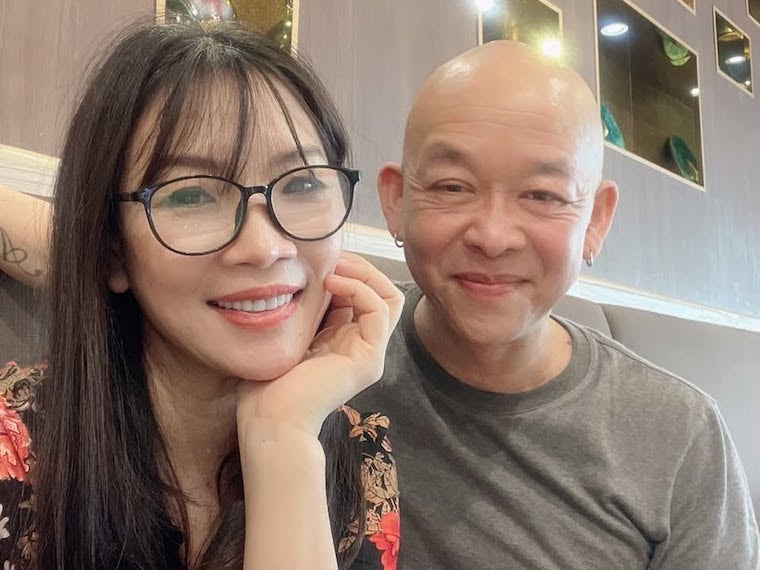
Professor of Studio Art and Photography Pipo Nguyen-Duy and his wife, Tran Thi Nam Phong
Photo credit: Facebook
Professor of Studio Art and Photography Pipo Nguyen-Duy and his wife, Tran Thi Nam Phong, exuded warmth and care for the Oberlin community—whether they were offering students a steaming hot bowl of phở on a cold night, providing a friendly space for them to take a study break, or simply encouraging students in creative pursuits.
The beloved couple died on Wednesday, October 28.
“This is a devastating loss for Oberlin,” says Dean of the College of Arts and Sciences David Kamitsuka, who describes Nguyen-Duy’s brilliant capacity “to see—and to see possibility. His work demonstrates that when we truly encounter the world and each other in new ways, it expands our capacity to love. His devotion to his students and his work as an artist will continue to be an inspiration for us all, as will the way he and Phong created a welcoming community for Oberlin students and alums.”
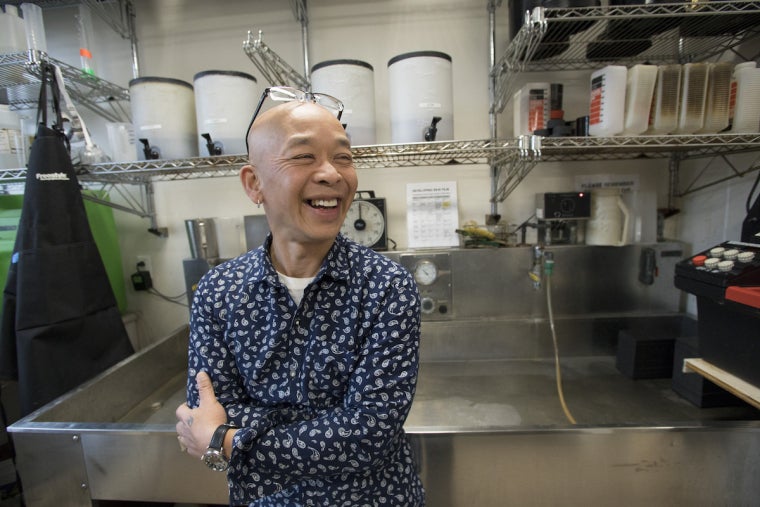
The recipient of a Guggenheim Fellowship and countless other awards, Nguyen-Duy was an esteemed Oberlin faculty member for nearly three decades. Although the 64-year-old's artistic practice encompassed printmaking, sculpture, and performances, he distinguished himself through photography. His process was “very similar to painting,” he said in a 2011 Oberlin faculty profile video. “I keep going back to the same situation and rework it until it feels right for me—that is, composition, content, lighting.”
In a testament to his thoughtful, deliberate approach to photography, Nguyen-Duy added that his images sometimes took three years to make, from the initial research until the finished product. “For me the camera is the way that I want to be able to control what the viewers see,” he added. “A lot of my photographs…[don’t] necessarily come from reality but they come from either a memory or from an idea.”
Nguyen-Duy, who arrived at Oberlin in 1998, was a familiar presence in the community, walking his beloved dog Poppy, biking across Tappan Square, or attending concerts in the conservatory. In a testament to his varied intellectual interests, he also maintained a perfume lab alongside his darkroom. He was proud of his son Quentin, a graduate of Interlochen Arts Academy who attended Oberlin for a year and has since launched a celebrated acting career, including in the new Broadway production of A Few Good Men.
Over the decades, Nguyen-Duy became known as a warm and inspiring professor who thrived in—and became an integral part of—the college’s collaborative environment. “If anyone had an opportunity to see Pipo in the classroom, you would understand how profoundly his teaching anchored the making of his work, his sense of place, and the importance it held in challenging him creatively,” says Emeritus Professor of Studio Art Sarah Schuster.
In a 2019 interview with the journal Matca, Nguyen-Duy affirmed the ways teaching informed his artistic practice. “To me, teaching and working are so intertwined that I cannot take them apart; teaching pushes me to make work and further myself in my intellectual and creative process. It gives me a community and a chance to have a dialogue with really inspiring and smart people.”
Accordingly, Emeritus Hunter Young Professor of Arts and Africana Studies Johnny Coleman calls Nguyen-Duy a “master teacher” who was “a catalyst within the studio art department. As a colleague, Pipo was a clear, focused, and vocal partner in the collaborative shaping of an exemplary interdisciplinary studio art curriculum.”
To me, teaching and working are so intertwined that I cannot take them apart ... It gives me a community and a chance to have a dialogue with really inspiring and smart people.
Pipo Nguyen-Duy, 2019
Coleman adds that Nguyen-Duy taught multiple film mediums—black and white, 35mm, medium- and large-format color—as well as digital photography. “Across all of the photographic formats and processes that he taught, Pipo helped his students to discover ways of viewing the specificity of place, history, culture, and themselves.”
Nguyen-Duy’s mentorship extended well beyond campus. Countless Oberlin alums recalled the way he supported them after graduation with job recommendations, marathon meals, notes of encouragement, and friendship.
“He actually was really instrumental in giving me the confidence to be a visual artist in the first place,” Josh Faught ’01 told the Oberlin Review in 2025 upon winning a Guggenheim Fellowship. “I remember Pipo looking at my work and saying, ‘I feel like you’re after this queer sensibility that isn’t easily located, but is somewhere in the work itself.’ This was the first college-level photography class I’d ever taken, and the fact that he had taken me so seriously and found this thing in my work that I couldn’t really articulate just really set the gears in motion.”
In a 2014 interview as part of DePaul University’s Asian American Art Oral History Project, Nguyen-Duy likewise praised Oberlin students for what they taught him. “My students are really smart. I mean, they are really incredible people,” he said. “I find them to be my peers. They give me my feedback, and I do the same. If anything, I feel like a more experienced student.”
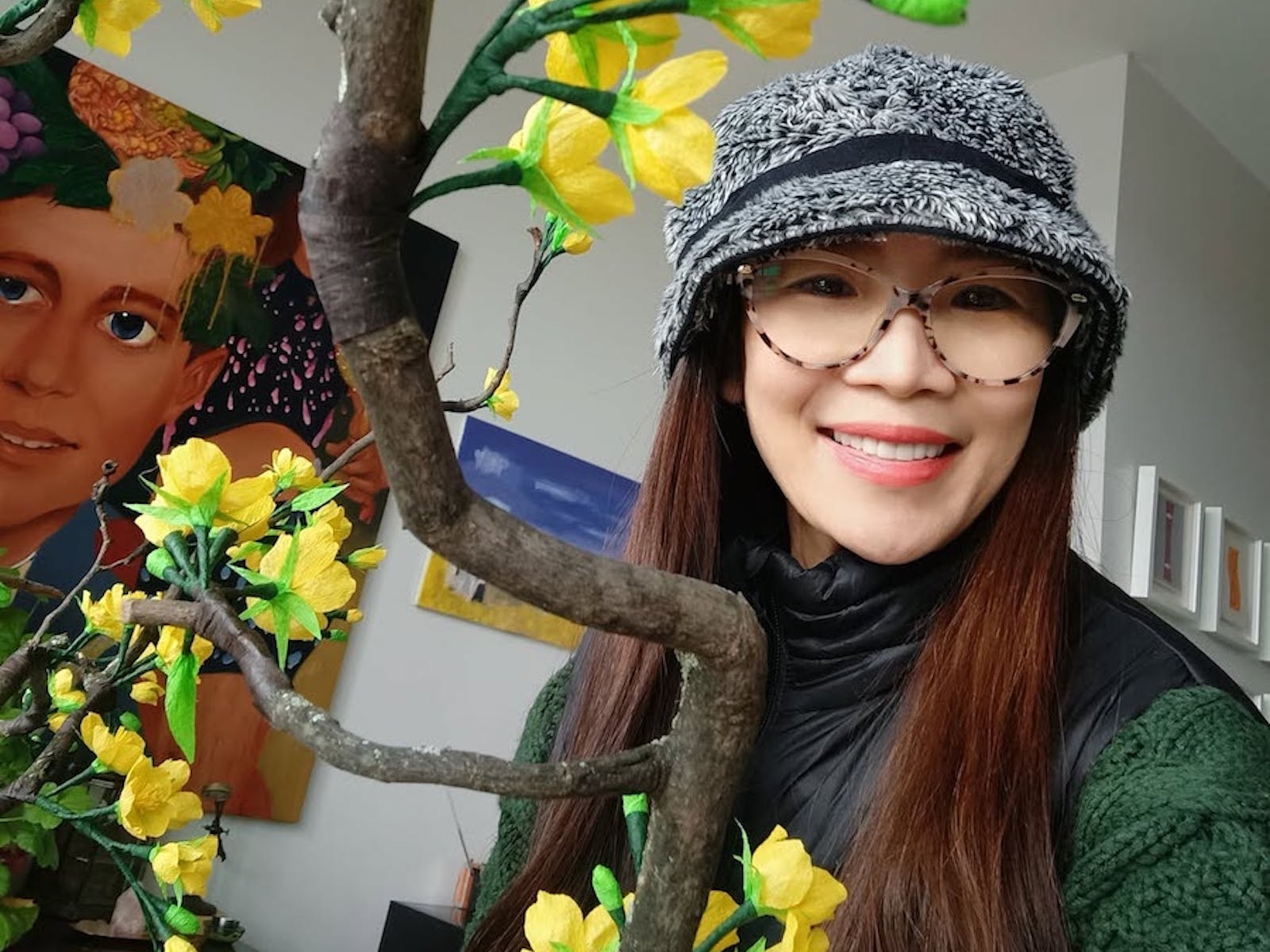
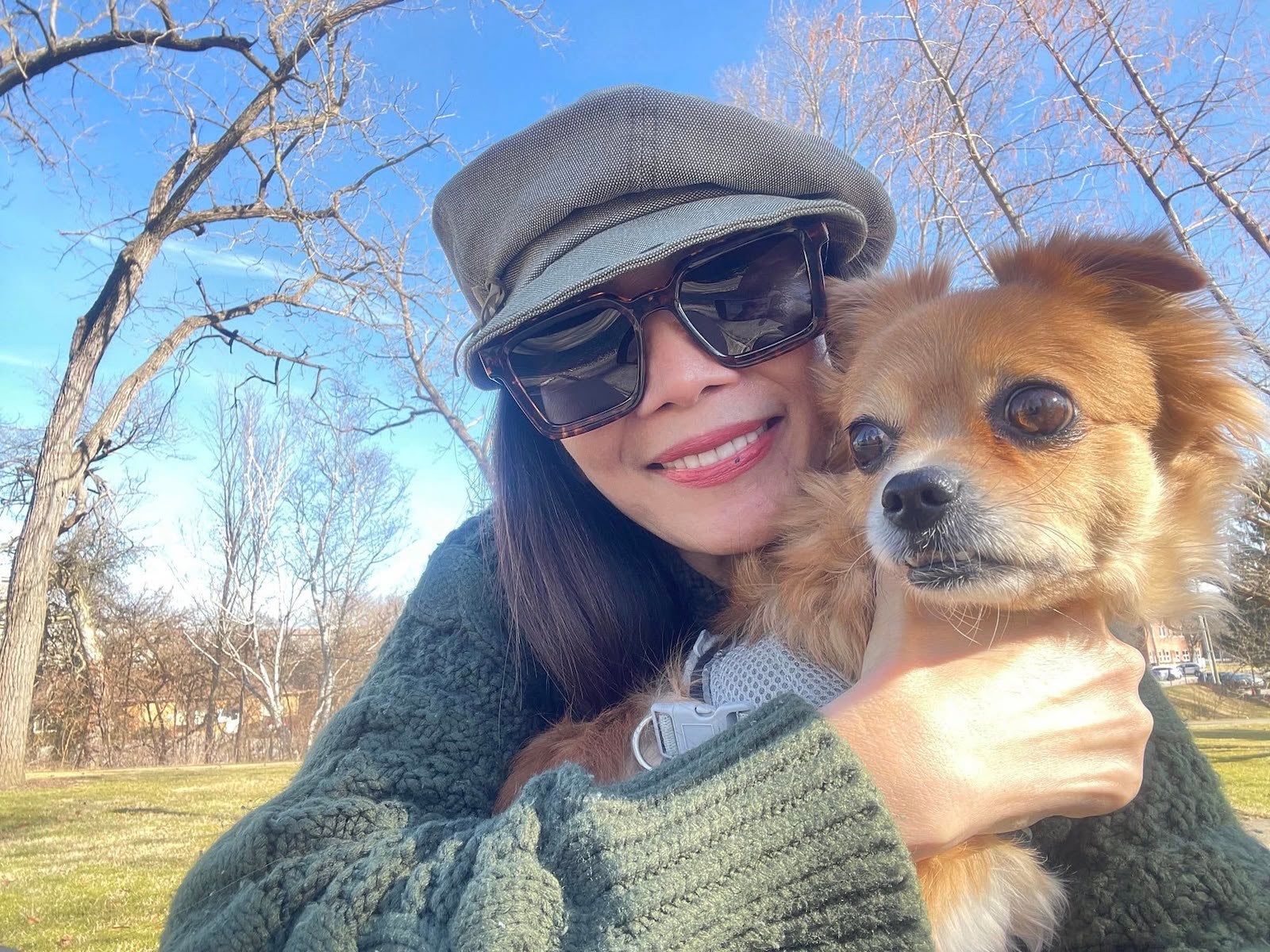
Tran Thi Nam Phong (pictured with the couple's cherished dog Poppy, at right) was a vibrant part of Oberlin's community who was beloved by students.
Nguyen-Duy and Phong, who was 56, married in 2023. The couple (who were known simply as Pipo and Phong) shared a deep love for one another and collectively possessed impeccable fashion sense; their Instagram account, where they filmed lighthearted videos together, had the tagline: “Where absurdity meets style: A nerdy professor husband and a stylish Vietnamese wife collab.”
Pipo and Phong were also a warm, supportive presence in Oberlin’s Vietnamese and international communities, providing hot meals, hospitality, and a sense of family that helped students feel connected to home even while far away. The couple launched Oberlin Xôi, a popular community service that provided homemade Vietnamese food; the description, “a hub where good vibes can be shared and spread over good Viet bites,” embodied their commitment to spreading joy and happiness.
“Phong showed her care to all students through Xôi and her friendliness,” said Ruby Cohen ’26. “She had this infectious smile that made it so you couldn’t help but feel warmth and happiness when she looked at you. Pipo and Phong knew so many students, and they were able to make each one of us feel special. I know every one of us was important to them for a different reason. I cannot thank them enough for the Oberlin they helped give me and all of my classmates.”
Born in Huế, Vietnam, Nguyen-Duy competed as a national table tennis athlete as a teenager and maintained a passion for the sport; in a 2025 Oberlin video interview, he noted that if he weren’t a photographer or a professor, he would be a professional table tennis player. Nguyen-Duy immigrated to the United States as a political refugee in 1975.
In 1983, he earned an economics degree at Carleton College and moved to New York City, where he lived in the East Village—or, as he put it, “the crux of creativity in New York”—while working as a bartender and later a nightclub manager. Through this work, he crossed paths with luminaries like the musician Don Cherry and artist Keith Haring.
“I was just observing; I was not doing anything that was creative,” he told the public radio outlet Ideastream in 2021. “I think part of what I was doing at the time was just waiting to have a certain language, a medium in which I can communicate and tell my stories.”
Nguyen-Duy eventually left New York and spent two years studying Buddhism at a monastery in Northern India. “I did not take the final kind of vow to completely become a monk,” he told Ideastream. “Right before that final vow, I just decided that I needed to explore life a lot more.” That led him back to the U.S., where he earned a master of arts in photography and a master of fine arts in photography at the University of New Mexico at Albuquerque, studying mediums such as sculpture, photography, and printmaking.
In the late 1990s, he worked on two self-portrait series, AsSimulation (exhibited in late 2025 at New York City’s CLAMPgallery, which represents him) and AnOther Western. Both dealt with “race and gender within the context of cultural assimilation,” he noted on his website, with the former using “traditional Asian theatrical and visual language to imitate and interpret Renaissance and Baroque paintings” and the latter drawing on the iconography and photography approach of the late-1800s American West.
“Everything has to do with my specific dialogue and where I see myself in terms of my own assimilation and my cultural position within the culture that I find myself in,” he said of these series during his 2014 interview with DePaul, while noting that his work had evolved. “Instead of being very specific about identity, the work I have been doing during the last 10 years addresses home in more of a metaphorical way rather than [a] very specific way.”
In 2011, Nguyen-Duy received a prestigious Guggenheim Fellowship in the Creative Arts for photography. The award supported his project East of Eden: Vietnam, which represented the culmination of two trips to Vietnam in which, riding a rented moped, he searched for war survivors to photograph against what he calls a "regenerated Southeast Asia." The result is a series of staged, large-scale color photographs that explores hope and renewal 30 years after the Vietnam War.
"It was important to see it in a whole new way and to explore the anxiety we all feel every day by living in a post-9/11 society," he told the Oberlin Alumni Magazine in 2011. "Many of the subjects were in their 60s; two of them have since died. There was an urgency to the project; it was important to get to these subjects before their stories could no longer be told." Nguyen-Duy added that he sought to capture the strength, courage, beauty, and wholeness of the people he met. "I want to show that we do have the capacity to overcome the challenges brought on by war."
Nguyen-Duy received many awards and grants in addition to the Guggenheim Fellowship, including an En Foco Grant; a Professional Development Grant from the College Arts Association; an American Photography Institute National Graduate Fellowship, NYC; a B. Wade and Jane B. White Fellowship in the Humanities at Oberlin College; and three Individual Artists Fellowships from the Ohio Arts Council. Over the years, he was an artist-in-residence in multiple places, and his work is held in collections worldwide.
“Pipo was an extraordinary artist, thinker, and teacher, but above all, Pipo made community wherever he went,” says Eva and John Young-Hunter Professor of Art Julia Christensen. “He always welcomed his students into his family. Pipo's legacy will live on through a universe of students, colleagues, collaborators, and friends who are mourning his loss and celebrating his life.”
Oberlin is planning opportunities to gather as a community to remember and celebrate Pipo and Phong on Monday, November 23; details will be available as they are confirmed.
Students, alums, and community members are invited to share reflections on a memorial page, which has a growing collection of tributes.
Pipo has photographs displayed in FIT, 2026: Studio Art Staff & Faculty Exhibition, which is on view through November 14.
You may also like…
James Millette, Professor Emeritus of African American Studies, Dies at 92
Trinidad and Tobago native made a late-career transition to Oberlin, where he was a staunch advocate for Black students and a mentor to young faculty.
Tenor Limmie Pulliam ’98, Who Sang on Stages Worldwide, Dies at 50
Gifted singer became a regular presence on the Oberlin campus where he honed his craft.
Julie Baker, Administrative Assistant for Jazz Studies, Dies at 61
Julie Baker, the Administrative Assistant for Oberlin’s Division of Jazz Studies and a key member of the conservatory’s Facilities Operations team, died May 12. She was 61. Born in Oberlin and a...
