Campus News
George Andrews, Fifth-Generation Student and Longtime Math Professor, Dies at 94
Dedicated teacher and friend remembered for his steadfast love of all things Oberlin.
November 11, 2026
Communications Staff
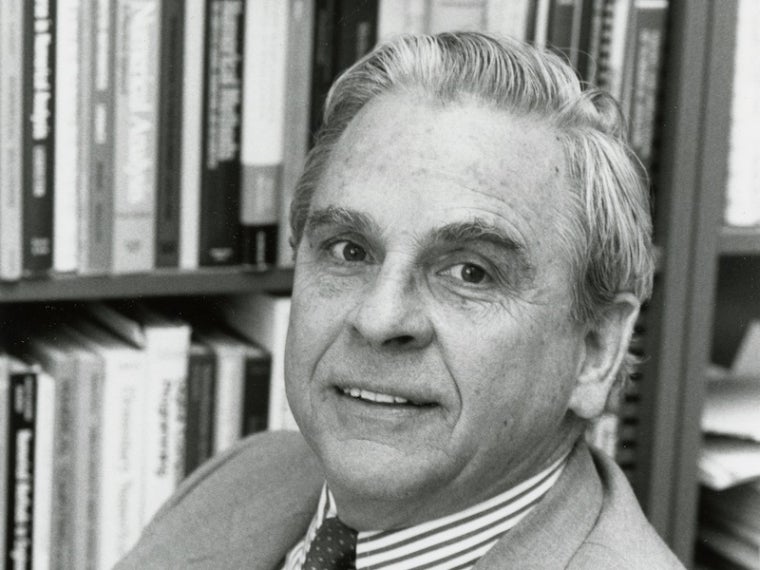
Photo credit: Oberlin College Archives
George Andrews ’54, a fifth-generation Oberlin graduate, a fixture in the Mathematics Department for 35 years, an architect of the Computer Science Department, and a steadfast supporter of Oberlin athletics, died October 12. He was 94.
A native of Syracuse, New York, Andrews continued a deep family tradition by attending Oberlin. His great-great-grandmother, Delia Finn, earned an Oberlin degree in 1841—the 13th female graduate in the college’s history. As an undergraduate, Andrews studied mathematics, competed as a two-sport athlete, and served as president of his senior class.
After earning a master’s degree at the University of Michigan, he worked in the actuarial program at Connecticut General Hospital, where he met his future wife, Marlene Erickson. Following service in a U.S. Army computer modeling unit, he returned to Michigan to complete a PhD in 1962, shortly before joining the Oberlin faculty.
A specialist in actuarial mathematics and numerical analysis, Andrews conducted extensive research on the U.S. Social Security system, and he coauthored the book Actuarial Projections for the Old-Age, Survivors, and Disability Insurance [OASDI] Program of Social Security in the United States of America. He regarded Social Security as one of the federal government’s most efficient operations and modeled policy improvements designed to extend its financial viability by 50 years. He was an Associate of the Society of Actuaries and co-wrote some of the professional examinations required to enter the field.
In 1995, Andrews was appointed the inaugural Andrew and Pauline Delaney Professor of Mathematics. “Students seek out Mr. Andrews, and he responds with genuine enthusiasm, supporting their educations both inside and outside the classroom,” then-President Nancy Dye said. “Mr. Andrews is an extraordinary contributor to the life of the college.”
Andrews’ dedication to students was matched by his commitment to colleagues. “George was as steady, solid, and principled a person as can be imagined,” said Professor Emeritus of Mathematics and Computer Science Michael Henle, who became close friends with Andrews after arriving at Oberlin in 1971. “His spring parties for the Mathematics Department were legendary while he was chair.”
James F. Clark Professor Emeritus of Mathematics Robert Young echoed that sentiment: “George’s sense of community—to the Math Department, the college, and the town—was legendary. He and his family embraced every young newcomer to the department and showered them with support and affection.”
Susan Colley, Delaney Professor Emerita of Mathematics and department chair at the time of Andrews’ retirement in 1997, noted his far-reaching influence: “I remember George Andrews as a colleague who always made sure that students came first. Whether preparing classes or providing out-of-class support, he was fully dedicated to students’ success and growth—not only mathematical growth, but personal growth as well. This dedication quite naturally extended to his thoughtful and kind mentorship of junior faculty—myself among them—and amplified the great good he did for Oberlin students and Oberlin College.”
During the 1992-93 academic year, Andrews enjoyed the rare distinction of teaching alongside his son, Chris Andrews ’90, a sixth-generation Oberlin alumnus who stepped in to teach math for a year following an unexpected faculty departure. “I’ve seen the career of professors, and it’s an easy one,” Chris told the Lorain Morning Journal in a feature profile—prompting an immediate “Whoa!” from his father.
“A fun one, rather,” the younger Andrews clarified.
Athletics offered a continuous thread throughout Andrews’ life. As an undergraduate, he played center on the football team and was a member of the swim team. Later, as Oberlin’s longtime faculty representative to the NCAA, he advocated for expanded women’s programs and helped establish the North Coast Athletic Conference—a pioneer of gender equity in collegiate sports. Shortly after retiring in 1997, Andrews returned as interim athletic director, revitalizing multiple programs over an 18-month tenure. He was inducted into Oberlin’s John W. Heisman Club in 2022 and remained an avid sports supporter and active community member into his 90s.
Andrews was a member of First Church in Oberlin beginning in 1963 and was an engaged resident of Kendal at Oberlin for many years. He is survived by his wife of 70 years, their four children, eight grandchildren—four of whom attended Oberlin and played varsity sports—and five great-grandchildren.
Learn more about Andrews’ dedication to Oberlin athletics on GoYeo.com; additional information can be found on the Dicken Funeral Home website.
You may also like…
James Millette, Professor Emeritus of African American Studies, Dies at 92
Trinidad and Tobago native made a late-career transition to Oberlin, where he was a staunch advocate for Black students and a mentor to young faculty.
Oberlin Reimagines Humanities Education Through $1.487M Grant
New “HOPE” initiative centers humanities learning with real-world impact.