Between The Lines
June 24, 2026
Annie Nickoloff
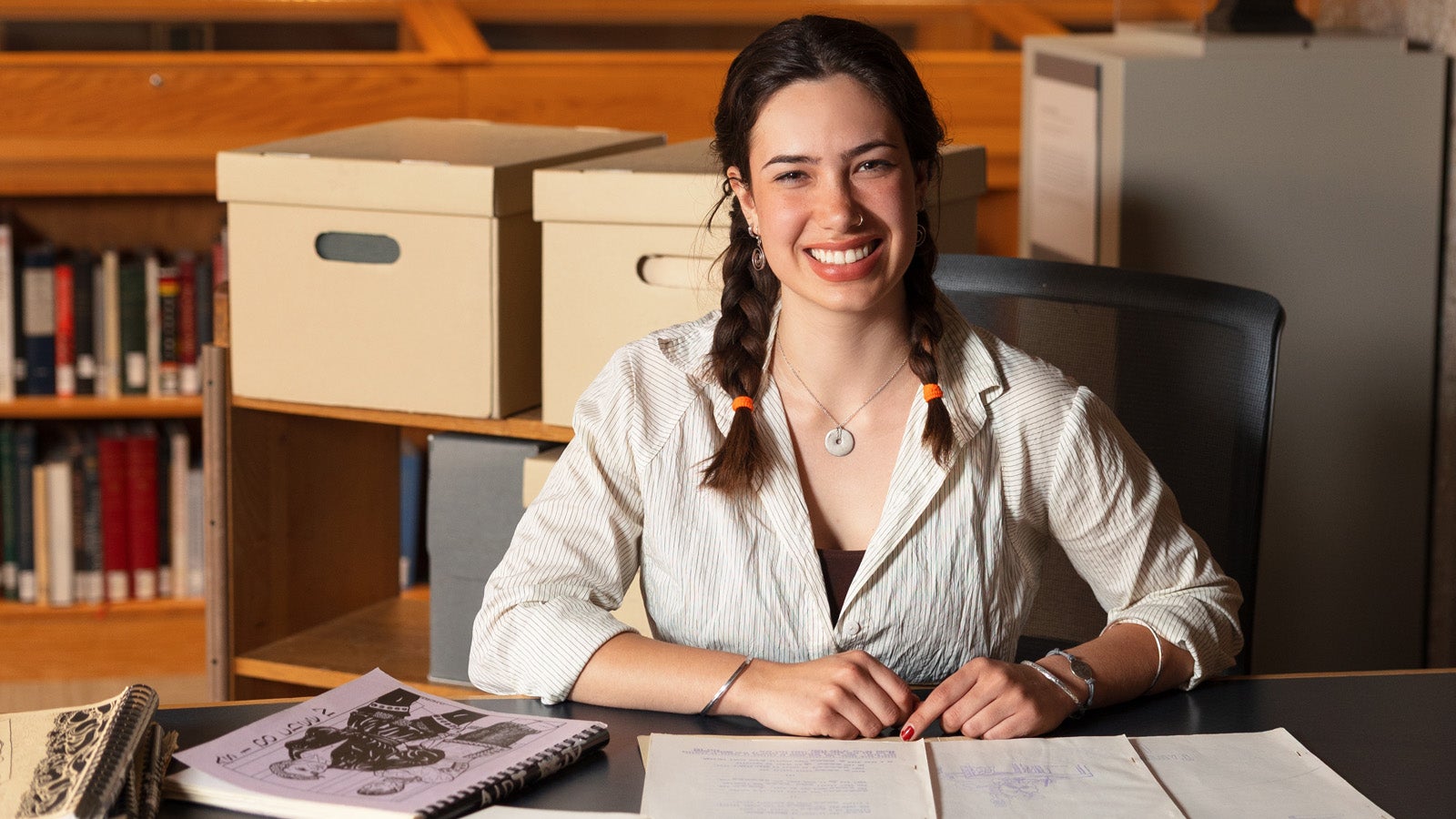
Header photo: Phoebe Dickinson ’26 explored "Star Trek" fanfiction from the 1960s in a paper for her book studies minor.
Header photo credit: Tanya Rosen-Jones '97
When you think about it, anything can be a book, from classic bound volumes to Star Trek fanfiction scrawled in indie zines from the 1960s.
Phoebe Dickinson ’26 explored this early Trekkie content—specifically, a story titled “Star Drek,” by Ruth Berman, first published in a cheaply printed science fiction fantasy zine called Pantopon—in a paper for her book studies minor. The course of study expanded her thinking around the world of books.
“You can think about, ‘Why was this book made, and who made it, and who was it made for?’” says Dickinson, a biology major who also earned an English minor. “It just opens up a lot more questions that you can ask about books other than just, ‘What do they say?’”
At Oberlin, those open-ended questions are at the heart of the book studies minor, an interdisciplinary program that asks students to look beyond texts and consider books as physical objects shaped by culture, history, and technology. Started as a weekend workshop organized by Senior Associate Dean of the College of Arts and Sciences Laura Baudot and Donald R. Longman Professor of English and Comparative Literature Wendy Beth Hyman, the initiative has bloomed into a course of study that broadly intersects with majors such as anthropology, psychology, art history, East Asian Studies, studio arts, and cinema studies.
At its core, the minor is based on the premise that the study of books—these primary and secondary drafts of history—remains critical to understanding culture. Students take five classes: two foundation courses, two history or theory courses, and one experiential course like papermaking or letterpress. Courses are far-ranging, examining topics such as medieval European manuscripts, early modern Japanese books, and graphic novels.
The whole point of the minor is “to think about the relationship between medium and message,” Hyman says. “It’s widely ranging from papyrus to cuneiform, through the origin of the novel, through multimedia design, screen printing. There’s a whole wide range of thinking about what happens when we instantiate or materialize language and art.”
Much of book studies digs into historical formats of books, like tablets, parchment, and prints created with movable type. But in hands-on Winter Term classes like the papermaking intensive, led by Aimee Lee ’99, or another on letterpress printing, students walk away with their own creations.
“I think that it’s not accidental in such a digital world that students are just brought to life by touching and making original objects,” Hyman says.
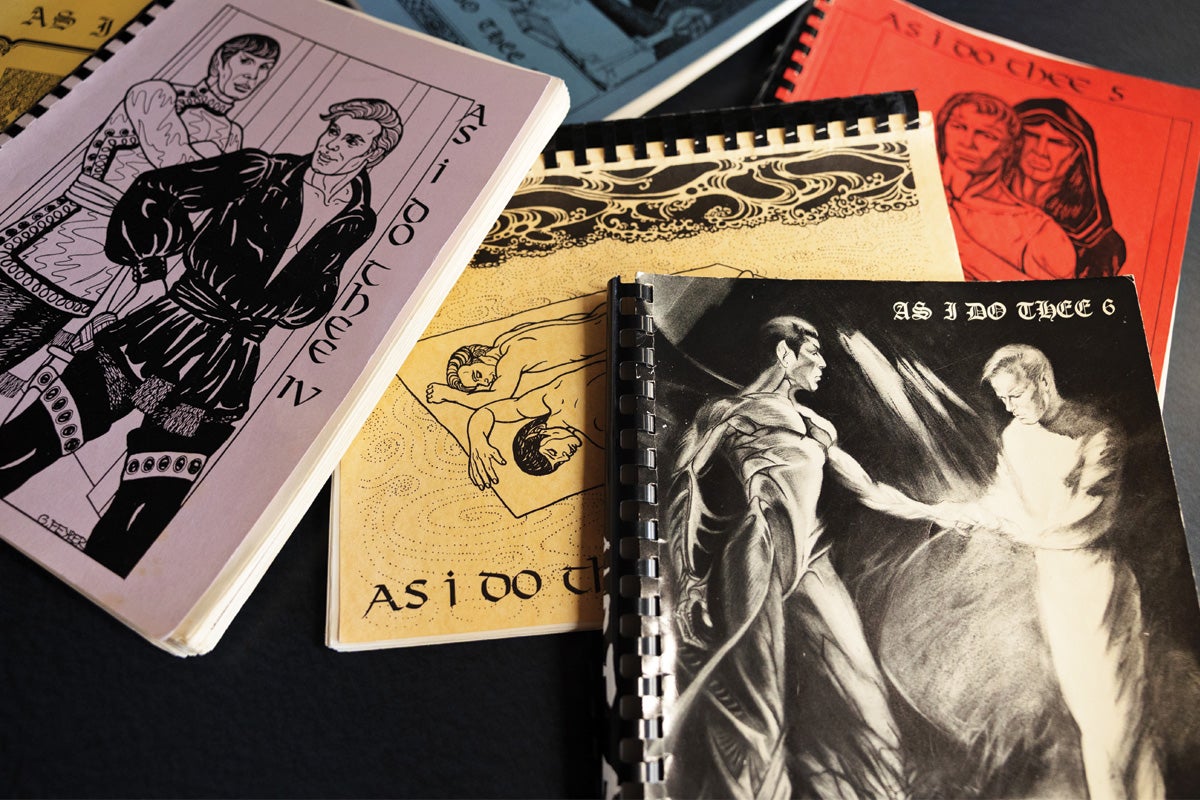
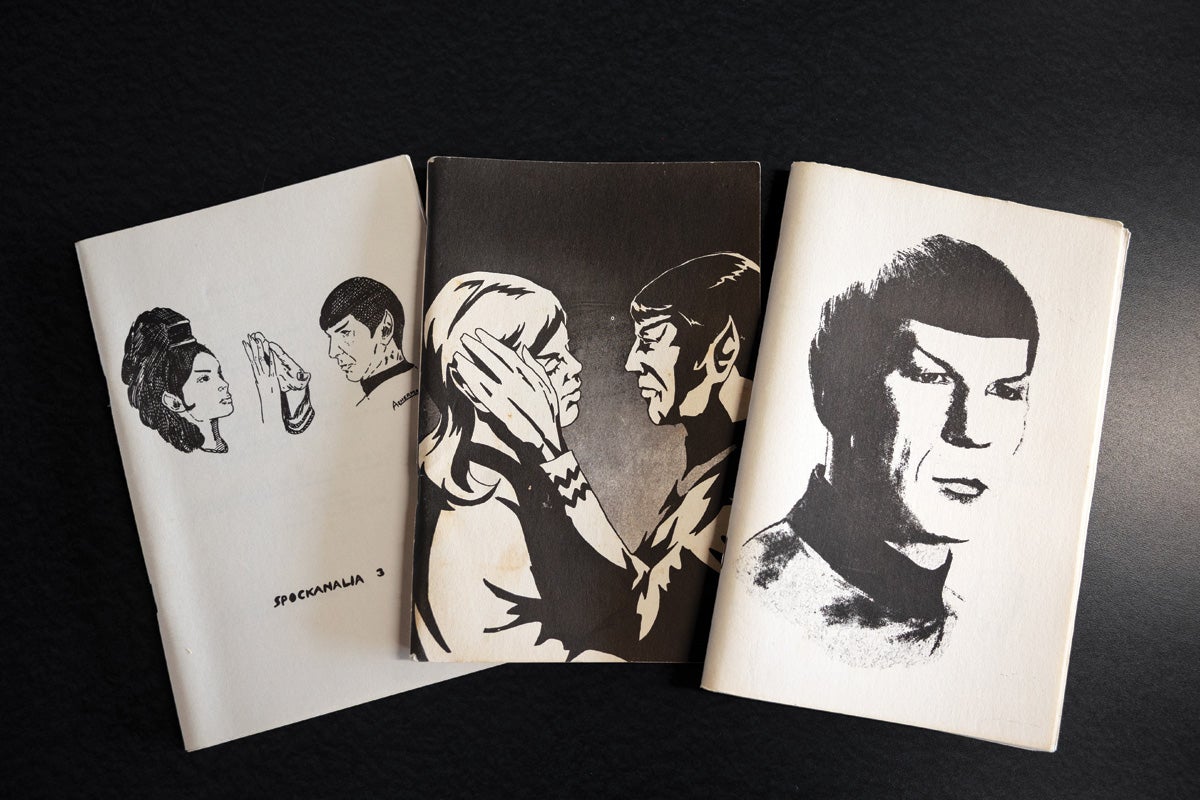
Photo credit: Tanya Rosen-Jones '97
"Star Trek" fan fiction from the 1960s is just one of the things that students can study as part of Oberlin's book minor.
The minor also encourages students to page through the book’s many historical forms. The holdings in Oberlin’s main, science, art, conservatory, and special collections libraries play an important role in that experience.
Here’s a tip-of-the-iceberg view of Oberlin’s collections, mainly compiled through alumni donations: North African Torah scrolls; a 7,000-piece Spanish Golden Age drama collection; preserved one-of-a-kind artist books; anti-slavery tracts; and the archives of the groundbreaking feminist book publisher Seal Press. The medium of each is just as fascinating as the stories it may contain; for example, Mildred C. Jay Professor of Medieval Art History Erik Inglis ’89 has learned more about world history by studying Chinese wood block printing and Korean movable type.
“If you’re focused only on the European book,” he says, “you’re actually belated when it comes to printing.”
Oberlin’s library collections are key to Inglis’ Intro to Book Studies course. His classes spend about 25 percent of their time in libraries or museums conducting research and exploring a preserved history of media.
“The intro course is the constant discovery of stuff that’s already in the library, which is one of the really exciting things about it,” Inglis says. “It’s taking an asset that Oberlin has and making it useful as much as possible.”
In Inglis’ class, Caleigh Lyons ’25 found inspiration in a beaded Dakota hymnal, containing a collection of hymns in the Dakota language, in Oberlin’s Special Collections. The cover is a work of art in itself: an animal hide featuring vibrant glass beaded images of a cross and flowers.
Lyons, who majored in English and cinema studies and minored in gender, sexuality, and feminist studies, says the class paper had a big impact on her academic career. Her research on the hymnal earned Oberlin’s Alison Scott Ricker Research Award and was used in her application for Brown University’s master’s in public humanities program, where Lyons now studies aspects of librarianship and archive work.
“I think realizing that all the stuff is there for the students, it takes a minute to realize that,” Lyons says about Oberlin’s collections. “But having classes that are in Special Collections or in the Allen [Memorial Art Museum] can lay the seeds.”
Hyman has seen former book studies students find careers as book cover designers, teachers, librarians, and archivists. One alum participated in a conservation program in Rome, where they learned how to preserve historical texts and recover information.
English major Loie Schiller ’26 plans to use her book studies minor in a postgraduation apprenticeship with a bookbinder to learn more about bookmaking. Then, she hopes to learn more about conservation and book restoration.
“I think it’s really important to keep those traditions alive, of historical bookbinding, and also to figure out new ways to do it and continue to innovate with that form,” Schiller says. “In the current digital age, especially with AI, I think there’s a real desire for physical, tactile, real experience that books can provide in a way that being online can’t.”
This article originally appeared in the Spring 2026 issue of the Oberlin Alumni Magazine.
You may also like…
Jane Wickline ’21 Finds Community in Comedy
A Q&A with the Saturday Night Live cast member and Dukes cofounder
When Stars Align
The Oberlin Contemporary Music Ensemble shines on Jennifer Koh ’97’s "The American Concerto, Volume One."
Wright On, Sister
Would the Wright brothers have invented their airplane without the support of their sister, Katharine Wright Class of 1898? Probably. But they might not have been the first.