Alli Roshni ’23 Awarded the Weidenfeld-Hoffmann Scholarship
The prestigious award covers her entire tuition fee for a master’s of science in global health science and epidemiology at the University of Oxford
July 31, 2025
Communications Staff
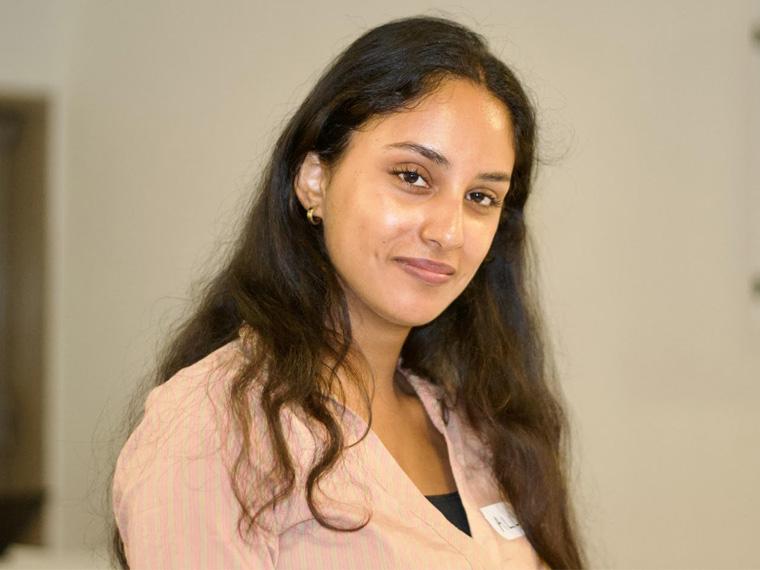
The biology and economics major from Delhi, India, also won the 2023 Nexial Prize.
Photo credit: Courtesy of Alli Roshni '23
Alli Roshni ’23 has been awarded the Weidenfeld-Hoffmann Scholarship, a prestigious award that covers her entire tuition fee for a master’s of science in global health science and epidemiology at the University of Oxford, as well as living, travel, and other miscellaneous costs. “I am truly so grateful for this opportunity, as I would not have been able to afford it otherwise,” says the biology and economics major from Delhi, India, who also won the 2023 Nexial Prize.
As part of this scholarship, Roshni will participate in a Leadership Programme, which involves “various extracurricular activities and events” throughout her period of study at Oxford. “I am very much looking forward to all of these activities,” Roshni says, “and also hope that interacting with the diverse cohort of scholars, who this year come from 24 different countries, would allow the opportunity to spark collaborations that I hope will result in concrete, interdisciplinary future efforts harnessing my commitment to population health.”
What have you been up to since graduating from Oberlin?
From 2023-24, I was awarded a Watson Fellowship for a fully-funded, year-long, self-designed project titled “Rethinking ‘Global Health.’” I worked in Zambia and South Africa with a University of Cape Town/University of Oxford team to research the intersections of HIV and gender-based violence and the experiences of young HIV peer counselors. Also, I provided administrative, website, medical, and educational support for the South African Butterfly Home for pediatric palliative care.
Following this, in Jordan I researched the reproductive health of migrant garment workers, conducted health surveys with Sudanese, Somalian, and Yemeni refugees, and supported skills-building and English-teaching programs.
I am also currently co-founder of the Khushtaar Initiative, a non-profit that aims to bridge access to healthcare for girls and women from minority communities in India through community-based interventions, while continuing to work on research projects stemming from my Watson work.
How does pursuing the Weidenfeld-Hoffmann Scholarship align with your post-college life and career goals?
My lifelong aspiration is to channel my commitment to public health into outcomes that leave meaningful, lasting fingerprints on the intricate machinery of our world. However, growing up and working extensively in countries where “aid” is fettered by a lack of remorse towards history – and “development” rings hollow without the profound power of empathy – has influenced me deeply.
I want to ensure that my future work actively grapples with the roots of the issues of our world, both abstract and concrete, and the Weidenfeld-Hoffmann Leadership Programme would offer a life-changing opportunity to merge the intellectual stimulation of academia with the practical skills required to perhaps actually make a difference.
How did Oberlin shape or influence you to pursue the Weidenfeld-Hoffmann Scholarship?
I always knew with certainty that my future work would focus on social justice, and being at Oberlin allowed me to deeply understand the nuanced and multifaceted ways in which it might be possible to achieve this goal. It allowed me the opportunity to interact with a student body who largely had similar aspirations to me, and made me feel hopeful about the future of student organizing, whether that was through my work with the Oberlin Public Health Society, the Reproductive Justice Alliance, OSCA, Third World Co-op, or the Asian American Alliance.
The liberal arts framework also allowed me to peel back some of the layers of our world and understand the social, cultural, economic, environmental, and physiological factors that interact and interconnect to make our world the way it is, for better or for worse—particularly during classes such as Disease Ecology with Emerita Professor of Biology Mary Garvin; Designer Babies and Other Possibilities with Emerita Professor of Biology Yolanda Cruz; and The Economics of Housing and Real Estate with Professor of Economics Ron Cheung, as well as Winter Term projects on climate and sanitation and my extracurricular work.
What’s the best advice you’ve received from your Oberlin faculty mentors?
I’ll mention two. The first is from Yolanda Cruz, who once told me to relax and not take achievement as a challenge, which is definitely something I do. The second is from Mary Garvin, who taught me how important it is to advocate for yourself!
Connect with Fellowships & Awards to learn more about the opportunities available to students.
You may also like…
Reyna Berry ’27 earns a 2026-27 Newman Civic Fellowship
The theater major will continue her work supporting prison and detention center programming

Andy Roshal '26 earns DAAD scholarship
The Hartsdale, New York, native will travel to Germany to expand on the Yiddish studies they began here at Oberlin.
Nissa Berle ’24 earns Fulbright Study/Research Award
The psychology major will earn a master’s degree in disaster and emergency management at York University