
Running to the Noise, Episode 26
From Big Dreams to City Hall: Ali Najmi ’06 on Electing Mayor Zohran Mamdani and Reshaping New York’s Courts
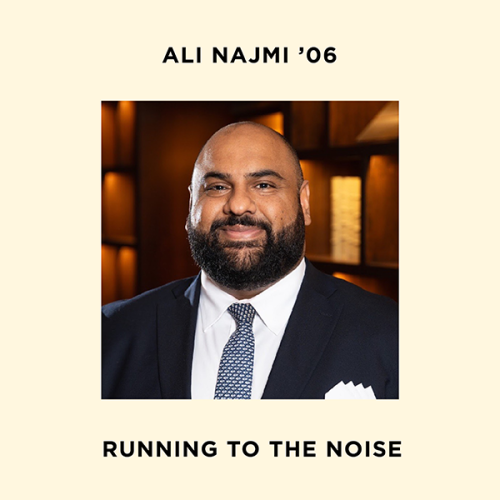
A decade ago, Ali Najmi ’06 ran for city council in Queens and lost. But that loss forged a partnership and a political foundation that would eventually help propel Zohran Mamdani to the mayor’s office in New York City.
Today, Ali sits at the center of power in the nation’s largest city as Mayor Mamdani’s election lawyer, trusted advisor, and chair of the Mayor’s Advisory Committee on the Judiciary. From organizing immigrant communities to reshaping New York’s criminal and family courts, Ali’s story is about representation, persistence, and what it takes to move from insurgent campaigns to the hard work of governing.
In this episode of Running to the Noise, President Carmen Ambar speaks with Ali about identity, authenticity in politics, and the courage to dream big. They explore what it means to build coalitions across communities, to lose and learn, and to carry big ambitions into real institutional power.
Ali reflects on belief as a political force. Belief in yourself. Belief in your community. Belief that what sounds unrealistic today can become institutional reality tomorrow. From a hookah bar conversation about running for mayor to reshaping the city’s judiciary, his journey is a reminder that dreaming big is only the beginning. The work that follows is what turns vision into change.
What We Cover in this Episode
- Growing up in Queens as the son of immigrants and becoming the first in his family to graduate from college and law school
- Leadership at Oberlin, including organizing for a permanent Muslim prayer space on campus
- What he learned from running for city council and losing
- The origins of his partnership with Mayor Zohran Mamdani
- Lessons from insurgent campaigns and multiracial coalitions
- How authenticity and affordability became winning political messages
- The transition from campaigning to governing
- The work of the Mayor’s Advisory Committee on the Judiciary and why criminal and family court judges shape daily life in New York City
- What it means to run to the noise in public service
Listen Now
Carmen Twillie Ambar: I am Carmen Twillie Ambar, president of Oberlin College and Conservatory. Welcome to Running to the Noise, where I speak with all sorts of folks who are tackling our toughest problems and working to spark positive change around the world. Because here at Oberlin, we don’t shy away from the challenging situations that threaten to divide us.
We run toward them.
Ali Najmi grew up in Queens. He’s the son of immigrants and became the first in his family to graduate from college and law school. Today he sits at the center of power in the largest city in America. He is Mayor Zoran Mamdani’s election lawyer and one of his closest advisors, someone Mamdani calls his brother.
On January 1st, 2026, Mamdani was sworn in as mayor of New York City. The next day, he appointed Ali as chair of the Mayor’s Advisory Committee on the Judiciary, the body that helps determine who becomes a judge in New York City’s family and criminal courts—courts that shape the lives of thousands of New Yorkers every day.
But their story didn’t begin at City Hall. A decade ago, Ali ran for city council in Queens and lost. A young Zoran Mamdani volunteered on that campaign, and together they knocked on doors trying to mobilize voters in communities long dismissed as politically marginal. The loss left Ali disillusioned, but it also forged a partnership.
Now that work has shifted from knocking on doors and building a movement to governing eight and a half million people. So what does it take to move from an insurgent campaign to institutional responsibility? And what happens when the work shifts from winning elections to reshaping the courts that decide freedom, family, and opportunity?
In this episode, we’re talking to Ali about power, reform, and what it means to govern with your values intact. Welcome to Running to the Noise podcast. We’re so glad to have you.
Ali Najmi: Thank you. It’s great to be on.
Carmen: So I’ve been looking forward to this conversation for a while because the Zoran Mamdani campaign has captured everyone’s attention, and it didn’t surprise me at all that there were some Obies at the center of it.
We certainly want to get to your role in that campaign and how you all met and what your next steps are, but it didn’t seem right without starting out with your little Oberlin origins. I know you were born and raised in Queens. What drew you to Oberlin?
Ali: Yes, I’m from Queens, New York, born and raised, and I’m still in Queens. Same number, same hood, as we say.
Carmen: Oh really? Where in Queens?
Ali: In eastern Queens, in Glen Oaks. It’s close to Long Island. Very sort of residential area, but a great place to be.
Carmen: So I used to live in Astoria, which is why I was asking.
Ali: Oh, because I used to work for the Corporation Counsel’s Office.
Carmen: For those people who don’t know, I practiced in New York City representing the City of New York at the Corporation Counsel’s Office. So I was an attorney for the Corporation Counsel’s Office for about five years. Took my N and R train down to 100 Church Street, so I know Queens.
Ali: So Zoran Mamdani represented Astoria. And you probably lived in the district that he represented before he became mayor.
Getting to Oberlin, I went to high school in Manhattan, and my sister, who is 14 years older than me and was at that time an English teacher and became a principal, was very much involved in my academic life and getting me ready for college and making sure that I knew all my options.
And she was a big believer in small liberal arts colleges.
Carmen: We love her.
Ali: Yes. And she opened my eyes to a couple of schools that I wouldn’t have otherwise thought of. And Oberlin was at the top of the list. And my high school had always a couple of kids that go to Oberlin every year.
Even when I went, there were another two or three people that came. So I applied to Oberlin, I visited, I really loved the history of the school. I loved the music that was on campus. I loved that it was a small school that was really committed to academic excellence and a place where I think it was, and it still is, a creative hub.
I knew I didn’t want a big school. I knew I didn’t want to be involved in the frat life. And so it was a perfect fit for me, and I’m so happy I went to Oberlin.
Carmen: I love it.
Ali: I still have a lot of love in my heart for Oberlin, and I wouldn’t be where I am today without the college.
Carmen: Oh, that makes me feel so good. I’m wondering, when you think about your Oberlin experience, is there anything that you were involved in while you were here that you can directly link to your organizing and campaign work, anything that happened while you were here at Oberlin that you could say, well, man, that’s a few breadcrumbs away from where I ultimately ended up?
Ali: I was very involved in religious life at the college. I was the president of the Muslim Students Association at Oberlin, which wasn’t the biggest group.
But one of the things I did accomplish was getting that permanent prayer space in Wilder.
Carmen: Yes, yes, the prayer room space.
Ali: It’s a prayer space for Muslim students. And if you’re an observant Muslim, you have five prayers a day. To do them in congregation is better. We wanted to have a space, particularly in the religious wing of Wilder where the other groups are, and we were able to convince the administration at that time to give us this permanent prayer space.
It’s a small room, but it’s big enough to hold a couple of us and to pray together, to worship together, and to make our mark in the religious wing.
Carmen: Excellent.
Ali: That was all me during my tenure. I was organizing and representing this community, even at Oberlin. That was my first part of being a leader of a community in that sense.
The passion for that also translated here to New York, and we’ve elected the first Muslim mayor of the city of New York, a mayor for all communities. But the fact that he’s the first Muslim mayor is not lost upon us and was a big driving force of my involvement in organizing with him. And it’s sort of how we found each other 10 years ago.
Carmen: I’d certainly want to get to the conversation about him being the first Muslim mayor, but I wanted to go back to some of your early times, because I know you ran for public office, and I’m wondering what you learned from that experience and anything you would want us to know about what it means to have feet on the ground running a campaign.
Ali: The first election I ever ran was an election for class trustee of Oberlin College.
Carmen: It’s true. I didn’t know it was your first election, but I knew you were a class trustee. So just for the audience, one of the distinctive things about Oberlin is we have what we call class trustees, and it’s a way for the institution to tap into very recent graduates, and they’re an important part of how we think about leadership of the college with these young trustees.
Ali, you were a class trustee, what, in like 2006 or so?
Ali: Right. 2006 through 2009.
Carmen: For your term. And so that was your first campaign. What did you learn from that?
Ali: My first campaign, and it was a decisive win.
Carmen: Ah, I love it.
Ali: And I saw it as an opportunity to really learn something. And the network that I made on the board of trustees is one that I’ve carried over with me through my political work. In my first campaign, a lot of the bigger donors were Oberlin trustees.
And so I’m thankful to the Oberlin network.
But to answer your main question, when I ran for City Council in 2015, I had already been organizing. I went to law school straight after Oberlin in New York. When I graduated, I worked in the City Council for two years. Then I left the City Council to start my own law practice because I wanted to be my own boss and I wanted to do community organizing as much as I wanted to.
And I knew I wanted to be in politics at that time. To be completely candid with you, I was like a full-time political candidate moonlighting as an attorney. And I did that for a couple of years. I didn’t know when the seat was going to open up. What I wanted most out of my life at that moment was to be in elected office.
Now my priorities have completely changed, but at that time, that’s what I wanted for myself the most. I had the bug.
Carmen: Ali, so what was driving you to say, I want to be in public service, I want to be in political office? I’m doing this law thing on the side to, I’m assuming, pay the bills and make life work, right? But what were the issues that were animating your campaign and why you wanted to be a city council person?
Ali: I come from a neighborhood in Queens that has had a huge immigrant influx, particularly from the South Asian American community, immigrants from India, Pakistan, Bangladesh, Indo-Caribbean people as well. And there was no representation.
And New York City politics has a lot of community groups represented, and certain neighborhoods have a particular flavor, and their elected officials come from those communities and they represent particular interests. That’s just what New York City is like.
Carmen: That’s totally right.
Ali: At that time, there was no elected official of South Asian origin in New York City, despite the fact that the community was in all of New York City.
Carmen: At the time?
Ali: At that time, yes. That’s correct.
Carmen: Wow.
Ali: And so one of that was just like we wanted representation.
I started something called the Muslim Democratic Club of New York, which is still a strong force here, in 2013. And, you know, we had a couple of issues. There was the quote unquote “Ground Zero mosque” debate at that time, where somebody was opening a Muslim community center and then it became a right-wing talking point and attraction.
And people were like, how could somebody try to start a mosque a couple blocks from Ground Zero, from the World Trade Center?
Carmen: Mm-hmm.
Ali: Which, you know, a couple blocks in New York City is a big deal. It’s like a whole different neighborhood.
Carmen: Yeah.
Ali: So they made it seem like they were making a mosque right on top of a sacred space of the World Trade Center, which is not true.
I saw sort of the politicization of my community. I saw my community on the menu, not at the table. And there were times where elected officials didn’t want to stand with us.
We started organizing with some colleagues to have politics as an insurance policy to us. And in a post-9/11 New York, for my community, you know, there were complications, right?
My family’s from Pakistan. My mom wore Pakistani clothes every day of her life to her job in Manhattan for like 20 years. But after 9/11, she stopped wearing it because she felt like people were looking at her weird or she could be a target.
And then we had this “Ground Zero mosque” quote unquote debate. And I hate using that word, but that’s what people know it as.
Carmen: That’s what it was at the time, yeah.
Ali: And so, you know, I was like, okay, the response wasn’t good enough, in my opinion, from the elected officials, and people were not willing to stand with us. And so I was like, this is not right.
And then we had a lot of other issues in my community, in my neighborhood in Queens. I mean, this is a city that spends hundreds of millions of dollars on senior services and senior centers, but there wasn’t a senior center that could accommodate immigrants from my community that had certain dietary restrictions and cultural sensitivities.
And I’m like, why not? We’re a big part of the tax base. We should have that type of service.
We also had a lot of people in an industry that literally moves New York, which is taxi drivers.
Carmen: Yeah.
Ali: And at that time, Uber was just coming in, but now this is still one of the biggest industries in the city of New York, and it still has a lot of people that look like they could be my dad and my uncle driving that cab.
Carmen: Right.
Ali: And I felt they had zero representation.
And this is at that time. Now we have the biggest champion of taxi drivers and Uber drivers as the mayor of the city of New York, right? We have a South Asian mayor. We have a Muslim mayor.
So, you know, we have taken this to the highest level and of great success, but these were the factors that were on my mind that were motivating me.
Carmen: So I love that because we are constantly talking about how to get engaged, how to get involved, but not a lot of people decide that the way I’m going to do it is to put my name on the line in the process.
So I know that campaign was a tough campaign, and I think that it wasn’t a successful campaign in terms of winning that campaign.
And, you know, I want to know what you learned from not having success, right? Because I’m having this conversation with students all the time about what you learn from people viewing you as a success, but sometimes you learn a lot from the times when things don’t go quite the way you wanted it to go.
So I know that was tough, because I read enough about you to know that was brutal. But now that you’ve had some time to reflect, what did you learn from it?
Ali: You’re 100 percent right. You learn the best from losing or from failing.
And politics is something that takes time to develop. So I learned how to run an election. I learned the ins and outs of election law, how to sit for an endorsement interview, how to burn the phones and set a fundraising record.
I learned how to ask people for money.
Carmen: I was gonna say, that’s why that hit so hard. When you said that, I was like, I know that part of the job.
Ali: Right. And that involves maintaining relationships, cultivating a donor.
I learned about the press and media and how to really cultivate earned media for yourself or your agenda or your issue.
And you cannot chop a tree down with one swing of the ax.
There were some successes in this campaign, many of them.
First of all, I had a huge volunteer base. I also was running as the most progressive candidate. I know I mentioned a lot of issues related specifically to an ethnic community, but I really was a candidate for all communities, and my platform was very diverse.
And I was the progressive left candidate on criminal justice reform in my race, on issues of funding, on issues of decision-making, on how to include people as a grassroots council member if I were to get elected.
And I got a lot of heat for some of those issues. I was the progressive candidate talking about police reform in a district where that wasn’t really easy at that time, especially at that time.
Carmen: Yeah.
Ali: I also got the New York Times to endorse me, and no one reads the New York Times where I’m from, but they still endorsed me.
Carmen: That’s right. Well, I think everyone loves a New York Times endorsement, even if people don’t read it, right? You gotta feel good about that.
Ali: But I sat through the editorial board’s interview, and I sat through a bunch of labor union interviews, and these are all things that I learned that I then got to pass on.
Many of these I passed on to Zoran Mamdani.
My race at that time was a well-watched race for people who cared about the issues that I cared about. This was a race that got the ball rolling.
I was one of the most legitimate candidates out of my community to run at that time.
Carmen: Right.
Ali: And it was at that time that a young Zoran Mamdani read about me in the Village Voice and decided to come and volunteer on my race.
Carmen: Oh wow. I knew that he had volunteered on your campaign, but I didn’t know that it came—he really just read something in Village Voice and said, I’m going to go and meet this person and try to get involved.
Ali: Yes. And then he sent correspondence to our campaign, and they were like, hey, this guy really wants to knock doors with you.
I’m like, okay, tell him to come by.
And I still remember the first time I met him.
Carmen: So what happened in that first meeting?
Ali: I’m in full candidate mode. I look completely the part—white shirt, tie, rolled-up sleeves. I’m there, I’m on.
Carmen: Your candidate uniform.
Ali: I’m in my candidate uniform.
At that time I was 31 years old. Zoran was 22, I think, or 23. And he comes in, you know, thousand-watt smile, just so eager to learn from me and to be part of this.
The first door he ever knocked on was alongside me. He joined me on a canvas, and we went through a neighborhood called Queens Village, very diverse neighborhood.
Carmen: Yeah, of course. Know that well.
Ali: We knocked on a bunch of doors together, and he got to hear my pitch, and he was holding my literature and just absorbing it.
Carmen: That is an incredible story, and it reminds me of how mentorship changes, roles change.
And I guess one of the things that I learned just from listening to you is sometimes you have to learn the foundations of something.
It seems like you got kind of the nitty-gritty of campaign work that really prepared you foundationally to help Mamdani when he begins his bid, right?
So I’m wondering, that first conversation with him was about when he was contemplating his run. We all view you as, because we’re Obies and we know Obies are doing great things, you are considered in his inner circle, the foundational core of people who were there at the beginning.
So maybe I wonder if you can take us back to those moments where he’s starting to think maybe I should do this, and what was your reaction at the time when he, I assume, says, hey, I’m kind of thinking about running for mayor. Give us a sense of what that moment was like.
Ali: Well, I think more foundational than that is him running for the assembly.
And so after we knocked on doors together, my loss—I think he might have taken my loss harder than I did, by the way—when I lost, we created a bond together, and we were inseparable since then.
And I also took Zoran and I didn’t let go of him, and he didn’t let go of me, and we kept working together.
Carmen: Right.
Ali: I put him on the board of the Muslim Democratic Club in New York. I started helping him develop. He became addicted to campaigns after that. He started being a field director of campaigns.
And we would talk about, hey, this is a good place for you to go. This is the right campaign for you to go work on.
And then ultimately, you know, he wanted to run for office. And we started talking about him running for office around 2019. He ran eventually in 2020.
I was the first person to tell him to come to Astoria. I said, this is where you gotta run, because I know your politics.
Carmen: This is where you gotta go.
Ali: This is where you gotta go.
Carmen: I’m in Astoria in, well, ’98 to kind of 2003 or so. It was kind of an immigrant community at the time. Since then it’s gotten a little gentrified from my perspective, and it’s a little bit different than it was.
Ali: Very gentrified.
Carmen: Very gentrified, but it definitely was an immigrant community and was a place where people from a variety of backgrounds could find their way. By the time he’s running for assemblyperson, what does it look like then?
Ali: By the time he runs for assembly, it’s post-AOC. It’s the People’s Republic of Astoria.
Carmen: Okay.
Ali: You have the Democratic Socialists of America who moved in heavy. You have a lot of young white kids who are gentrifiers in the neighborhood, but you still have a huge Arab immigrant community. Steinway Street is very famous.
Carmen: Of course.
Ali: A place for this. You still have your old-time Greek and Italian communities, but a lot of their kids didn’t stay in Astoria. A lot of their kids moved out of Astoria. All their kids moved to Jersey or Long Island or something like that. Their homes and apartments are being filled with a bunch of gentrifiers, yep, what some people would say.
And Astoria is a lot more hip than it was when you were there.
Carmen: Absolutely.
Ali: The rent is way more.
Carmen: I was gonna say, I couldn’t have lasted there. I was on a, I think my salary when I first started working with the law department was $29,000, and I don’t think I could afford Astoria right at this moment.
Ali: So Zoran moves to Astoria as well, and counseling him on the assembly seat, just putting the mechanics of that, I was his election lawyer then. I was his election lawyer now.
I have become one of the top election attorneys in New York City. I represent a lot of candidates and I do a lot of ballot access litigation. It’s a very niche practice. You help people qualify. Sometimes you disqualify some people too.
Carmen: You seem like you took a pleasure in that for some of the people you disqualified. I’m not gonna make it.
Ali: Sorry. But ballot access is not simple in New York. They didn’t make it simple. So mastering how to get your name on the ballot is one of the things I’ve helped people with.
With him as well, you gotta do petitions to get on, and then how to sit through an endorsement interview, that’s something I’ve passed on to people, including Zoran, at that early stage. When you’re developing somebody and you’re developing a person for success and pop-quizzing them with questions and making sure they know the stuff they need to know.
And then winning that assembly seat, running against an incumbent, was a huge thing. We finally got one of our guys in. It’s how we all felt. And we did with a multiracial—
Carmen: With a multiracial coalition, yeah.
Ali: With a huge coalition of different actors.
Carmen: Did you feel at the time, at that campaign, that it had the same upstart energy, the kind of we’re new on the block, no one expects much of us, but we’re gonna outwork the system? Was it that same energy that I think people have described the campaign you were in? Was that where you learned what to do?
Ali: Yes, definitely. I mean, for me, my race was the 1.0. This assembly race was the 2.0. And by the time we’re running for mayor, I mean, nobody else thought we were gonna win, but I knew we were.
This is the 3.0 software we’re running, and Zoran came on his own creative genius in using tools like direct-to-camera video and his social media game.
To be honest with you, with everything I’ve ever worked on, the mayoral campaign was less of an upstart campaign.
Carmen: Wow. That is a revelation, I think, but it’s a testament to the kind of foundations that you laid. When you all were thinking about this, you were confident that you all were gonna win, despite this is the mayoral campaign now. You are feeling like, hey, we know what we’re doing and we have the tools to be successful.
Ali: The first time I spoke to Zoran about the mayoral campaign was November 2023.
Carmen: Wow.
Ali: We’re sitting in a hookah bar in Astoria.
Carmen: I love it.
Ali: It’s just me and him.
Carmen: Love it.
Ali: And I—
Carmen: Did he broach it first or did you broach it first?
Ali: He broached it first. I was like, this makes perfect sense to me. I said, let’s do it because we got nothing to lose. It’s gonna be in a year where you don’t have to even give up your assembly seat to do it, because the assembly seats are even years.
I had no idea Eric Adams was gonna implode the way he did.
Carmen: Right.
Ali: And I said, you know, it could be a one-on-one. We’ll run to the left of Eric Adams. Which I knew anybody waking up on an average day would be left of Eric Adams. And you get a matching fund system in the city of New York.
Carmen: Okay.
Ali: You get an eight-to-one. So I knew that we would be able to do a huge donor base match.
Carmen: So you felt like you were gonna be able to match up from a fundraising perspective because of the way the system was designed, that you didn’t feel like you were gonna just get outspent crazy on money. You thought you could lay the foundation there?
Ali: Right. I thought if everybody stayed within the matching fund system, we would have millions of dollars to use, and there really was nothing to lose. And we take our best shot.
Was I like 100 percent we’re gonna win this? No, because how could you be? Running citywide is a big, big thing, right? We are going from, okay, we got able to run an assembly seat pretty decisively, but let’s take a shot. Let’s do something different. Why not?
Carmen: But I just want, for the audience and maybe for our students too, think just about that moment where you and Zoran are talking for the first time about this mayoral run.
And one of the things that struck me in the conversation was that moment that you tell somebody your dream, that they are with you in the moment, and they say yes to it the same way you say yes to it.
And I just want to mark that for a moment. Because when you’re out here trying to do difficult things, and when you’re out here trying to do things that people maybe don’t think are possible, be careful who you tell your dreams to. Because you want somebody who’s gonna be sitting there with you when you tell them that’s gonna say, yes, we can do it. We have nothing to lose.
Because that, for me, is a moment, right? You could have said something different. Uh, yeah, but, you know. And that totally shifts this moment that’s now become one that people around the world and the country know.
But he told his dream to someone who was gonna be with him. And in that moment you affirmed him, and that’s the moment that you take off together. I just wanted to pause for that because I’m a big believer in let’s get aligned with people who are gonna believe in us too.
Ali: That’s true. And he would feel comfortable telling me. He’s like my little brother. It’s not just an attorney-client relationship. We are brothers. And so I’ve always been there for him, although at that moment, could have been, this is a crazy idea.
Carmen: It’s a crazy idea.
Ali: But crazy ideas make change.
Carmen: Of course.
Ali: If you sit around waiting, you can’t be a big dog if you don’t get off the porch. So you gotta be willing to do something crazy. You’re not making change if you’re not doing something that other people would think, this is a crazy idea.
Carmen: I love it because I think in this world that we’re in right now, as people are trying to think about how they have an impact, it’s just important to hear these stories. You need some people to go with you, and you need somebody who says, yeah, it is crazy, but it’s the right thing to do, and let’s do it.
Ali: And that’s my advice to everybody that’s listening to this and watching this podcast, all the Oberlin students: you gotta dream big. Don’t be afraid to dream big. You then have to match it up with the work.
We gave our lives to this campaign and now also to this administration. But the level of work that followed that “yeah” was tremendous. And honestly, there’s nobody that’s working harder in politics than Zoran Mamdani. And I’ve seen the work he’s put in firsthand, and I get exhausted just seeing him do the work.
Carmen: On the outside looking in, it definitely feels like there’s a lot of intense work going on. Let’s talk a little bit more about the campaign before we get into governing, because as I’ve been thinking about this interview, I can’t help but go to that Hamilton line — “winning is easy, young man, governing’s harder.”
Ali: It’s true.
Carmen: Yeah. So I definitely want to make sure we talk a little bit about that. But as you’re in the midst of a campaign, what was the obstacle that you really had to push through and solve?
Ali: In the primary election campaign?
Carmen: Yeah, in the primary election campaign.
Ali: He had a vision and he had his message, and he was so zeroed in on the affordability message, and he went with it.
People tried to constantly throw out parts about his background, his religion, things that have nothing to do with New York City. I don’t want to give it enough credence to say it was the biggest obstacle, but something that kept coming up was this unfair slandering of him as an antisemite, which was completely baseless.
Carmen: Did you think that was just purely about his religious beliefs, his ethnic background? Was that the reason why that slander was used, or was there something more than that?
Ali: Well, it was based on his position on the Israel-Palestine conflict and positions he’s taken on that issue in support of Palestinian human rights.
What we wound up learning after this election is that most people agreed with what he was saying in support of Palestinian human rights. In fact, the more they called him an antisemite, the more young Jewish people showed up to the campaign.
Perhaps the biggest block of support that Mamdani has, that people don’t realize, is young Jewish people. You look at the donor list, you look at the names, the last names, you look at who’s knocking on the doors — because I know who our fellow campaign people are — and so it had this inverse reaction.
Carmen: I think it’s interesting because I think some people, when they look at kind of the endorsement list and they don’t see some of the more prominent Jewish organizations connected to Zoran, they may perceive that as a lack of support from the Jewish community.
But you’re saying the opposite is really true, that the core block was lots of young Jewish people who were supporting his campaign.
Ali: That’s correct. And I think what our campaign has shown is that the real political leader of the young Jewish community in New York is Mamdani. And so there’s a huge disconnect between some of the standard bearers of that community and their own youth.
Carmen: Interesting. That’s a bold statement.
Ali: Look at the numbers.
Carmen: Yeah. I’m just — the declaring it of that is bold. But I still think that’s a bold statement. As a standard bearer, as a leader of a community, would be Zoran. Yeah. That’s fascinating.
I know you are now in this position that I think I want to understand more, because I know the mayor’s appointed you to the advisory committee on the judiciary, and I want to understand that role.
But I guess I want to step back to — I’m imagining you all in this elated moment where you’ve won this campaign, this thing that you’ve imagined has come true. Like a lot of us who take on things that are a little bit larger than what we planned, you get there and it is harder than you thought it was — the governing part of this.
I’m wondering what surprised you the most as you start to get into the governing phase?
Ali: I was lead counsel to his campaign and also to the transition, and that was quite an experience.
I have decided not to go into City Hall, because I wanted to remain in private practice.
Carmen: Yeah. So you’re not a city employee?
Ali: So I’m not a city employee.
Carmen: I was wondering, because I didn’t know where this judicial advisory committee — how it framed itself.
Ali: Right.
Carmen: Before we were talking, I realized where Ali was physically sitting at this interview, and I used to be a city employee, so I was trying to figure out if this was one of my city buildings that I know.
So you’re not a city employee. You’re in this advisory role, and you decided to do that because you wanted to keep practicing. Was there any other reason?
Ali: I wanted to keep making money, to be candid with you.
Carmen: Listen, we tell the truth on this podcast.
Ali: And just what was right for me at this moment in time, and for my family, was to maintain private practice. And it was not an easy decision for me to make.
But I am happy to have helped shape the people that are filling in City Hall. As lead counsel during the transition, I was involved in a lot of the vetting and appointments process — picking the chief counsel, helping pick the corporation counsel, helping pick some of the deputy mayors and commissioners that are running the city.
And he has a really strong team.
For me, the judiciary has always been something that I really, really am invested in shaping. I’ve done it in my political life and electing judges.
In New York, you can be an elected judge or an appointed judge. There are different routes. In criminal court and family court in the city of New York, judges are appointed by the mayor.
And as somebody who’s committed to social justice and progressive lawyering, family court and criminal court are the courts that impact people’s lives the most, especially poor people.
Carmen: Yeah.
Ali: Family court is where people have their kids taken away from them. Criminal court is where people receive sentences, potentially to go to prison.
The people we put on the bench in these courts arguably have more of an impact on the lives of people than the mayor or any elected official does.
And so, in 1978, the City of New York — Mayor Koch — set up the first advisory committee on the judiciary so that there would be a standard and you’d have the highest quality people on the bench.
And that tradition has continued with every mayor after that, including Mayor Mamdani.
And so the Mayor’s Advisory Committee on the Judiciary, which I’ve been appointed chair of, is responsible for convening the rest of the members of this committee, who are all lawyers in different areas. They’re all volunteer public servants who have another day job.
The number one thing that I’m doing is recruiting a bigger applicant pool of judges.
Mayor Mamdani has stated unequivocally that he wants to see people who are qualified and deserving of being a judge, but who never thought that they could be a judge before, to be part of this.
People who have backgrounds representing indigent people, people who represented parents in family court, people who represented indigent criminal defendants, people who come from legal services and legal aid backgrounds — to apply to be on the bench.
We’re increasing the applicant pool. We are going to convene shortly and then start screening applicants and interviewing them to recommend to the mayor people to become judges.
And this year alone, there are 11 vacancies in criminal court and two in family court. So that’s 13 judges in one year. And this is a four-year appointment.
And so we have a once-in-a-lifetime opportunity to reshape New York City’s judiciary in a really strong, profound way that will be beneficial to all New Yorkers.
Carmen: That’s so fascinating. I practiced law. I’ve been many times in family and criminal court in all the boroughs of New York City, and you speak the truth in terms of those judges and the role that they play.
I’m wondering, because I guess I had understood that this particular advisory group had kind of been defunct or hadn’t been working effectively — was Zoran’s desire to bring it back fundamentally about diversity in the backgrounds of people and making sure that the people who are in these judgeships didn’t just come from a corporate background or some of these typical backgrounds? Was that the main impetus?
Ali: So it was active. It’s always been active. It was active under Mayor Adams as well.
But I think what we are doing is we’re looking for different types of lawyers to apply and to be considered for a judicial appointment.
Historically, you could say that a lot of prosecutors and court attorneys have come out of this committee.
Carmen: Yeah.
Ali: And certainly we need to have a diverse judiciary that does include people who are former prosecutors.
What’s new about this committee is that we’re going out of our way to seek people who are from these different groups of lawyers and have different backgrounds, and letting them know that your background — working at a legal services organization, defending parents in family court — that is something that we value.
And I can tell you this: lawyers who work in this background have reached out to say thank you, because we’ve never heard that before. We never thought that we could become a judge. We never thought that our application would even be considered.
Carmen: That makes sense to me, because sometimes you just think that there’s only a particular path.
And what’s powerful about what you’re doing is that if you open up that door, even when Zoran’s time is done, if that door gets opened, maybe it always stays open.
Because some of this is also about raising your hand and saying, I want to be a part of it.
Ali: Yeah.
Carmen: So I don’t want to miss this issue around the governing piece, and I know you’re not sitting in the center of the governing work, but I’m sure you and your brother have talked, as you have described him. And I’m wondering how he’s feeling about the challenge of governing — the kind of, I have to now do what I said I was going to do — and I’m wondering what pressures he’s feeling now about delivering on the promises that the campaign said they were going to pursue.
Ali: This stuff is hard. And even though I’m not in City Hall, anytime anybody doesn’t like something that the mayor’s doing, people are calling me from all over the city of New York. I’ve become that guy.
Carmen: You could have said it’s hella hard, because that’s what it is.
Ali: You have to balance. Basically what I’ve realized now is this is going to be four years where everybody’s just mad at us all the time.
Carmen: Yeah. Everybody’s just mad, and we’re probably doing it right if everybody’s just mad.
Ali: Right. And it’s such a big city with so many different interests and so many different communities and neighborhoods. It’s a daunting task.
But I can tell you that the hardest-working person in city government is the mayor right now.
Carmen: Mm-hmm.
Ali: That’s not something that you can always say about the city. But it’s true right now. And he is working overtime constantly to make sure that his agenda that he campaigned on is going to be delivered.
And then there’s a lot of basic other stuff that you don’t really think about in the campaign, like snow removal.
Carmen: Yes.
Ali: And the trash.
Carmen: And it can impact people’s view of the success of a mayor if the snow didn’t get removed during the blizzard.
Ali: Right. You could have a million-dollar smile, but if the mayor didn’t pick up your trash, you ain’t smiling.
Carmen: You ain’t smiling.
Ali: These are the sort of less glamorous things you don’t really think about, but these are hugely important. These are the core city services people rely on.
And then you have to manage hundreds of thousands of city workers.
But what we have now — he is hitting his stride. He’s been in there now just under two months. The city press corps is relentless. A New York City press corps is unlike any other.
You have a lot of very well-resourced interests and groups and people who don’t want him to succeed, who are waking up every day, spending a lot of money and time trying to change a narrative on him. So we’re constantly pushing back against that.
But I think the bottom line is he is a man of integrity. He wakes up every day wanting to do the right thing. He’s a good listener. He is doing it.
He’s there shoveling the snow himself. All the Caribbean aunties are like, where’s your hat, young man?
Carmen: Of course.
Ali: And now he’s wearing the hat.
Carmen: You’re not dressed warmly enough. The aunties are gonna be upset. Put your hat and your gloves on.
Ali: Exactly. So now he’s got the hat on. It may not look as good on TV, but he’s listening to the aunties.
And then things happen that you don’t expect. There was a horrible incident in New York City in front of a historic synagogue, 770 Eastern Parkway, world headquarters of Chabad. Somebody drove a car through it. The mayor rushed to Crown Heights to be there with the community the night that it happened and to be on the ground.
You’re constantly working. So governing is very difficult. You’re never going to make everybody happy, and you’re never going to agree with the mayor on everything.
I think the honeymoon is about to be over soon. There’s a honeymoon period for a new mayor. It’s ending very, very soon. I can feel it.
Carmen: And they never last as long as you want them to, those honeymoons.
Ali: The first preliminary budget was just released this week, and he’s dealing with a major shortfall in funds. So he’s trying to negotiate with the governor and to raise taxes on high-income earners. He doesn’t want to raise property taxes on people in the city.
So we’ll see how that goes. There’s a lot to do with the state legislature. He is going up there asking for more money.
He was able to expand universal childcare with a partnership with the governor that expanded it to two-year-olds in the city of New York in a way that’s going to get phased in. So he has had some big wins also in this short time.
Carmen: You know, I ask the question because leadership is daunting no matter what level you’re doing it at — local nonprofit to whatever it means to be the mayor of New York.
We all have to learn how to balance all the incoming, balance all the interests, and still try to get the big rocks in the jar, right? Because that’s why he was elected.
Lots of people have looked at the campaign, and obviously lots of eyes are on Zoran as he governs. Is there anything that the Democratic Party in particular can learn from that campaign?
Ali: I think there are definitely some lessons. I think the number one thing is you need to be authentic and real, and people can feel that.
People can feel that on you, and people felt that about him. He wasn’t afraid to say something that he really believed in that, in hindsight, is pretty obvious to people, but in that moment was a politically risky thing to do.
And he got a lot of flak for it, but it resonated with a lot of regular people.
If you look at what happened with Gaza and his stance on it, it resonated. Him just saying that that’s wrong and that many people dying is wrong resonated with the average voter in New York.
You have to be authentic. You have to believe something and stand by it.
And I think one of the things that the Democratic Party is struggling with is: what are you really about? You just can’t be against.
We could have run a campaign that was just “we’re against Cuomo,” but that’s not how we ran it. We ran it as, we’re here to make life affordable for New Yorkers. And that was a clear message.
Now I think the Democratic Party has taken that affordability message naturally. We gave them that message. We just saved the Democratic Party by giving them that message, because I haven’t heard a message from the Democratic Party for a while. All I’ve heard is “we’re not Trump.” That’s not good enough.
And one of the smartest things Zoran did was go to the neighborhoods in New York City where Trump did well and do street interviews.
There were areas of the Bronx that Trump won. Like him or not, you could disagree with his values, but he’s authentic and he’s saying, this is what I’m about.
We as Democrats need to be clear about what is the message. What are your values? Reaffirm them, be honest about them, and be unapologetically a Democrat.
Carmen: We’ll see if it reaches the DNC and others as they’re thinking about the campaign.
This podcast is called Running to the Noise because Michelle Obama came to Oberlin to be a graduation speaker several years ago, and she described Obies as people who run to the noise.
And I think there’s a cadre of Obies working with Zoran. I think Christine Clark is there. She’s the chair of the Commission on Human Rights.
I’m wondering what you would describe as the way you run to the noise.
Ali: Public service is about running to people’s problems. You are running right into them. You’re not running away from them.
When people are in need, you gotta run right to them. You’re here to help them. You’re here to serve the public. You’re running to the noise in that way.
There is some noise you gotta tune out.
Carmen: I’m gonna take that lesson right there. Some noise you gotta tune out, but go ahead.
Ali: The noise that you gotta tune out is the parts where people are expressing disbelief in you.
My message to all the students: you gotta believe in yourself. That’s the one thing that I think I have in common with the mayor and people who’ve done something exceptional — we have believed in ourselves when many other people didn’t believe in us.
Carmen: Amen. I love that. And yeah, for our students here who are listening, and our alums and anybody else who’s listening, believing in yourself is the foundational piece.
Lots of things can happen when you have self-belief.
I so appreciate this conversation. It’s been great for you to give us a behind-the-scenes, and we’re wishing you much success, as we do all of our Obie colleagues, but certainly those who are out there running to people’s challenges.
You’re running to the challenges that people have, trying to help them. We truly believe that our Obies go out and change the world for good. They meet it as it is, and then they go out and change it.
And we’re so glad that you are representing the Obie mantra in that way.
Ali: Thank you so much.
Episode Links
- Mayor Mamdani Appoints Ali Najmi as Chair of Mayor’s Advisory Committee on the Judiciary
- Mayor Zohran Mamdani Appoints Christine Clarke to Lead the New York City Commission on Human Rights
- Who’s who in Zohran Mamdani’s administration?: Meet the folks who are running New York City
- Office of the Mayor of New York City
Running to the Noise is a production of Oberlin College and Conservatory.