
Student Project Profile
Could Arendt’s Thinking Prevent the Next Moral Catastrophe?
Project Title
Could Arendt’s Thinking Prevent the Next Moral Catastrophe?
Faculty Mentor(s)
Project Description
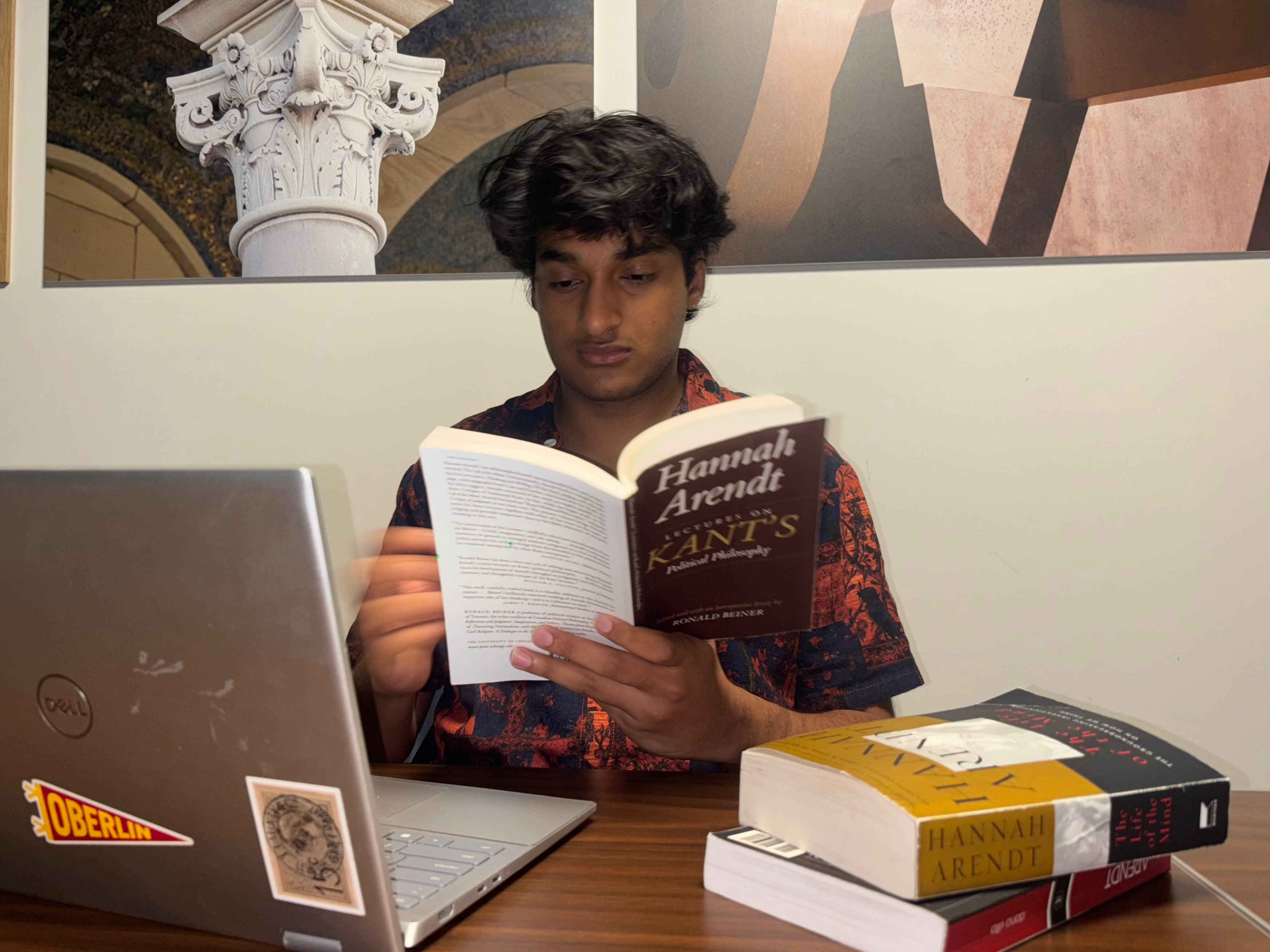
Harsh Satish studies Hannah Arendt's Lectures on Kant's Political Philosophy in the Oberlin College Libraries.
Hannah Arendt’s initial grappling with "thinking" began as a result of her covering the trial of Adolf Eichmann, a Nazi leader tried in 1961 for his prominent role in the Final Solution. Therein, she characterized the nature of Eichmann’s evil to be neither radical nor demonic, but thoughtless—arising from an organic inability to think critically. What followed was her lifelong effort to answer the question—could the activity of thinking “condition” men against evil-doing? Arendt does not end up providing a straightforward answer to this question, but nonetheless her rigorous work on it provides many useful insights into how the bridge between thought and morality may be built. My goal in this project is twofold. First, I will provide an in-depth account of what Arendt really meant by "thinking" throughout her various works, and then answer how this cognitive faculty that she describes may actually play a role in "conditioning" men to abstain from evil deeds. I will further argue that while Arendt’s account of the conscience provides the most important route to answering her question, there remain many challenges in her attempt to bridge the gap between thinking and morality which leave us in an interesting place regarding the nature of the conscience.
Why is your research important?
Arendt’s concept of the "banality of evil," which describes evil as banal or ordinary instead of radical or demonic, has lost its novelty in the present day. Every day we see egregious evils committed on massive scales by people sitting behind bureaucratic desks. In such a situation, I think it is really important to study whether thinking—an activity we take for granted from everyone—can truly prevent moral catastrophes.
What does the process of doing your research look like?
My research process starts with reading the primary texts of the author/ argument that I am interested in. This is where a lot of the important work happens. I keep notes about important things and passages, and then cross examine my reading of the argument with secondary texts. Writing consists in going back through my notes and strategically building my argument.
What knowledge has your research contributed to your field?
Hannah Arendt’s account of thinking has been extensively studied in various disciplines including political theory and literary studies. Since Arendt is not a classic analytic philosopher, and her obscure arguments have rarely been thoroughly reconstructed analytically leading up to her conclusion. I try to take on this task with my project.
In what ways have you showcased your research thus far?
I will present my research at the Oberlin Summer Research Institute Symposium. Other than that, I gave a lightning talk about my project to fellow researchers, and regularly talk about it with my friends and family.
How did you get involved in research? What drove you to seek out research experiences in college?
My research experience started simply by reaching out to my mentor and asking whether he would be interested in doing a summer research project with me. We worked through various potential projects and finalized the one I am pursuing. I heard about OSRI through various college sources and decided that it would be an amazing way to get early philosophy research experience.
What is your favorite aspect of the research process?
My favorite aspect of the research is definitely the reading process, followed by wrestling with the ideas in my head. I really enjoy philosophy and getting familiar with different arguments about the most fundamental questions humanity has asked.
How has working with your mentor impacted the development of your research project? How has it impacted you as a researcher?
Working with my mentor has been an incredibly fruitful experience for my research. Whenever I meet with him, he gives me great advice about how to further think about my project and important things I might be missing. It has been really helpful to make me a more independent researcher, as he always pushes me to work through problems myself while guiding me towards the right direction.
How has the research you’ve conducted contributed to your professional or academic development?
The research I have conducted has been great for my development as an academic. I have always been interested in pursuing graduate work in philosophy, and this project has been my first real look into what that would look like and what it will entail. It has also made me a better reader, writer, and analyst—skills I am sure will be incredibly helpful in my professional career.
Students

Harsh Satish ’28
- Major(s):
- Philosophy, Economics