
Student Project Profile
Prograde and retrograde zirconium-in-rutile thermometry of the Junction School eclogite, California, USA
Project Title
Prograde and retrograde zirconium-in-rutile thermometry of the Junction School eclogite, California, USA
Faculty Mentor(s)
Project Description
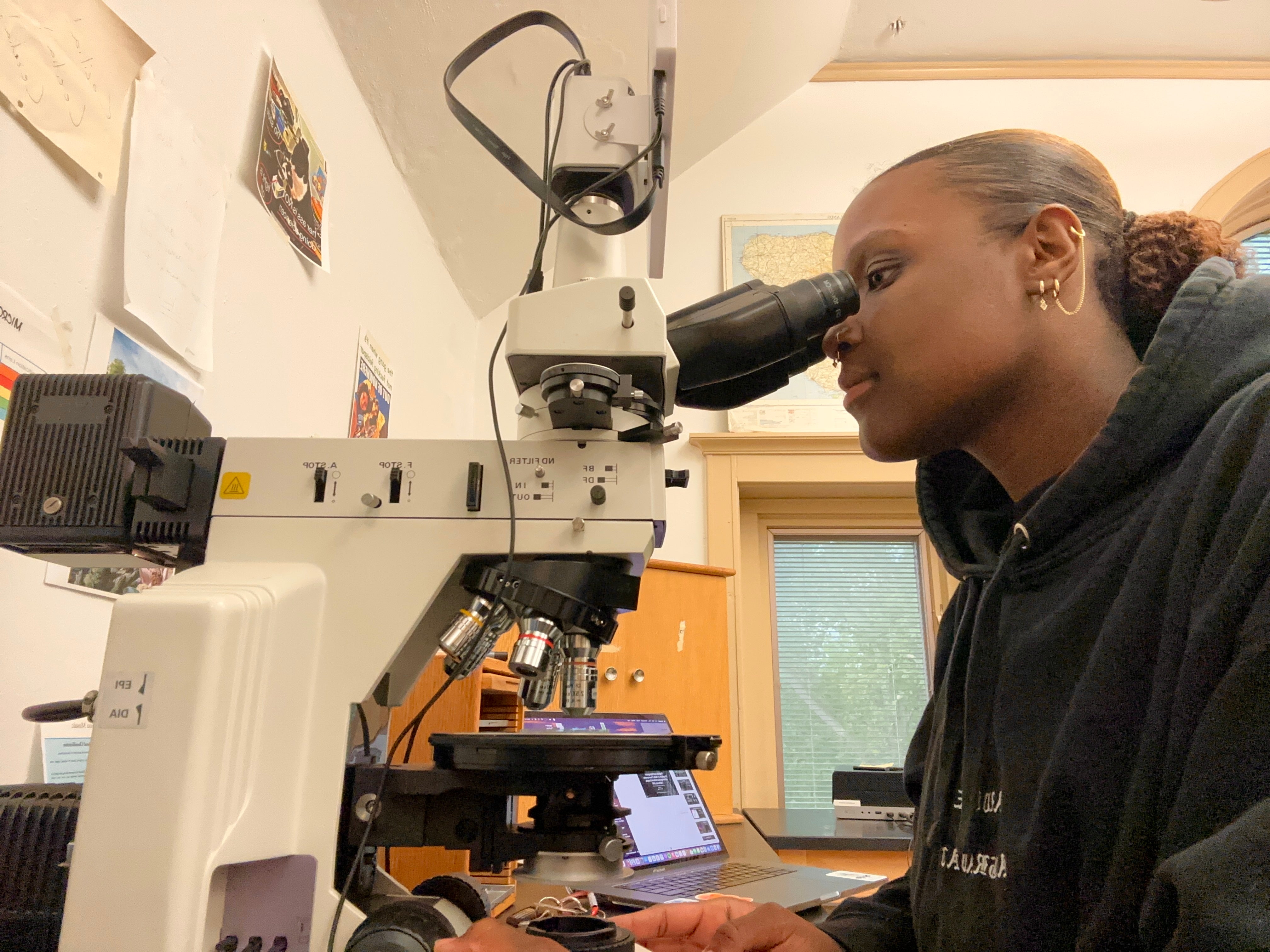
In this project, I explore how rutile (TiO₂), a titanium-rich mineral that forms during high-pressure metamorphism, can be used to estimate the temperatures rocks experienced during subduction, the process by which oceanic crust is transported deep into the mantle. Using eclogites from the Franciscan Complex in Northern California, I measure trace amounts of zirconium (Zr) in rutile using laser ablation inductively coupled plasma mass spectrometry (LA-ICP-MS). Because Zr concentration in rutile increases with temperature, it serves as an effective measure of peak metamorphic conditions. Many rutile grains are extremely small; some are preserved as inclusions within garnet, while others occur in the surrounding matrix. Thus, these rutile inclusions likely crystallized earlier during prograde metamorphism, in contrast to matrix rutiles, which record subsequent thermal overprinting during later metamorphic stages. By comparing these groups, I aim to reconstruct more complete pressure-temperature-time paths. Such comparisons will improve understandings of rutile-based thermometry, aiding more accurate interpretations of metamorphic histories while providing broader insights into subduction zone dynamics, including the processes that drive metamorphism, earthquake generation, and continental crust formation.
Why is your research important?
Understanding the temperatures that rocks experience during subduction helps geologists reconstruct how Earth's tectonic plates interact over time. My research focuses on using rutile, a titanium-rich mineral, as a thermometer to estimate these temperatures. This work helps refine how we interpret metamorphic histories in subduction zones which are environments that are fundamental to the creation of continental crust, the cycling of elements through Earth, and the generation of earthquakes. By improving how we read these geologic “records,” we gain a clearer picture of our planet’s dynamic interior.
What does the process of doing your research look like?
My research involves a combination of lab work, imaging, and geochemical analysis. First, I identify and characterize rutile grains under a microscope. Then I use laser ablation inductively coupled plasma mass spectrometry (LA-ICP-MS) to measure zirconium concentrations in these grains, which tells us about the temperatures they formed at. I compare grains inside garnet (which formed earlier) to those in the matrix (which formed later), allowing us to track how temperature changed over time.
What knowledge has your research contributed to your field?
My project contributes to a growing work of trace element thermometry in metamorphic petrology. By comparing different populations of rutile, I help refine how we interpret pressure-temperature (P–T) paths in subduction environments. These methods can be applied to other regions and rock types, expanding the tools geologists have for reconstructing tectonic processes.
In what ways have you showcased your research thus far?
Thus far I have showcased my research to my mentor, lab group, and Oberlin Summer Research Institute (OSRI) fellows in the form of a lighting talk, and showcased my research at our final OSRI research symposium. . In the future, I plan to present at the Oberlin College Research Symposium and present at the GSA (Geological Society Association) conference this fall.
How did you get involved in research? What drove you to seek out research experiences in college?
I got involved in research with the help of my faculty mentor Zeb Page. Research is something I am really interested in, and I know it will help me in terms of my career goals in the future. Professor Zeb was so enthusiastic and helpful, he made my interest a reality.
What is your favorite aspect of the research process?
My favorite aspect of the research process is all the skills I continue to learn. Being new to research it was really daunting, I was scared to make mistakes, I had imposter syndrome, and I didn't know if this was something I could do well. Going though the OSRI program really gave me the research confidence I need to continue with researching post undergrad.
How has working with your mentor impacted the development of your research project? How has it impacted you as a researcher?
Working with my mentor has impacted my development of my research project significantly. In our LOLA Lab, our LA-ICP-MS machine is very intricate and expensive. Without the help of Zeb the process would not have gone as smooth. Working with my mentor has exponentially increased my confidence as a whole. I was able to make mistakes, to learn, and then before proficient in skills I will carry with me post undergrad.
How has the research you’ve conducted contributed to your professional or academic development?
The research I have conducted will continue to contribute to my professional development because having access to a LA-ICP-MS machine is very rare. On top of that, knowing how to use it is another skill in itself. Having the knowledge of how to use this powerful tool will help in terms employment and future research in mineralogy.
What advice would you give to a younger student wanting to get involved in research in your field?
I would say just do it! It will be scary, you will make mistakes, but that is all a part of the process. You have to be new to something to then be good at something, so just do it!
Students
Alira Allen ’26
fourth-year- Major(s):
- Geosciences, Sociology