
Student Project Profile
Untangling Repeated Episodes of Metamorphism: Zirconium-in-Rutile Thermometry of the Bakersville Eclogite
Project Title
Untangling Repeated Episodes of Metamorphism: Zirconium-in-Rutile Thermometry of the Bakersville Eclogite
Faculty Mentor(s)
Project Description
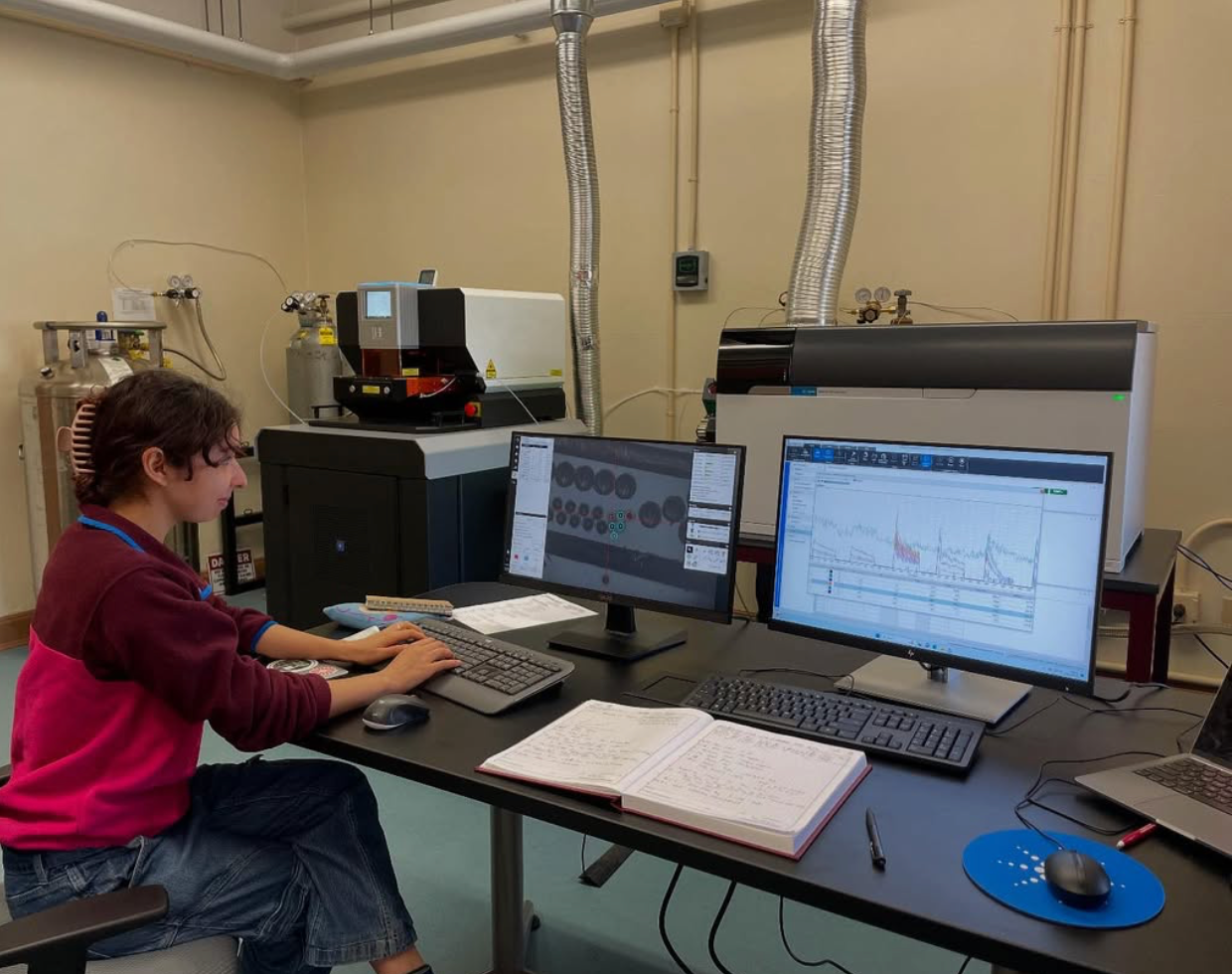
My project looks at metamorphic rocks called eclogites from the Bakersville, North Carolina area in the Appalachian Mountains. The Bakersville eclogite formed during the subduction of one tectonic plate under another, an event which led to the plate collision that began the formation of the Appalachian Mountains 460 million years ago. My research seeks to reconstruct the pressure-temperature path that the eclogite took during its subduction. After the initial metamorphism spurred by subduction, the eclogite experienced more metamorphism when it was exhumed, or brought to the Earth’s surface. The exhumation of the eclogite caused it to retrogress to a lower level of metamorphism. This retrogression caused overprinting, or a partial erasure of the rock’s initial metamorphism. We use zirconium-in-rutile thermometry to measure the amount of the trace element zirconium in the mineral rutile. The amount of zirconium in rutile is temperature dependent, allowing us to obtain temperature data from zirconium concentrations. Trace elements are more resistant to the decompression caused by exhumation, suggesting that we may be able to see through the overprinting and obtain data that reflects the subduction temperatures.
Why is your research important?
My research into the Bakersville eclogite contributes to greater understanding of how crustal recycling and mountain building function. These critical processes, both driven by subduction, are how Earth restructures itself over millions of years. Understanding these processes, which are still occurring across the world, helps us reveal the inner workings of our planet.
What does the process of doing your research look like?
Most of my research occurs in a dry lab, using highly sensitive instruments to do chemical analyses of rocks. I spend a lot of time collecting data and refining our analysis techniques to better suit our needs. Part of my work is overseen by my mentor, but as I’ve gained experience, more of my work is independent.
What knowledge has your research contributed to your field?
My research has contributed to understanding of the earliest stages of the formation of the Appalachian Mountains. Additionally, my current work with zirconium-in-rutile thermometry will test the efficacy of the method on rocks that have experienced overprinting, which is valuable knowledge for other researchers.
In what ways have you showcased your research thus far?
I have presented previous research into the Bakersville eclogite at the Geological Society of America Southeast Section Meeting in 2024. Here at Oberlin, I participated in the Oberlin College Research Symposium, and most recently I presented at the Oberlin Summer Research Symposium.
How did you get involved in research? What drove you to seek out research experiences in college?
I got involved in research through a Geosciences Department program that is generously funded by an Oberlin Geosciences alumna, Carole Hickman. I have always enjoyed hands-on learning, and I felt that research would be a great way to experience that at Oberlin.
What is your favorite aspect of the research process?
I do work with some really cool instruments, such as a scanning electron microscope (SEM) and a laser ablation inductively coupled mass spectrometer (LA-ICP-MS). These instruments allow me to analyze rocks at the scale of fractions of a millimeter. I feel incredibly lucky to have the opportunity to use these instruments (often independently!) as an undergraduate student.
How has the research you’ve conducted contributed to your professional or academic development?
Over the last year, this project has developed into my undergraduate honors thesis. After Oberlin, I’m looking to attend graduate school for geosciences. I believe that the skills I have acquired through my research will serve me well in that endeavor!
What advice would you give to a younger student wanting to get involved in research in your field?
My greatest piece of advice is to not let imposter syndrome get in the way of pursuing research. You won’t know everything, and that is okay! Professors take on undergraduate researchers precisely because they know that research is a great way to learn and build confidence in your abilities.
Students
Julia Sotelo-Emery ’26
fourth-year- Major(s):
- Geosciences