
Campus News
Writing Science Truth
April 25, 2017
Communications Staff
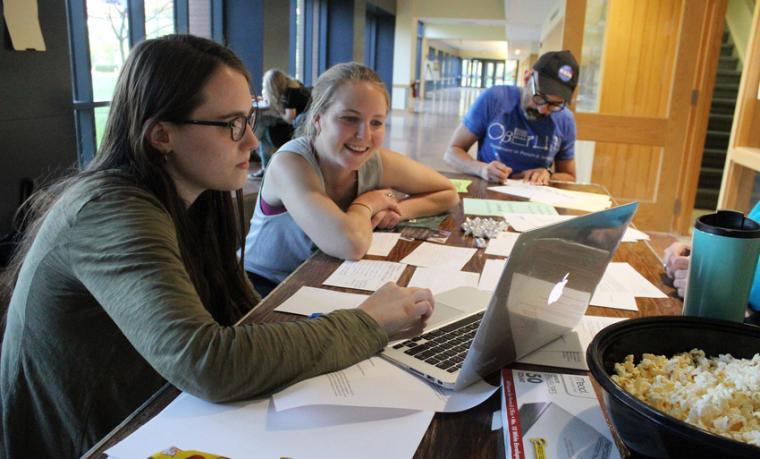
Photo credit: Anna Norris
Harnessing the momentum from the March for Science rallies held across the nation on April 22, faculty from the sciences and the Rhetoric and Composition Program hosted “Truth to Power: Writing Science to Your Local Representative,” as part of a week of action dedicated to scientific advocacy. Held in the Science Center’s Bent Corridor, the event included write-in stations for such topics as such immigration and science, funding for the Great Lakes, and support for basic scientific research.
“Writing to your representative is one of the best ways to be heard in the political sphere,” says Rebecca Whelan, associate professor of chemistry and biochemistry. “Your personal experience and why the issue matters to others in the representative's district are key.”
According to event organizers, effective communication efforts of this kind are direct, free of jargon, and based in evidence. Any communication with local representatives, no matter how brief, is important. “Even if it's only in the form of writing a postcard, every show of support matters,” says Whelan.
“Truth to Power” facilitators will continue to organize around the topic of science communication. The group is planning the symposium “Translating Science,” for fall 2017. For this, they plan to invite alumni who work in science policy, journalism, and communication.
You may also like…
Three Things with Jillian Scudder
Oberlin’s astrophysicist-author shines a light on our dark universe.

The Course that Changed Everything
Music and math brought Alina Zhu to Oberlin. An irresistible challenge defined her final year on campus.

Oberlin Researchers Part of Breakthrough Study on Gravitational Waves
Fifteen-year NSF-funded project involves dozens of students past and present, provides evidence of Einstein’s theory of relativity.
