Vision Accomplished
January 12, 2026
Dyani Sabin '14
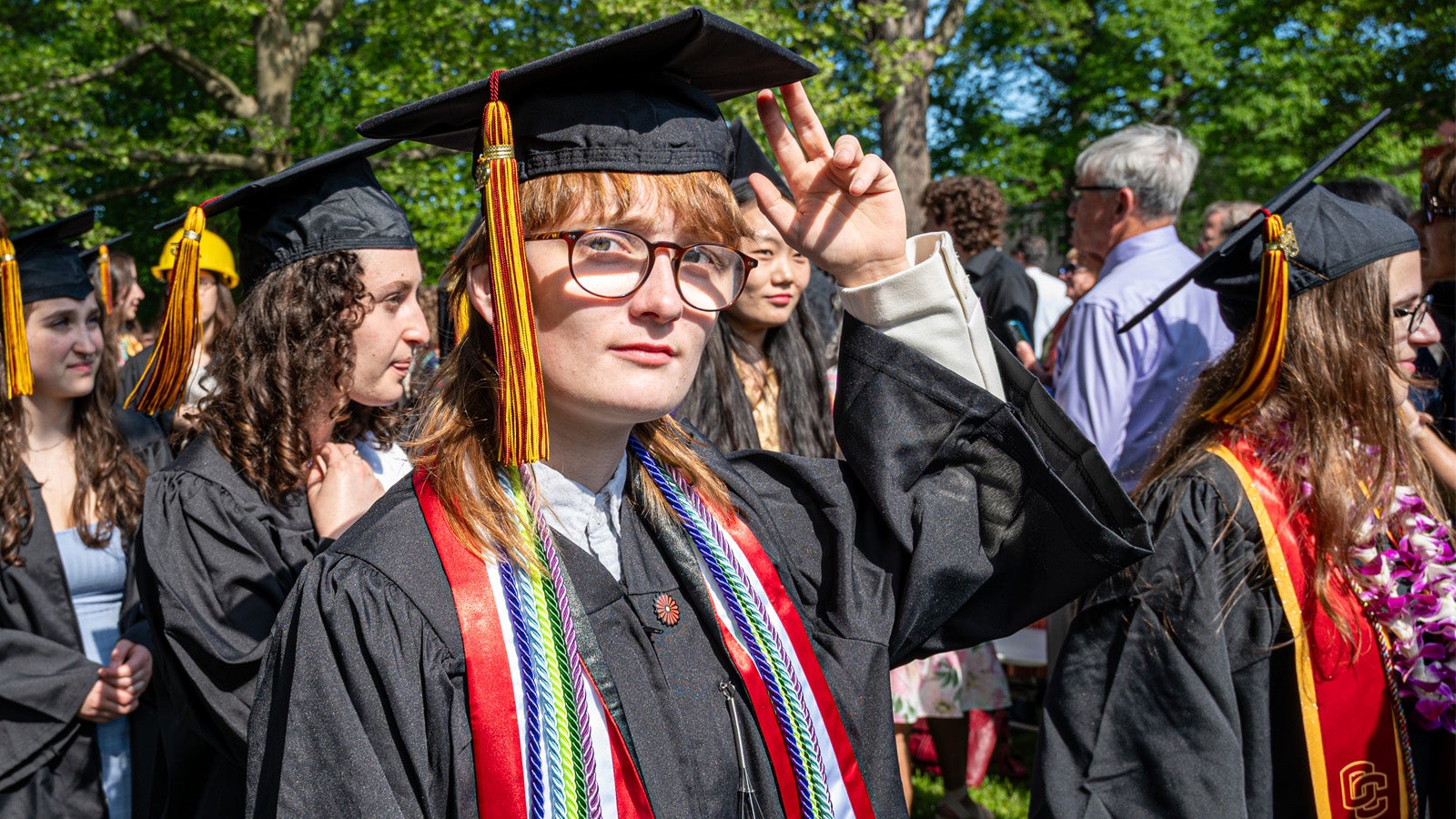
Header photo: To commemorate Oberlin becoming a carbon-neutral campus in 2025, the Office of Communications’ design team led the creation of a distinctive brand mark, the Burst, that graduates wore as pins during commencement.
Header photo credit: Alaina Battle
Long before global leaders started to take climate change seriously, Oberlin was paying attention. In January 1978, Karen Florini ’79 took the Winter Term intensive Humankind Tomorrow. Each day, students heard lectures on different aspects of sustainability and the broad impact of climate change. “[This] really set the course of my life’s work,” says Florini, a former Oberlin trustee who’s also worked as a deputy special envoy for climate change at the U.S. Department of State. “I was already somewhat on that path, but that experience of that class ensured that I could never consider doing anything else.”
Decades later, Oberlin’s early warnings about climate change look increasingly prescient. Research showed that 2024 was the hottest year on record since scientists started recording temperature measurements in 1880—continuing a warming trend that’s accelerated markedly in the last decade. Climate change is driven by human-created carbon emissions, with electricity, transportation, and industrial production being the largest sources. The more carbon that’s released into the atmosphere, the bigger the impact: These atmospheric greenhouse gases trap heat, which warms the Earth’s surface. At our current rate of emissions, the temperature of Earth is expected to rise by at least 3 degrees Fahrenheit in the next few decades.
“The one thing that really matters most in addressing climate change [is] reducing emissions, because the only thing that matters to the atmosphere is tons of carbon pollution,” says Florini, a strategic advisor at the nonprofit C-Change Conversations. Failing to reduce carbon emissions, she adds, has massive negative impacts on food and water systems and increases geopolitical tensions and the number of destructive global weather events. “It’s a pretty ugly picture,” she says, “including extreme heat, wildfires, droughts, and floods—with all the resulting impacts on health and the economy—all occurring with increasing severity and cascading into one another.”
Florini says the way to combat climate change is by taking action. In late 2024, Oberlin announced it was on track to reach a milestone almost 25 years in the making: achieving carbon neutrality by 2025. This milestone reflects a steadfast commitment to sustainability projects on the part of three college presidents and multiple city leaders, as well as collaborations with the city of Oberlin and student involvement.
“We know what to do to avoid these horrible outcomes; we just have to do it,” Florini says. “And Oberlin has done it—and that is why Oberlin should be very proud of what it has accomplished here.”
The infrastructure difference
What put Oberlin over the top was the Sustainable Infrastructure Program (SIP)—the transformation of the college’s 100-year-old steam-heating system into a geothermal heating and cooling system that connects 60 campus buildings. Although Oberlin switched its energy source from coal to natural gas in 2014, the college’s central heating plant was still the largest source of on-campus emissions. Finding an alternative energy source was a crucial next step.
“Energy is probably one of the single most—if not the single most—critical emission source to figure out how to transition to net zero [carbon neutrality],” says Lyrica McTiernan ’04, a sustainability consultant who formerly worked on Facebook and WeWork’s sustainability teams and originally decided to attend Oberlin because of the Adam Joseph Lewis Center for Environmental Studies (AJLC).
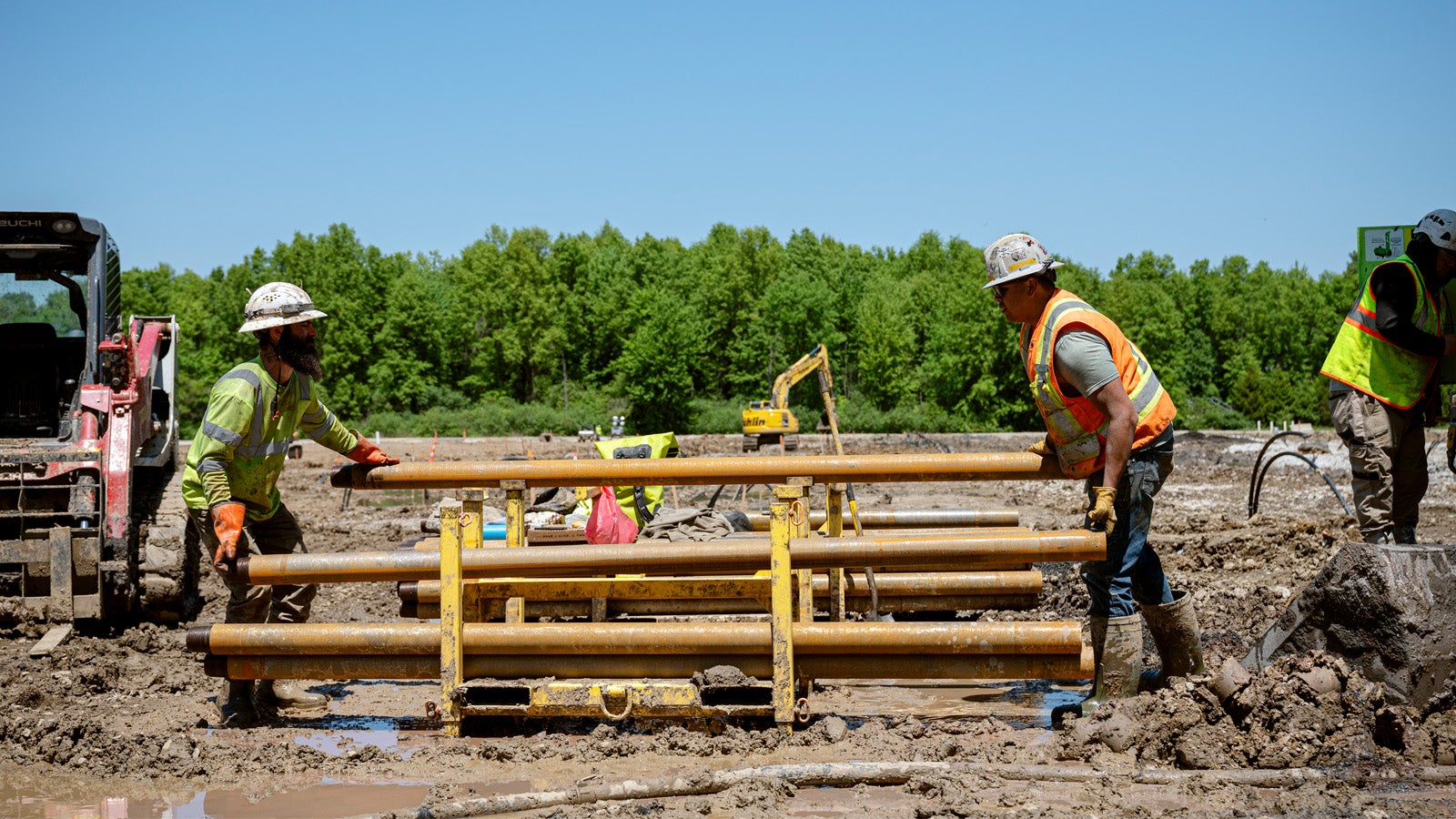
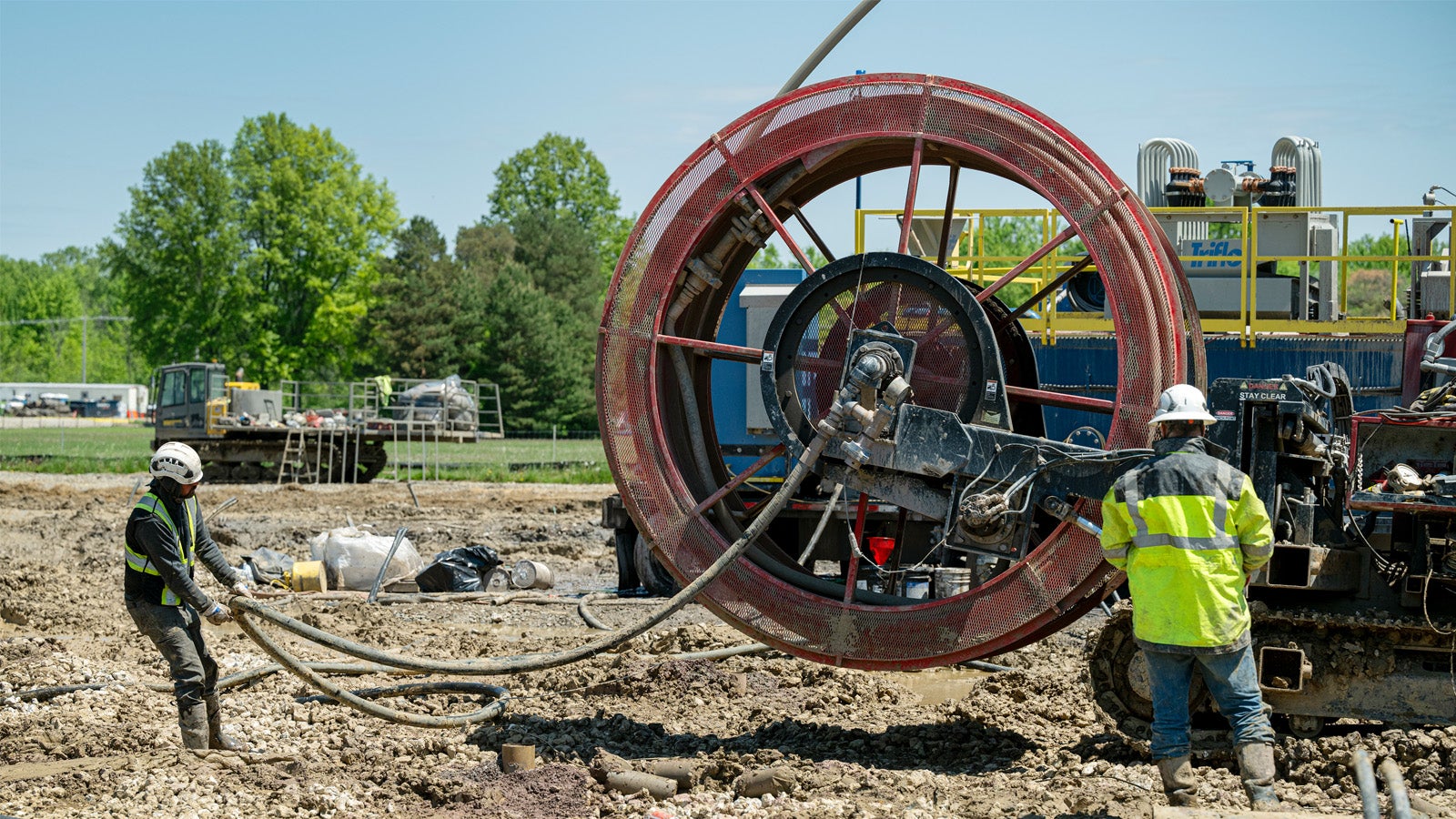
Oberlin's Sustainable Infrastructure Program involved creating a closed-loop system featuring 850 geothermal wells that drop 600 feet into the Earth.
The geothermal system is an underground roller coaster of pipes that transports water around campus and through the college’s central heating plant in order to heat and cool buildings and provide hot water. Creating the closed-loop system involved digging 850 geothermal wells beneath one of the practice fields on north campus. These wells, which drop 600 feet into the Earth, allow water in the pipes to pull heat from the Earth in winter and shed it in the summer. No matter the season, the temperature of the Earth remains the same, so the water leaving this field is approximately 55 degrees Fahrenheit. The central heating plant then uses heat pumps to chill or warm the water, which circulates through campus before reaching the field, where the loop repeats.
Geothermal energy is one of several sustainable energy sources Oberlin is using to reduce emissions; for example, the college also has multiple solar arrays. While McTiernan stresses that a small amount of greenhouse gas emissions are inevitable even with alternative energy—among other things, you might still need to use backup generators in extreme weather—Oberlin has been successful using infrastructure to neutralize its carbon output. All told, the college has reduced roughly 90 percent of campus’s total emissions by switching to alternative energy sources.
“[Oberlin has] taken on the hardest part of the work by actually reimagining some of the most greenhouse gas-intensive systems in their footprint and fundamentally redoing them in such a way that deeply decreases emissions,” McTiernan says. “That is the way to do it.”
To reach 100 percent carbon neutrality, institutions typically purchase carbon offsets, a transaction that involves paying another entity to reduce or remove a quantifiable amount of greenhouse gas emissions. Making sure that the offsets are high-quality is essential, says Claire Jahns ’03, whose background is in climate economics. “Offsets should be quantifiable, measurable, and verifiable; otherwise, they’re not good offsets.”
Oberlin partnered with its natural gas supplier to purchase high-quality offsets from a third party to cover things like gas used for on-campus buildings not connected to SIP. To account for things like employee travel (e.g., business trips and daily commutes) that contribute to the college’s total emissions, Oberlin chose the offsets provider Tradewater, which captures and destroys potent greenhouse gases like refrigerants and plugs up abandoned oil and gas wells that leak methane gas. In other words, these offsets are actively, permanently removing carbon emissions.
Thanks to the college’s extensive, up-front infrastructure work, Oberlin had to purchase only a very small number of carbon offsets—far fewer than many other colleges and universities that have reached carbon neutrality. This impressed Bridget Flynn, a former sustainability officer at the college, now a climate programs senior manager at Second Nature, a nonprofit that works with Oberlin and other higher education institutions on carbon neutrality and resilience. “Oberlin is an example that other campuses will be able to use, demonstrating tangible decarbonization on campus is possible.”
Further analysis indicates that Oberlin’s geothermal system not only reduces carbon emissions, but also saves 5 million gallons of water and 4 million gallons of sewage simply because steam isn’t leaking from old pipes. That’s another reason a major infrastructure project like this is so important, says Gavin Platt ’06, vice president of design at Acuity, which creates sustainable building management systems.
Sustainability is both technical and cultural. It’s about infrastructure and policy, but it’s also about people and behavior.
Gavin Platt ’06, vice president of design at Acuity
“Physical buildings and their supporting infrastructure don’t change very often,” Platt says. “How we manage our buildings and optimize their performance is usually the biggest and only lever we’ve got.” Greater change is possible when you have more levers, he adds: “Sustainability is both technical and cultural. It’s about infrastructure and policy, but it’s also about people and behavior.”
A town-gown partnership
A great example of that is the relationship between the college and the city of Oberlin. “The city’s climate action plan is, in effect, the college’s climate action plan,” says Chris Norman, the college’s senior director of energy and sustainability. The college contributes about 25 percent of the city of Oberlin’s total greenhouse gas emissions, so the two entities have been intentionally working together on sustainability projects for decades. Among other things, this included the Oberlin Project, an early—and catalytic—town-gown partnership on sustainability; additionally, the city sold all of its renewable energy credits to the college in 2005.
Committing to green energy has required taking risks; for example, in 2008, Oberlin City Council voted down a new coal plant contract and started sourcing contracts for alternative energy. “Doing the SIP and getting to carbon neutrality would have been really difficult without the city’s carbon-free electricity,” says Heather Adelman, the college’s sustainability manager and an associate director of the Oberlin Project. “The leadership it took on the part of the city, where they made long-term commitments to green energy, was crucial.”
That relationship is key, says Brian Pugh ’08, the mayor of Croton-on-Hudson, New York, a village about the size of Oberlin, which he has led to become the No. 1 clean energy community in New York state. “The fact that a village of a little over 8,000 people is able to do things like this shows that it can be done,” Pugh says, “Oberlin would probably say the same thing—if a small liberal arts college in the Midwest can do this, maybe some of the mighty universities of the East and West with multibillion-dollar endowments could do the same.”
For a small town, having a large stakeholder like a college interested in purchasing green energy creates essential financial backing for sustainability projects. Pugh’s village works with Columbia University; Oberlin College, meanwhile, was that anchor for the city of Oberlin’s first renewable energy credits. It’s a mutually beneficial relationship: The college ensured that its electricity came from a renewable source; in turn, this helped the city invest in long-term renewable energy contracts for electricity.
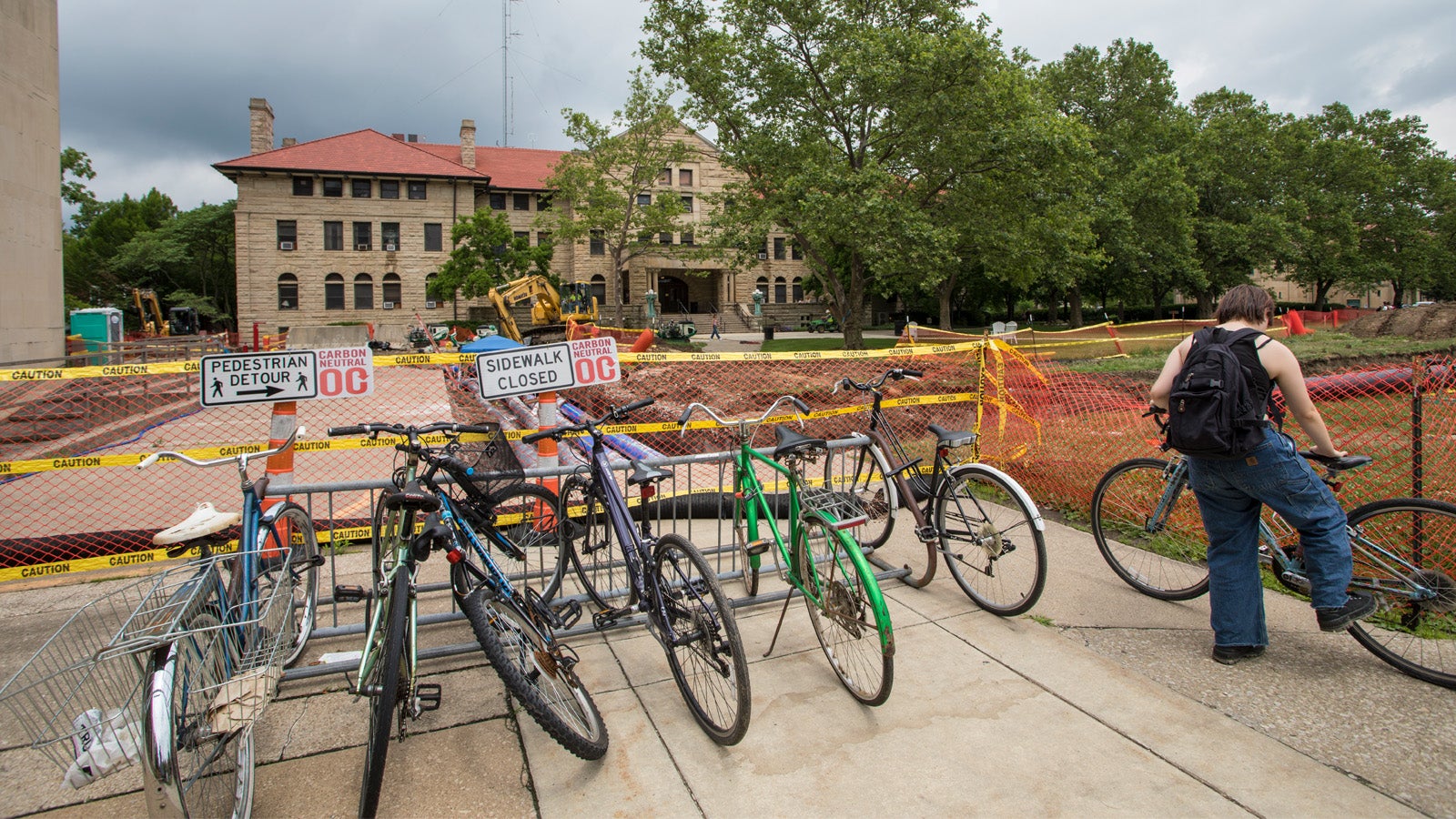
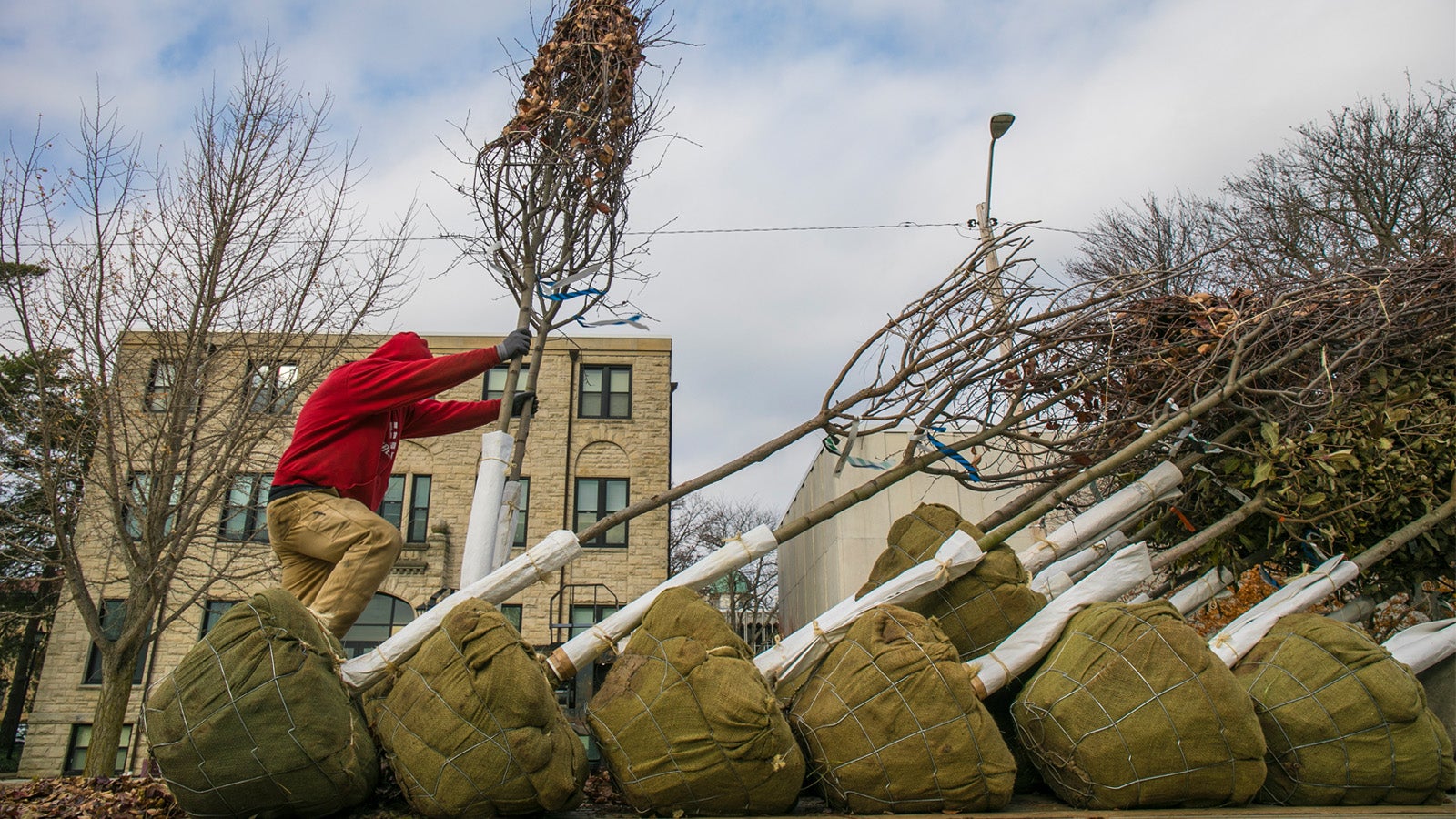
As part of on-campus construction for SIP, workers also planted new trees.
Jahns had been pushing for renewable energy credits decades ago while still a student. She was at Oberlin right after the signing of the Kyoto protocol, the first international agreement for nations to reduce carbon emissions. In response, Jahns formed a student activist group, Climate Justice, and worked with the campuswide sustainability group to get the college to reduce emissions.
“One of my final memories of Oberlin is when I graduated in 2003,” she says. “I walked across the stage to accept my diploma, and I shook [then-Oberlin president] Nancy Dye’s hand, and she said to me—while handing me my diploma—‘We’re going to go ahead and buy those renewable energy credits,’ which is something Climate Justice had been really pushing for.”
Jahns, who founded the climate change strategy consulting firm Scale, is impressed with how the college has continued that commitment, which had seemed almost “pie in the sky” then. That Oberlin partially funded SIP using green energy bonds—becoming only the second higher education institution approved to use them to fund sustainable infrastructure—impresses her even more.
“Oberlin can teach other small and medium-sized institutions about how to leverage investor interest and climate finance to make really clear and permanent emission reductions possible,” Jahns says. “To see this massive investment in infrastructure—really transformational for the college’s infrastructure, period, but also for student life—the contributions that can have to student educations at Oberlin and careers afterwards is monumental.”
On-campus support
The impact of what happens next at Oberlin is hard to quantify, but having this project physically on campus is important, says Justin Mog ’96, director of sustainability initiatives at the University of Louisville. “On-campus things always have to be the first priority,” he says. “That’s where you discover these things and learn to care about them. It’s not just about the infrastructure of the campus; it’s the infrastructure of our minds.”
One of his memories of Oberlin is the smell from the facilities plant. “Especially on cold nights, I remember I could taste the sulfur in my mouth from the coal burning on campus,” Mog says. At the same time, he was in the design charrettes for what became the AJLC, dreaming of a building that produced more energy than it consumed. “To see how far the college has come since then is really so inspiring, and I’m not surprised to see that Oberlin is leading the way on sustainability.”
Mog emphasizes that having buy-in over time from the college administration also helped the college achieve carbon neutrality. “It makes all the difference in the world,” he says, although he also credits the constant push of Oberlin students toward sustainability as one thing that shapes how the college reached its goals.
[With] this massive investment in infrastructure—[which is] really transformational for the college’s infrastructure, period, but also for student life—the contributions that can have to student educations at Oberlin and careers afterwards is monumental.
Claire Jahns ’03
As a student, Gavin Platt was integral to the development of the technology that now drives the Environmental Dashboard, a campuswide energy monitoring system that shows electricity and water usage in real time.
“The overall idea was to make energy use more visible so students could connect their daily choices to Oberlin’s broader sustainability goals,” he says, noting that this experience led to his career in sustainable management systems. “It taught me that even small shifts in awareness can ripple outward and support larger systemic changes. As a student, I didn’t fully understand just how difficult these things were to pull off, and it’s humbling now to know how slow change could be. Looking back, I’m glad to have played a small part in it.”
Current students can take a course with Professor of Psychology and Environmental Studies Cindy Frantz called Advanced Methods in Community-Based Social Marketing. As part of the class, students design and evaluate programs to promote sustainable behaviors like using cold water to wash clothes and taking shorter showers. Their research has led to tangible, campuswide programs, Adelman says, like stickers explaining when it’s efficient to have windows open, and a ban on single-use plastic water bottles.
Moving forward, Oberlin has more work to do with the geothermal system, including connecting additional buildings and optimizing the system for efficiency. In the future, the college plans to transition the rest of the maintenance fleet to electric vehicles and imagine campus landscaping for biodiversity and resilience in extreme weather. Meanwhile, the city of Oberlin is talking about building an eco-industrial park with a geothermal system built in from the start.
Starting in mid-October, UL Verification Solutions (UL Solutions) also embarked on a third-party review of Oberlin’s carbon-neutral status for 2025. This verification ensures the college continues to be on track with its sustainability goals—and going forward will be a model for other places to replicate.
“Oberlin is a laboratory for the future,” Platt says. “Smaller institutions like Oberlin can be test beds for innovation. That’s what we did there. And as it turns out, what happens on campus doesn’t stay on campus. Students carry those lessons into the world, and other schools and communities notice.”
And, as Florini notes, having real-world examples makes all the difference —“especially in responding to people who say it can’t be done,” she says. “The best response is to say, ‘Well, actually—we just did it.’”
This article originally appeared in the Fall 2025 Oberlin Alumni Magazine.
Dyani Sabin ’14 is a freelance science journalist, an author of speculative fiction, and one of the first residents of the Kahn Sustainable Living dorm.
You may also like…
Jane Wickline ’21 Finds Community in Comedy
A Q&A with the Saturday Night Live cast member and Dukes cofounder

When Stars Align
The Oberlin Contemporary Music Ensemble shines on Jennifer Koh ’97’s "The American Concerto, Volume One."

Wright On, Sister
Would the Wright brothers have invented their airplane without the support of their sister, Katharine Wright Class of 1898? Probably. But they might not have been the first.