Building a Legacy
January 8, 2026
Ginger Christ
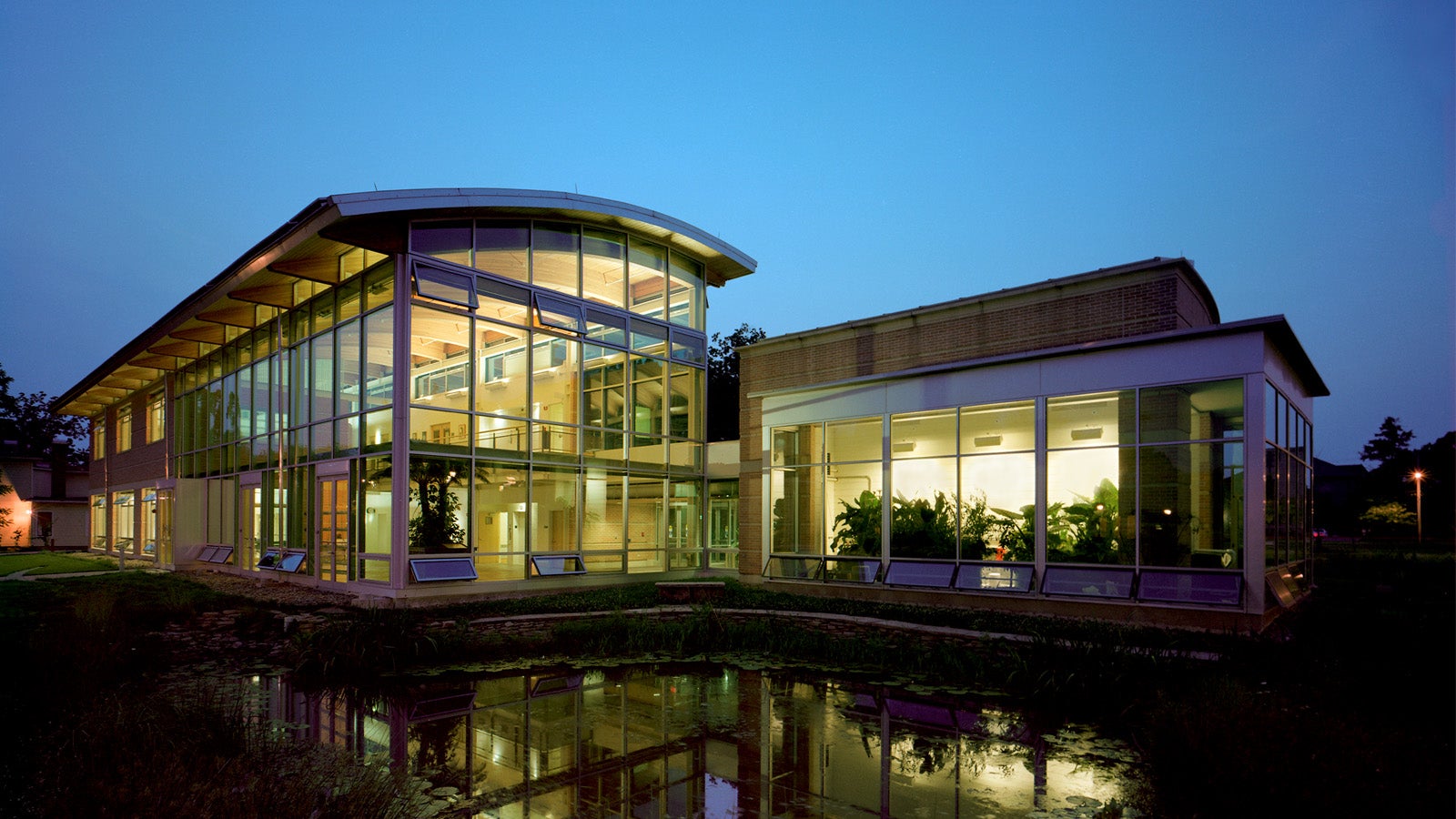
Header photo: Opened in 2000, the solar-powered AJLC is considered a pioneer of the green campus movement.
Header photo credit: Barney Taxel, courtesy of William McDonough + Partners
Before a visitor ever steps foot inside the Adam Joseph Lewis Center for Environmental Studies (AJLC), the building’s ties to the natural world are clear. On the south side, a seasonal sundial set to mark solstices and equinoxes stretches out before the glass- encased atrium. On the southeast side, a restored wetland is visible from a stone amphitheater.
Inside, a welcome sign displays the Environmental Dashboard, which shows real-time data on resource consumption, and a 100-square-foot water sculpture rises to the ceiling. The sound of trickling water echoes through the plant- laden two-story lobby.
Opened in 2000, the solar-powered AJLC, which Building Design + Construction magazine once named one of 52 “game-changing buildings” alongside the Gateway Arch in St. Louis and London’s Savoy Theatre, is considered a pioneer of the green campus movement. The space laid the groundwork for a one-of-a-kind experiential learning experience and the future of green building.
The AJLC also launched Oberlin’s sustainability journey and cemented the college as a leader in environmental innovation. For example, Oberlin achieved carbon neutrality thanks to its groundbreaking Sustainable Infrastructure Program, which involved replacing aging infrastructure with an eco-friendly system powered by 850 geothermal wells.
“[The AJLC] opened a door that a lot of people have walked through since,” says Lindsay Baker ’04, CEO of the International Living Future Institute, a nonprofit committed to advancing regenerative design.
Baker says that prior to the AJLC’s construction, there was an assumption that the built environment couldn’t be changed or influenced by new ideas—especially from students. “That building and the way that it was designed, built, and then operated really busted that myth for a lot of undergraduates at Oberlin. We were told, ‘It’s possible to run buildings in a different way, to build them in a different way.’”
The Origin Story
It all started with a rainstorm—or a few of them.
David Orr, who is now the Paul Sears Distinguished Professor of Environmental Studies and Politics Emeritus, had an office in the basement of Rice Hall, which flooded every time it rained.
“We had to build a building to get out of the wetland,” he quips. With a grant from the George Gund Foundation to assess the possibilities for an environmental studies center on campus, Oberlin launched what amounted to a full-year building course. The college brought in a dozen well-known architects from across the country to present architecture and landscape concepts to students.
None of the options for using existing buildings panned out, so Orr and the students worked with the design team at William McDonough + Partners to create their vision for what would eventually become the AJLC.

Orr, who envisioned using architecture as a tool to teach environmental lessons, saw the building as an opportunity for students to be involved in every step of the process, to help craft the very place where future students would learn. For example, undergraduates have opportunities to oversee the Living Machine, which filters and recycles the building’s wastewater by mimicking natural wetlands. The building also incorporates natural lighting and ventilation and employs a ground-source heat pump system.
“You don’t stop to say, ‘Can it be done?’ You say, ‘Should it be done?’” Orr says. “The thing I’m most proud of about the building is that it drove green building in higher education and elsewhere.”
Sadhu Johnston ’98, who now consults on green building and climate readiness, couldn’t agree more. “That whole experience really shaped my passion and interest in green buildings and green building policy,” he says. “It had a fundamental impact on my career path.”
Johnston and his now-wife, Manda Aufochs Gillespie ’97, were involved in the building during the design and construction phase; Orr later tapped the couple to lead a sustainable community symposium tied to the AJLC’s creation. Even after the building opened, they gave tours and engaged with donors and prospective students.
“At that time, the building was this kind of living experience that we were having,” Johnston says, comparing it to a physical manifestation of what was being taught in the classroom.
Baker notes that the AJLC was a living building before the existence of the Living Building Challenge, which recognizes buildings that are net positive in terms of their energy and water; are free of toxic chemicals; and have shown positive impacts on the community.
“One of the handful of ways that the [AJLC] has had a lasting impact is that it has inspired and helped to fuel the growth of this program that we run that is designed to help people design and build and then operate and use these kinds of buildings as teaching tools,” says Baker, whose organization currently leads the certification program. “We work with a variety of different organizations around the country to use their buildings in the way that the [AJLC] does.”
Building a Green Community of Peers
The AJLC’s influence can be seen not only in physical buildings, but also from the impact graduates of the environmental studies program—and the college—have had in the world.
Historically, Oberlin has attracted students who “want to make a change in the world” and “want to be agents of change,” says John Petersen ’88, the Paul Sears Distinguished Professor of Environmental Studies and Biology.
Today, he says the right metaphor to show the building’s influence is to imagine someone dropping a stone into a still pond and seeing the ripples spreading across the water.
“Everything we are here at this institution today—and not just this institution, but the [Oberlin] community as a whole—can be traced back to the AJLC and the ripples going out,” Petersen says. Through the building, the college was able to show “what it means to create something that’s truly novel and innovative” and “to attract creative, smart, entrepreneurial people.”
The thing I’m most proud of about the building is that it drove green building in higher education and elsewhere.
Paul Sears Distinguished Professor of Environmental Studies and Politics Emeritus David Orr
Baker, a leader in the green building movement, has used her experience at Oberlin with the AJLC to create market and regulatory mechanisms to change how buildings are built in this country and around the world. “Fundamentally, I would never have understood the power of buildings to influence how we see the world if I hadn’t been in [the AJLC],” Baker says. “I got to learn that firsthand, and it’s enabled me to go and teach that lesson to many people.”
Baker’s work began right out of college, when she landed a position at the U.S. Green Building Council and helped create Leadership in Energy and Environmental Design (LEED) standards. Those standards are the most widely accepted green building rating system and assess a project’s energy and water usage, materials selection, waste management, and indoor environmental quality.
After graduating from Oberlin, Johnston was unsure if he wanted to attend graduate school and turned to Orr, his advisor, for advice. “He gave me this poke in the chest and said, ‘We don’t have time for you to go to graduate school. Get out there and start working,’” Johnston says. “That really had an influence on me; I could continue to learn in school or continue to learn on the job.”
Johnston moved to Cleveland and launched a speaker series, “Redesigning Cleveland for the 21st Century,” that brought thinkers, leaders, and architects involved in the AJLC to the city to speak at City Hall and in meetings with business leaders.
The series aligned with the creation of the Cleveland Green Building Coalition, where he served as founder and executive director. The group spearheaded a LEED-certified renovation of the Lorain Avenue Savings & Loan Building in Ohio City, a nearly 100-year-old building that was retrofitted with geothermal heating and cooling, solar panels, and a green roof.
Johnston went on to work as chief environmental officer for Chicago and a city manager for Vancouver, British Columbia, before launching his consultancy.
Today, he’s focused on bringing those green building concepts to smaller communities. Through a contract from the federal government with the Canadian Urban Institute,
he works with communities to integrate climate readiness into their infrastructure. He’s also dedicated to green housing and implementing solar design and rainwater capture, which he first learned about in the AJLC design.
“Throughout my career, I’ve definitely anchored back to those experiences and lessons learned at Oberlin and, in particular, with the building,” Johnston says.
Grant Sheely ’19, who minored in environmental studies, was encouraged by Petersen to work at the AJLC while he studied at Oberlin. Sheely became a Living Machine operator, where he helped monitor the solar panels and meters and ensure the building was operating at net zero. At the same time, he did greenhouse gas accounting for the college and presented data and suggestions on how to reduce emissions.
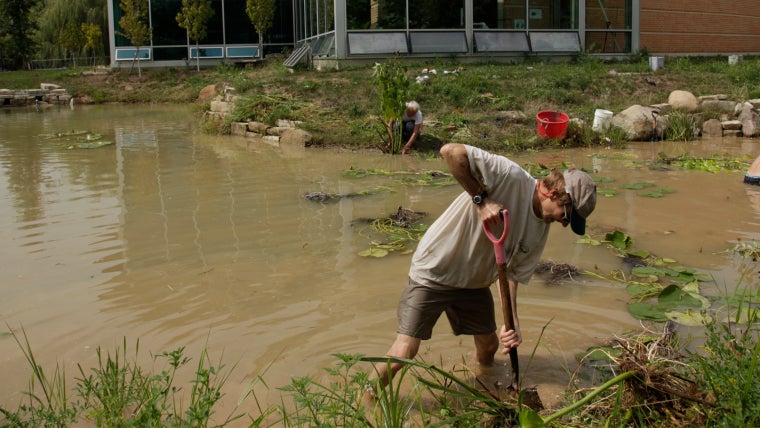
That experience propelled Sheely into a career involved in buildings and their environmental impact. He worked as sustainability coordinator for a real estate company before training to award LEED and Energy Star certifications to buildings being constructed. He now works for the New Buildings Institute, which does building code development and helps jurisdictions achieve their goals.
“This whole path of buildings being my focus truly originated at the AJLC,” Sheely says. “There’s no way I would have been like, ‘Buildings are cool,’ without one of the coolest ones ever.”
Growing a Sustainable Future
Being an environmental educator involves teaching students the often hard truth about the problems plaguing the world, but also showing them a path to make that truth better and giving them hope, Petersen says. “Hope is about rolling up your sleeves and getting something done. I think that’s what this building has been so good at.”
Through the AJLC, Oberlin has been able to show students firsthand systems thinking—understanding the complexity of the world through the relationships among its parts.
“The thing that you try to teach students is that yes, there are a lot of problems to solve in the environment, but if you solve those problems right, you can solve them across society,” Petersen says.
At one point, the AJLC and adjacent solar parking pavilion comprised the largest solar array in Ohio. “Today, this building has a solar array that is dwarfed by the solar array we have on the north end of campus,” Petersen says. “That’s how far we’ve come in these 25 years.”
Petersen and others have recently engaged in a series of envisioning sessions about the future of the AJLC, coined AJLC 2.0. They’ve identified physical things that need to be addressed, from heating to plumbing to electrical problems, and are considering how the building can inspire the next quarter century.
As Orr notes, the idea is to keep the vision not just going, but growing.
Having achieved carbon neutrality, Oberlin has an opportunity to build on the seeds planted by the AJLC, show others what is possible, and inspire the next generation of students to come to Oberlin, Petersen adds.
In other words, the true legacy of the AJLC is what change it brought about—and the trajectory it put the environmental community and Oberlin on, as he puts it.
“We have a unique moment right now,” Petersen says. “Oberlin is offering some hope right now with what we’ve done.”
This article originally appeared in the Fall 2025 Oberlin Alumni Magazine.
You may also like…
Jane Wickline ’21 Finds Community in Comedy
A Q&A with the Saturday Night Live cast member and Dukes cofounder
When Stars Align
The Oberlin Contemporary Music Ensemble shines on Jennifer Koh ’97’s "The American Concerto, Volume One."

An Obie Legacy Takes Flight
It’s a story as old as time: The strong woman, often a wife, plays a critical but largely unrecognized role behind a famous man. But in the case of Katharine Wright Class of 1898, it’s the strong...