Using Sociology for Better Higher Education
Neena Duphare ’24 is using what she learned at Oberlin to help med students find their way.
September 2, 2025
Dyani Sabin ’14
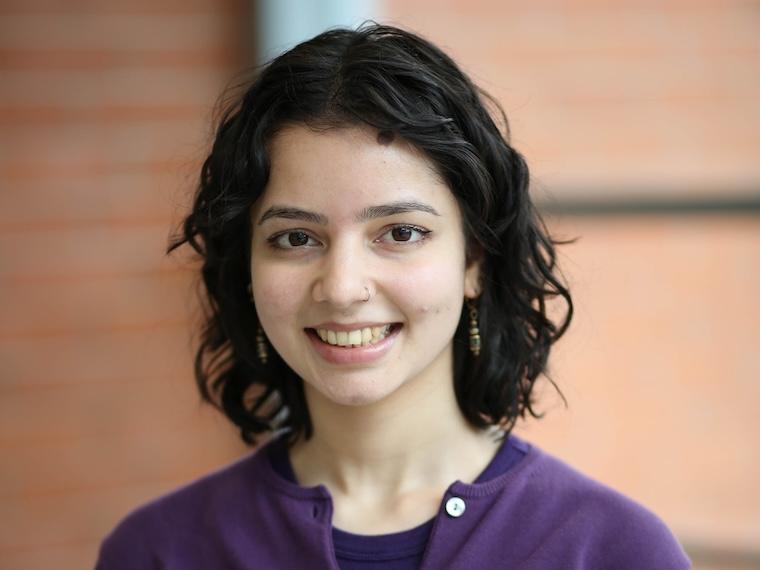
Photo credit: Courtesy of Neena Duphare
When Neena Duphare ’24, became a course-writing associate for William G. Smith Associate Professor of Sociology and Comparative American Studies Alicia Smith-Tran ’10’s first-year seminar, White Coat Wonders: Examining the Medical Profession, she wasn’t imagining it would be key to her future career.
“I was a sociology student, but a lot of the people that took that class were interested in going to medical school,” Duphare says. “A lot of them were prospective chem or bio majors, so it was also interesting to interact with them.”
Now, as the student affairs coordinator at the Drexel University College of Medicine, Duphare spends her days working entirely with medical students. She’s the main point of contact for student extracurricular organizations, helping them put on events and other programming. “It was very unexpected,” says the Palatine, Illinois, native. “I knew when I graduated that I was really interested in working in higher ed, but I didn’t expect to work at a medical school.”
However, Duphare believes her sociology background is beneficial for her position in student life. “I’m able to identify broader things in education and the student experience and keep them in mind,” she says. “For example, a lot of our student groups are identity-based, so it’s thinking about: What are the underrepresented groups within medicine? What is their programming like? How do they support themselves, and open up doors for people like themselves to have the opportunity to pursue medicine? Sociology is very applicable to the field of education in a lot of ways.”
During her second year at Oberlin, Duphare found sociology while attempting to pull together different interests, including global inequity and gender, sexuality and feminist studies. “Sociology offered a lot of paths to learn both about a lot of different things, but also focus on the niches I was interested in,” Duphare says. “It analyzes the world very critically, but also it’s trying to understand the undercurrents of why things are the way they are, why people or groups interact with each other or institutions the way they do.”
The interplay between identities and institutions was a major part of Duphare’s time at Oberlin. During her first year, she was one of several students involved in reviving the Multiracial Students Association (MULTI). “Talking about our experiences made me feel a lot less alone,” she says. “Just being able to talk to other people who came from very different backgrounds, but we were able to connect in so many different ways and learn how our experiences were both similar and different.”
Duphare also took her desire to connect with other students and make the transition into college easier for others by working as a writing associate and in the Peer Advising Leader (PAL) program, which creates orientation programming for incoming students and then also connects students with a PAL that supports them through the semester.
“I really enjoyed helping them navigate college, whether that’s academically, or socially, emotionally,” Duphare says. “Those experiences helped me get the skills I needed to be able to work with students, and understand how higher education programming can work,” Duphare says. “With the job I have now, they specifically said, ‘Oh, we noticed you have this experience with orientation programming,’ and that helped me get the job.”
Learn more about studying sociology at Oberlin, where students apply the quantitative and critical skills they learn in the classroom to address complex problems in the wider world and focus on the systematic study of social phenomena.
Dyani Sabin ’14 is a freelance science journalist and author of speculative fiction who has written for Strange Horizons, Inverse, National Geographic, The Washington Post, and Popular Science.
You may also like…
Jane Wickline ’21 Finds Community in Comedy
A Q&A with the Saturday Night Live cast member and Dukes cofounder
When Stars Align
The Oberlin Contemporary Music Ensemble shines on Jennifer Koh ’97’s "The American Concerto, Volume One."
An Obie Legacy Takes Flight
It’s a story as old as time: The strong woman, often a wife, plays a critical but largely unrecognized role behind a famous man. But in the case of Katharine Wright Class of 1898, it’s the strong...