A Supportive Environment
Thanks to Oberlin research opportunities and mentorship, Sam Fechner ’25 launches a career in economics.
September 17, 2025
Kira Goldenberg
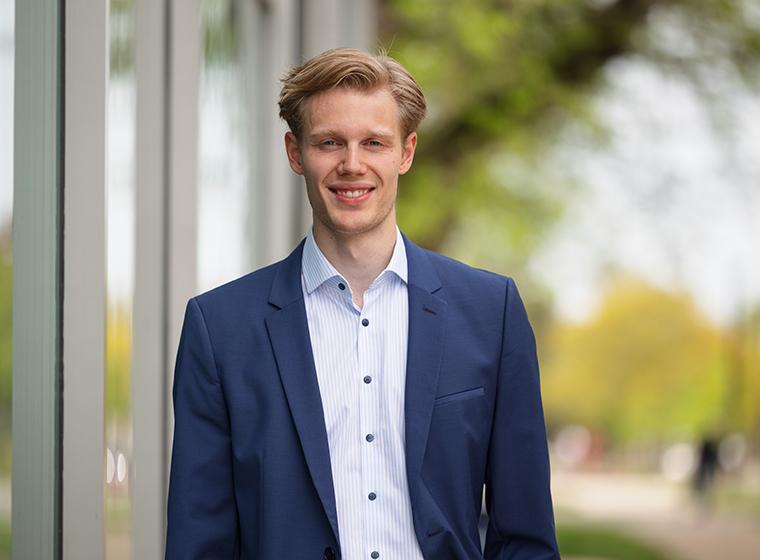
Photo credit: Tanya Rosen-Jones ’97
When Sam Fechner ’25 started looking at colleges, he was eager to find a school where he could be both a serious scholar and a dedicated athlete.
After starting high school in Germany, the economics major finished at the Trinity-Pawling School in New York, graduating as valedictorian before heading to Oberlin.
Fechner says his experience was all that he had imagined it would be. “Socially and athletically, it’s easy to find like-minded people [at Oberlin].”
A sprinter on the Oberlin track & field team, he earned two USTFCCCA All-Academic honors for the sport, and broke five school records during his career.
In fact, he currently holds four Oberlin relay records, both indoor (4x200m and 4x400m) and outdoor (4x100m and 4x400m).
Now, Fechner is heading to Boston to become an analyst at the economic consulting firm Analysis Group, where he will be parsing big data sets related to client work.
“It was very exciting to get the job,” Fechner says. “It was exactly what I wanted.”
He learned about the Analysis Group thanks to his Oberlin mentor and advisor, Associate Professor of Economics and Environmental Studies Paul Brehm.
Brehm taught Fechner’s favorite class (Environmental Economics) and hired the student as a research assistant; among other things, Fechner analyzed wildfires as one cause of electric grid unreliability.
That work earned him a shout-out in a resulting Journal of the Association of Environmental and Resource Economists paper, “Backup Power: Public Implications of Private Substitutes for Electric Grid Reliability.”
This experience “definitely sparked my interest further” in behavioral economics, Fechner says. “The econ faculty has just been amazing.”
In fact, while working on his honors project—an analysis of the connection between perceived risk and home sales after wildfires—he appreciated the department’s open-door policy.
“I’d see whoever was currently in their office and talk about all sorts of things,” he says, namechecking Professor of Economics Ron Cheung as an example.
Thanks to such support, Fechner ended up receiving highest honors for the project.
As he looks back at his time at Oberlin, he’s grateful for the experiences he had—and community he found—during college.
“I can hang out with my friends at practice and then after we all work hard on our homework,” he says. “It’s competitive, but everyone’s supportive of each other.”
When you major in economics at Oberlin, you’ll study the principles of economic theory as well as innovative approaches to problem solving in a rapidly changing world. Learn more about this academic option, which includes original research opportunities and faculty mentorship.
Kira Goldenberg is a writer, editor, and psychotherapist based in San Francisco.
You may also like…
Jane Wickline ’21 Finds Community in Comedy
A Q&A with the Saturday Night Live cast member and Dukes cofounder
When Stars Align
The Oberlin Contemporary Music Ensemble shines on Jennifer Koh ’97’s "The American Concerto, Volume One."
Wright On, Sister
Would the Wright brothers have invented their airplane without the support of their sister, Katharine Wright Class of 1898? Probably. But they might not have been the first.