Oberlin Alumni Magazine
Seeding the Future
In her role as a soil ecologist, Jenny Soong '07 thinks globally about climate change.
January 9, 2026
Annie Zaleski
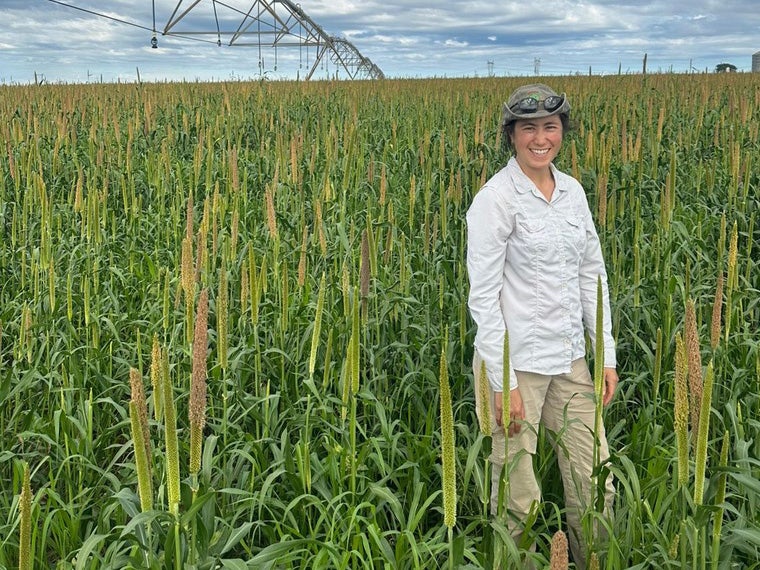
Inspired by professors David Orr and John Petersen '88, Soong majored in biology and environmental studies and had a minor in politics at Oberlin.
Photo credit: Courtesy of Jenny Soong '07
When Jenny Soong ’07 was at Oberlin, she participated in taiko drumming, giving her a chance to perform in nearby Cleveland as well as around Ohio and Michigan. In the years since graduation, she’s had plenty of chances to travel once again. While earning a doctorate in soil ecology at Colorado State University, Soong researched the Kansas tallgrass prairie. As a postdoctoral student, she analyzed the tropical rainforest in French Guiana; looked at soil and geothermal warming in Iceland; and worked in the Sierra Nevada mountains in California.
In her current role as a soil ecologist at Terradot—a company that generates and sells carbon credits to entities working toward carbon neutrality goals—Soong is continuing to think globally.
“My work very much focuses on climate change—how we manage the agricultural lands that we need for food, fiber, and fuel production in ways that are more sustainable, where we reduce our negative climate impacts and mitigate the climate impacts that agricultural systems have,” she says.
As part of this work, Soong conducts field work in farmlands across Brazil focused on “enhanced rock weathering,” she says. “We grind up reactive rocks that would typically sit on the mountainside and weather very slowly—and absorb carbon dioxide from the atmosphere very slowly.
“[We then] add it to soils in lower-productivity, acidic, wet, warm environments, like in Brazil, where it can help to stimulate crop productivity,” she adds. “Hopefully—and we need to measure it—but it also absorbs carbon dioxide from the soil.”
A San Francisco native, Soong had always been interested in nature and the outdoor world, along with how humans interact with nature, but she wasn’t sure what she wanted to study at Oberlin. However, she was excited to move to the Midwest so she could “see how we actually work the land, how we farm the land, where our food comes from,” she says. “Oberlin gave me that initial opportunity to have that liberal arts education and exposure to different fields and different ways of thinking. That was a wonderful, eye-opening experience.”
Inspired by professors David Orr and John Petersen '88, Soong majored in biology and environmental studies and had a minor in politics. A class taught by Petersen was particularly formative: She “learned about the carbon and nutrient cycles that drive these natural energy and productivity systems. It’s the energy balance in the natural world. That struck a chord with me in terms of how my mind works—somewhat quantitatively, but where my heart was in terms of attraction to the outdoor world and these natural landscapes.”
In recent years, Soong’s work has turned to climate resilience. “How do we manage these agricultural systems in ways that not only help to slow down climate change, but also that are more resilient or resistant to big shocks in extreme weather events?” she says. “I think of my career [as] not just thinking about carbon accounting, but also about farmer economics and decision-making and businesses and how climate change is impacting people and their livelihoods in these agricultural communities.”
This article originally appeared in the Fall 2025 Oberlin Alumni Magazine within the feature "Rooted In Purpose."
You may also like…
Jane Wickline ’21 Finds Community in Comedy
A Q&A with the Saturday Night Live cast member and Dukes cofounder
When Stars Align
The Oberlin Contemporary Music Ensemble shines on Jennifer Koh ’97’s "The American Concerto, Volume One."
Wright On, Sister
Would the Wright brothers have invented their airplane without the support of their sister, Katharine Wright Class of 1898? Probably. But they might not have been the first.