Richard Goode’s Musical Short Stories
The acclaimed pianist returns to the Artist Recital Series on April 29 with the charmingly curated “Fancies and Goodnights,” along with works by Mozart and Schubert.
April 9, 2026
by Stephanie Manning ’23
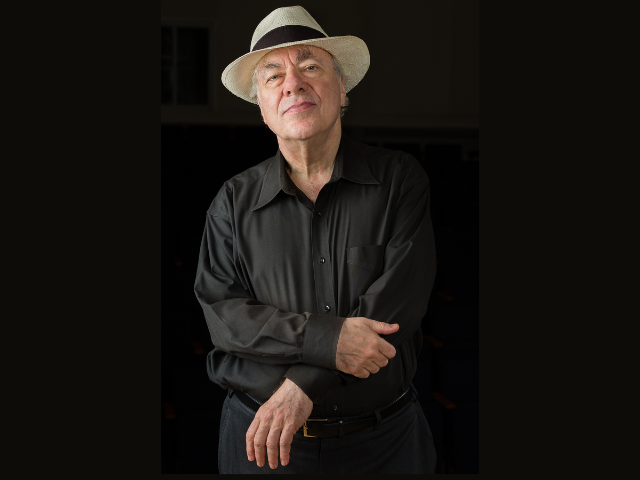
In Richard Goode’s mental directory of acoustically great places, Finney Chapel easily makes the list.
“ I think about places partly in terms of how the hall sounds,” he says. So when he finds venues with fabulous acoustics, “I remember them with great affection. The atmosphere was so perfect that when you played, you felt that everything mattered.”
The highly-respected American pianist, known for his interpretation of Mozart and Beethoven, has performed on the Oberlin Artist Recital Series quite a few times. It’s been nine years since his last appearance in Finney. “I don’t remember what I played,” he says. “I just remember how good it felt.”
On Wednesday, April 29 at 7:30 p.m., Goode will return to Finney Chapel and the Artist Recital Series with his program “Fancies and Goodnights.” He will pair that personally curated selection of short works with two sonatas by Mozart and Schubert.
The “Fancies and Goodnights” title comes from John Collier’s short story collection of the same name. Collier’s stories are funny, weird, and even a little cruel, so Goode found the name fitting for a group of off-the-beaten-path pieces. “I’m not terribly one for encores,” he says, “so there were these pieces that I couldn’t find a place for.”
Not to mention, the title just has a certain ring to it. “ Most of the pieces that we play and love are called sonata or symphony or impromptu or something like that, but poetic names are lovely.”
The nine pieces are presented in roughly chronological order and span five centuries, from Carlo Gesualdo in 1603 to Leoš Janáček in 1900. Goode says he felt “absolutely stunned” by Gesualdo’s “O vos omnes” from Sacred Cantiones for Five Voices, Book 1.
“ I’m simply playing the voices on the piano. I’m not arranging it in any way,” he explains. “I think it’s such a remarkable work that I’m just happy to be able to play it.”
For some pieces, he remembers exactly how he first heard them. A recording by Rachmaninoff introduced him to G. Sgambati’s transcription of Christoph Willibald Gluck’s Melody from Orfeo and Eurydice — “one of the most beautiful melodies ever written.” And he once heard a recital by Glenn Gould that championed the music of William Byrd, leading Goode to discover Byrd’s My Ladye Nevells Booke.
Meanwhile, Georges Bizet’s Adagietto from L’Arlesienne (trans. L. Godowsky) is a memento of Goode’s years at the Marlboro Music School and Festival, where he first attended as a teenager and served as co-artistic director with Mitsuko Uchida for 14 years.
Although Goode has performed Ignacy Jan Paderewski’s Legende, Op. 16, No. 1 in the past, he only recently grew to recognize Paderewski’s musicianship. “I had never really appreciated his music fully before,” he says. Legende “is a very sentimental piece, but really very beautiful.”
Franz Schubert’s Ungarische Melodie and two pieces by Jean-Philippe Rameau — The Assembly of the Birds and The Indiscreet One — add some warmth and levity to the proceedings. Eventually, the set comes to an end with Leoš Janáček’s aptly-titled “Dobrou Noc!” (Good Night!), from On an Overgrown Path.
Bookending the musical short stories sit two longer pieces — one of Goode’s favorite Mozart’s piano sonatas, the A Minor, K. 310, and Schubert Piano Sonata No. 21 in B-flat Major, D.960. The Schubert sonata is one of Goode’s signature pieces. At around 37 minutes long, it “ really requires such a long span of tension,” he says. Although “I don’t play the repeat, which I think asks maybe a little too much of the listener.”
Another thing Goode is known for is his love of books. As his bio mentions, he lives in New York City with his wife, Marcia, and their collection of some 5,000 volumes. But as to whether he’ll be visiting MindFair Books or any other bookstores during his visit to Oberlin, he says the jury is still out. “ I have bought too many books, so I try not to indulge myself.”
However, something he’s sure he will be doing is teaching a masterclass with conservatory piano students. “I learn a great deal by listening to people’s various approaches to pieces,” he says. “So I’m looking forward to that.”
Concert Details
Richard Goode, piano
7:30 p.m. Wednesday, April 29, 2025
Oberlin College Finney Chapel
90 N. Professor St.
Oberlin, OH 44074
Concert tickets are available online and by phone at 800-371-0178. Patrons may also purchase tickets in person between noon and 5 p.m., Monday through Friday, at Oberlin College’s Central Ticket Service, located at 67 N. Main Street, in the lobby of the Eric Baker Nord Performing Arts Complex.
Free Artist Recital Series tickets for enrolled Oberlin College and Conservatory students are available through the Claim Your Seat program, made possible through the generosity of Richard ’62 and Linda ’62 Clark.
Learn more about the Arts at Oberlin.
This program is proudly supported by Ideastream Public Media, official media partner of the Artist Recital Series.
—
Stephanie Manning ’23 completed her bassoon performance degree at Oberlin while finding her way into journalism as a classical music critic. She returned to Cleveland after finishing a graduate diploma in journalism at Concordia University in Montreal. A regular contributor to ClevelandClassical.com, she has also published articles with Signal Cleveland, The Montreal Gazette, and Carnegie Hall.
You may also like…
An Obie’s Guide to the Juilliard String Quartet
“The most important American quartet in history,” now celebrating its 80th year, opens the Artist Recital Series at Oberlin on September 26.
When Stars Align
The Oberlin Contemporary Music Ensemble shines on Jennifer Koh ’97’s "The American Concerto, Volume One."
Telling Stories Through Sound: The Verona Quartet and Mendelssohn's String Quartets
Storytelling has always been at the heart of the Verona Quartet. With its latest release, the ensemble turns to a composer who knew something about transforming stories into music: Felix Mendelssohn.