
Rethinking Antibiotics
Through a summer internship at Mass General Brigham, Caitlin Kluger ’26 explored new ways to fight infection.
March 11, 2026
Office of Communications
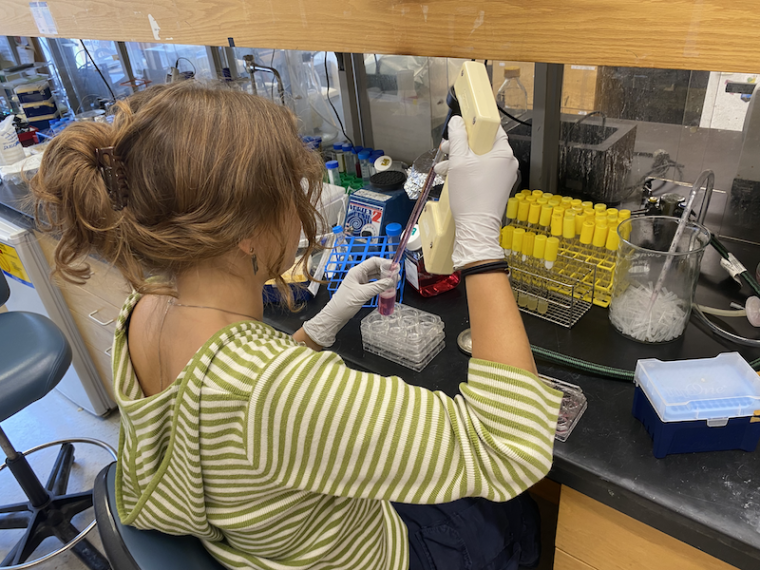
Photo credit: Courtesy of Caitlin Kluger
Caitlin Kluger ’26 is a biology major with minors in gender, sexuality, and feminist studies and comparative American studies. Originally from New York City, Kluger is involved with OSCA and works as a barista at Azariah’s Café. She answered these questions about the summer internship she held before her senior year at Oberlin.
Can you describe your summer internship?
I was a research assistant at Mass General Brigham, where I studied alternatives to treat bacterial infection by employing non-traditional techniques to protect the body’s healthy flora. Rather than using antibiotics, the lab targeted bacteria by inhibiting quorum sensing, which prevents communication and inhibits their virulence. Antibiotics are not a sustainable form of treatment, both due to the fact that they are not specific to the bacteria they target and because bacteria can develop immunity, so it's important to explore alternative forms of treatment.
How did Oberlin influence you to pursue your internship?
My work in Alex Pike’s lab taught me how to generate my own research questions and apply related procedures in order to produce meaningful results. Alex taught me how to critically think through protocols and how to execute them as productively as possible. I’ve been a member of her lab since my sophomore year, and she has been formative in preparing me for this internship.
How did your internship align with your post-college goals?
It taught me what full-time research looks like. Although I don’t yet have defined post-college goals, I know that I’ll use this experience to help shape my future.
What surprised you or made a big impression?
The experience reinforced the importance of genuinely understanding every step you take in a procedure. Research is not personally valuable unless you truly understand the role that each step plays in the experiment. This is a concept that can be applied beyond the lab to other academic procedures and will be valuable to me in my future endeavors.
What drew you to your major?
I’ve had a passion for biology for as long as I can remember. Many of my family’s dinner table conversations revolved around scientific discoveries we were passionate about, so it was unsurprising when I chose biology as a major. I’m excited by the prospect of understanding how things work, breaking them down to their most basic level, and then reapplying these findings to improve quality of life on a large scale.
You may also like…
Michael Dolton '27 strategizes with economics
The scholar-athlete from Trenton, Ontario, used his major to find creative solutions in his summer internship.

Johana Horvath '28 finds professional growth at a non-profit organization
The business major from Ann Arbor, Michigan, enjoyed an educational and confidence-building internship.
Jacob Day '27 explores international business in Brussels
The Oberlin football player and Entrepreneurship Club founder enjoyed an inspiring summer internship.
