Oberlin Uses Co-Designed Tech to Bridge Adult Education Gaps Amid AI-Driven Change
Oberlin's partnership with Northeast Ohio educators demonstrates how human connection—not just technology—is essential to unlocking workforce opportunities for adult learners.
July 9, 2026
Office of Communications
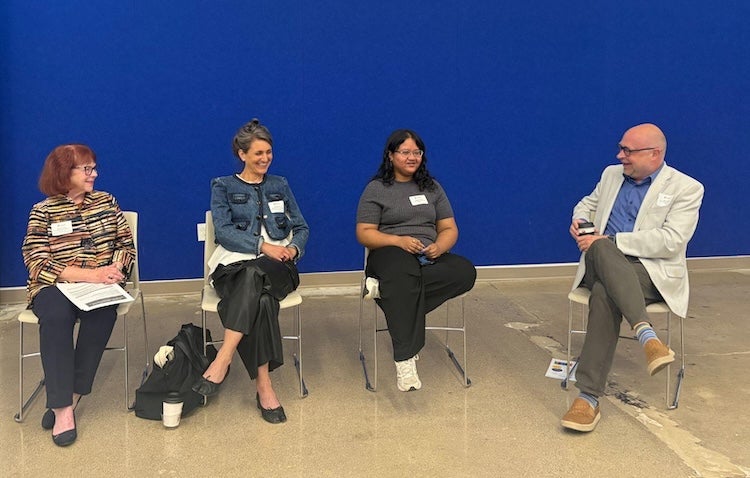
From left: Conference panelists Nadine Grimm, coordinator of 21st Century Learning at the ESC of Northeast Ohio; Oberlin Senior Associate Dean of Arts and Sciences Laura Baudot; Oberlin student researcher Tanisha Shende ’26; and moderator Shaun Yoder.
As artificial intelligence and rapid technological advances raise urgent questions about equity, access, and human connection in education and workforce development, Oberlin College is demonstrating how the same tools—co-designed thoughtfully and with communities at the center—can close gaps rather than widen them.
That message came through clearly at the Association of Independent Colleges & Universities of Ohio (AICUO) Collaborative Conference held June 4 at Otterbein University, where Oberlin faculty and students joined regional partners for a fireside chat titled “Bridging the Gaps: Designing Collaborative Information Systems to Support Adult Learner Transitions.”
The session spotlighted a three-year partnership between Oberlin and the Educational Service Center (ESC) of Northeast Ohio’s Adult Education Providers Network. The network brings together more than 36 independent organizations—spanning literacy programs, community colleges, career centers, and universities—to tackle Ohio’s pressing workforce shortages and the barriers facing hundreds of thousands of adults without high school diplomas, English language learners, low-income workers, and others.
Nadine Grimm, coordinator of 21st Century Learning at the ESC of Northeast Ohio, explained how providers had long operated in silos, often competing for limited funding while learners repeatedly fell through the cracks—forced to reshare personal histories and trauma at every program transition. Oberlin joined as a committed partner, leveraging its long-standing excellence in community-based learning and undergraduate research and its commitment to positive regional impact through the work of its Bonner Center for Community-Engaged Learning, Teaching, and Research.
May 2026 Oberlin graduate Tanisha Shende, whose own research sits at the intersection of technology and accessibility within education and healthcare, has led the effort as a full research partner. Drawing on human-centered design and co-design principles, she conducts empathy-based interviews with providers and learners, translates findings into design recommendations, and is developing a secure, voluntary prototype for information sharing and referrals.
“We’re treating learners and providers as partners rather than just participants,” Shende told the audience. “One important lesson that I've learned from this work is that technology is not the end-all be-all solution. I know that in this current day and age, we like to throw technology at our problems. We try to optimize everything. But what I've learned in the interviews is that human connection is key to this work.”
The iterative process—listening, prototyping, testing, and revising—has given her practical experience that classroom study alone could not provide.
Senior Associate Dean of the College of Arts and Sciences Laura Baudot, who has guided the partnership from its earliest days, described it as mutually beneficial and emblematic of Oberlin’s historic commitment to educational access and civic engagement.
“Oberlin has a strong tradition of community-based learning, but we haven’t always partnered regionally in this way,” Baudot said. “This work shows that a liberal arts college can address real workforce development challenges while advancing equity and access.”
Key to the collaboration’s success, panelists agreed, has been trust, humility, and grassroots leadership from the providers themselves. Oberlin has followed the network’s lead rather than imposing top-down solutions, adjusting pace and priorities to meet real needs.
“Tanisha has consistently delivered as a researcher and partner,” Baudot noted. “This isn’t about being a savior institution—it’s a shared endeavor.”
The approach aligns with Oberlin’s broader institutional direction, including the launch of a minor in critical AI studies in fall 2026, which emphasizes the humanities alongside technical fields to help students navigate technology’s societal impacts.
Audience members from other Ohio institutions shared their own parallel efforts, sparking conversation about scalability. Lessons from Northeast Ohio’s prototype could inform similar networks statewide, potentially unlocking new funding and broader impact.
For Oberlin, the partnership exemplifies how liberal arts values translate into tangible regional benefit—offering students high-impact research experiences while demonstrating the college’s commitment to Northeast Ohio communities. As Baudot put it, the work shows that “Oberlin does care about making the state and the region a more flourishing place for all people.”
For more on Oberlin’s community-engaged learning and critical AI studies opportunities, visit the Center for Engaged Liberal Arts and the Critical AI Studies program page.
You may also like…
Simon Korotzer-Mariani ’26 Builds a Future in Neuroscience
Hands-on lab work, health care internships and fellowship support shape a path toward medicine.
Mufalo Mufalo ’26 Bridges Art and Community Through CELA
The Bonner scholar and artist-in-residence uses experiential learning to shape creative practice and global engagement.

Dylan Hwang ’26 Connects Chemistry to Patient Care
A CELA-supported internship in Singapore reveals how analytical science drives medical breakthroughs.