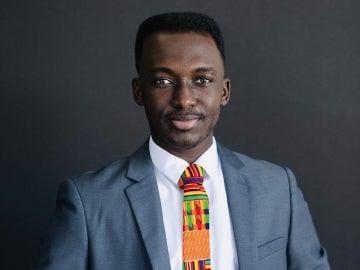
Miriam Entin-Bell ’23 Named 2025-2026 NYC Urban Fellow
The Brooklyn native will work on urban policy issues during a nine-month fellowship.
September 18, 2025
Communications Staff

Photo credit: Courtesy of Miriam Entin-Bell
Miriam Entin-Bell ’23 has been named a 2025-2026 NYC Urban Fellow. With this nine-month fellowship program, the Brooklyn, New York, native will work on urban policy issues in a mayor’s office or city agency. “Through hands-on experience, a dynamic seminar series, and service opportunities, I’ll be furthering my skills in and connections to public service work in NYC,” says the comparative American studies major.
After graduating from Oberlin, Entin-Bell did an AmeriCorps service year with FoodCorps, establishing partnerships between FoodCorps and public schools in Newark, New Jersey, and leading garden and nutrition programming for more than 8,500 school community members.
“I then transitioned to a role as an educator with the Horticultural Society of New York, facilitating garden and food education to school communities all throughout New York City,” says Entin-Bell, who also earned an environmental studies minor and participated in the Oberlin Student Cooperative Association (OSCA), Resource Conservation Team, and Students for Energy Justice.
How does this fellowship build on your previous studies and activities at Oberlin?
When I was a senior at Oberlin, I wrote a Comparative American Studies honors thesis about a multi-abled intentional community [Camphill] that I lived and worked at during the COVID-19 pandemic.
Grounded in interviews with community members, I uplifted the community's multi-abled practices of living that render binaries between disability and ability irrelevant to life at Camphill, while also revealing how Camphill contends with the imminent threat of the reinscription of these binaries in the form of state-mandated documentation and bureaucracy.
My thesis, along with the incredible education I got from the Comparative American Studies department, woke me up to just how much funding streams dictate what kinds of community-based work are possible and made me curious about how I could be a part of the apparatuses that resource communities professionally.
What made you want to apply for this fellowship? How does this fellowship line up with your career goals?
Growing up in Brooklyn, amidst decade-long commercial rezoning and residential upscaling, my life has always been shaped by city policy, but my on-the-ground experience doing public service health and education work since graduating has inspired me to pursue a career in city government.
After two years in public schools and communities in NYC and beyond, the systemic nature of the oppression that the communities I am working in is so evident; [there’s] food apartheid and access to green space, among other public health disparities. In tandem with that, I realized that almost all of the contracts I am working on are funded by the city. I am excited to take my on-the-ground experience and my questions around addressing systemic health issues to this fellowship.
How did Oberlin influence you as an academic, thinker, and person?
At Oberlin I practiced creating and building initiatives in collaboration with others. I got so much out of the bold, justice-oriented visions of professors and my fellow students because these were always backed up with a collaborative and nonhierarchical work ethos. The skills in communication, facilitation, critical thinking, and decision-making this fostered have served me so well as I entered the working world post graduation.
,What’s the best advice you received while you were at Oberlin?
Something I heard throughout my time at Oberlin was to release ambition and embrace curiosity. The most rigorous and meaningful work I have done, the choices I’ve been confident in, and the strongest relationships I have are centered in curiosity about myself, my communities and the world!
If you’re a rising or graduating senior interested in the NYC Urban Fellow, connect with Fellowships & Awards to learn more about pursuing research or an arts project, obtaining a graduate degree, or teaching English in a foreign country of your choice following graduation.
You may also like…
Walter Moak ’25 Earns Fulbright to Germany
The record-setting Oberlin athlete and musical studies major has earned a Fulbright English Teaching Assistantship (ETA) to Germany for the 2025-2026 academic year.
Alana Metcalf ’22 Earns Fulbright to Taiwan
The fellowship will help the psychology major achieve her goals of becoming a globally minded mental health professional.
No Limits
Gideon Ampofo ’23 knew he wanted to balance the world of business with the world of social change—and Oberlin helped him achieve both of these goals.