
Innovating cancer research, one cell at a time
September 2, 2025
Danielle Frezza
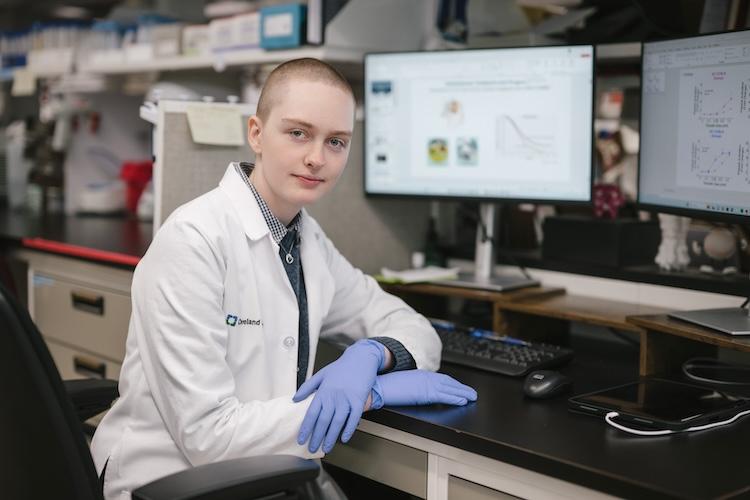
Photo credit: Yevhen Gulenko
As a child, Sunny Hunt visited their father when he was a cancer patient at Cleveland Clinic. Now a student researcher, Sunny has returned to the hospital to investigate glioblastoma, the most common and aggressive form of primary brain cancer. “It feels very poetic that I’d wind up here,” they say.
Oberlin College student Sunny Hunt says they find “literally everything” about cancer fascinating, which explains why they spent both Winter Term and this summer examining glioblastoma in Dr. Justin Lathia’s translational cancer stem cell research lab at Cleveland Clinic. In the lab, Sunny also worked under postdoctoral fellow Dr. Anthony Sloan, conducting research on sex differences in blood clotting.
“It turns out our initial hypothesis that estrogen is a big mediator for hypercoagulability [excessive blood clotting] was correct,” they say. “The reason I thought that is because it made sense from a kind of evolutionary standpoint. The female reproductive cycle involves a lot of bleeding and blood loss, especially when you think about childbirth.”
Sunny quickly found out they would need to investigate an additional hypothesis to get more answers about tumor growth.
Their second research project explores how microglia, the brain’s immune cells, often interact with glioblastoma differently in people assigned male at birth vs. female at birth.
“Microglia activation is a big part of the glioblastoma tumor microenvironment,” Sunny says. “One thing glioblastoma likes to do is hijack your immune system, creating a very immunosuppressive environment.”
Justin Lathia, principal investigator and vice chair and associate professor in the department of cardiovascular and metabolic sciences, explains that people assigned male at birth get tumors more frequently and tend to have poorer outcomes than those assigned female at birth, and notes that Sunny has been investigating this very phenomenon.
“We have been fortunate enough to work with Sunny over the summer,” he says. “They have designed a series of experiments to see how key parts of the inflammatory response are altered by estrogen and androgens and are making some exciting insights into the differential response to these sex hormones, which we hope to expand upon in the future.”
Sunny says their time conducting brain cancer research constantly intrigues them to explore more: “The problem is I keep on coming up with more angles… There are just so many ‘what-ifs’ that come up as I’m doing research. The issue is narrowing them all down.”
Sunny also finds inspiration from their studies at Oberlin, where they’ll begin their third year as a double major in biochemistry and sociology this fall.
They also recently tackled the issue of bigotry and misinformation in a journal article for the 2025 issue of Waves.
“Sociology is everywhere,” they say. “Science as an institution exists in a society, so studying how society can affect that institution has been very important for me, especially in the age of research not being funded and the rise of anti-intellectualist and anti-science rhetoric in our government, and how that ties into anti-trans rhetoric as well.”
Sunny’s undergraduate experiences have motivated them to continue their education, calling it a kind of “Oberlin effect”; after graduation, they plan to pursue an MD-PhD.
They also mention their family is proud of their work and success in college—especially their dad, who, after his cancer battle, is now in great health and doing well.
“He won’t stop telling me how many steps he does or how many calories he burns on the elliptical,” they say.
Check out our Winter Term page to learn about the exciting projects available to Oberlin students every year.